

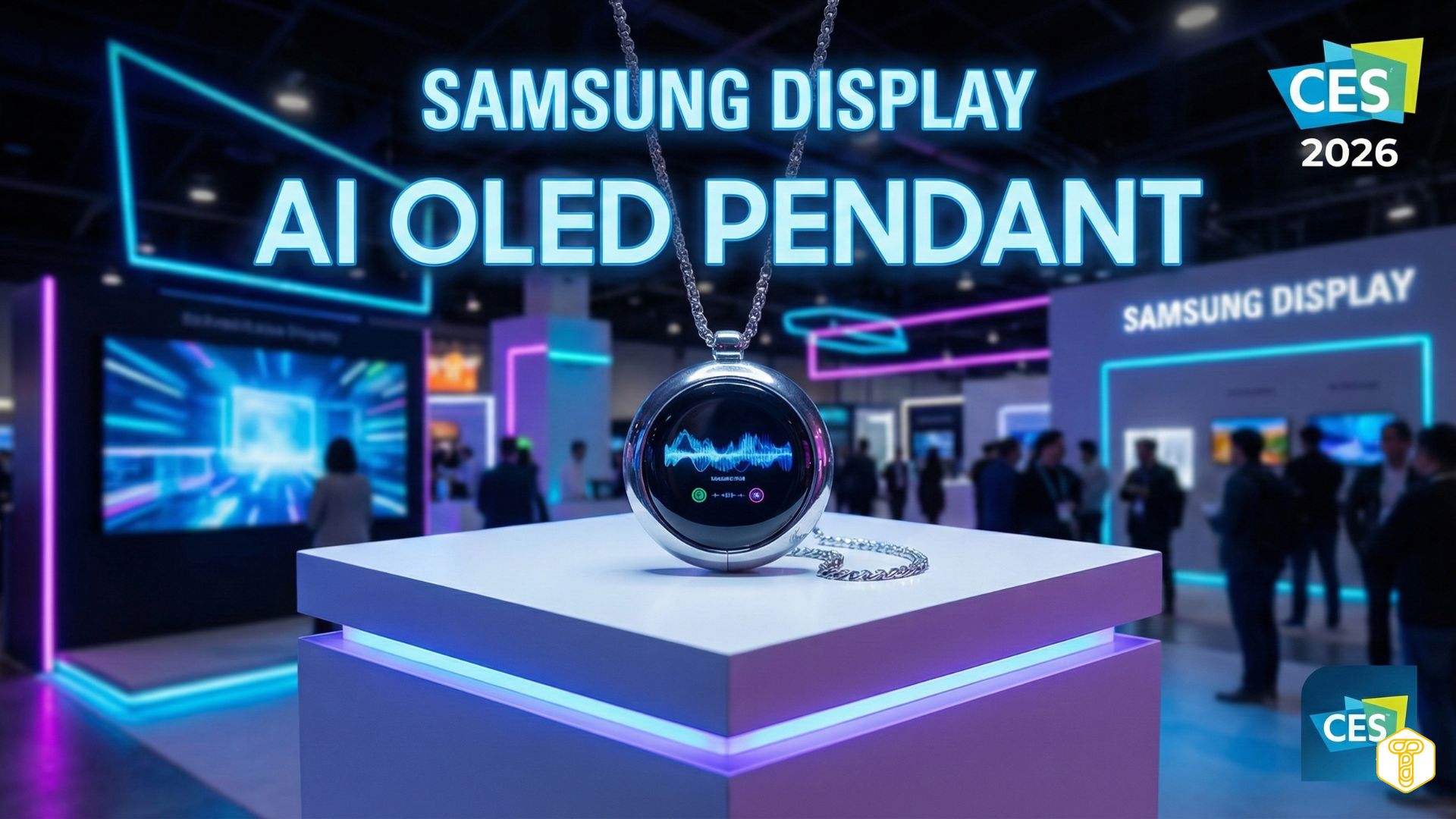
Samsung Display unveiled the AI OLED Pendant at CES 2026. Discover the 1.4-inch wearable screen, its voice-first features, and expected pricing for this futuristic concept.
Contents
Key Takeaways (Quick Summary)
- The Device: A necklace-style wearable with a 1.4-inch circular OLED screen.
- The Purpose: Reduces phone usage by displaying alerts, messages, and AI assistance at a glance.
- The Tech: Focuses on Voice Interaction and AI rather than touch, acting as a “hands-free” companion.
- Status: Currently a concept prototype shown at CES 2026, along with an AI Mirror and AI Bot.
- The Trend: Moves displays from “devices we hold” to “devices we wear,” aligning with the broader CES 2026 Tech Trends.
At CES 2026, the focus has shifted away from simply making screens bigger. Now, the goal is to make them disappear into our daily lives.
Samsung Display took the stage in Las Vegas to reveal a device that embodies this shift perfectly: the AI OLED Pendant.
Moving beyond smartwatches and phones, this necklace-style wearable suggests a future where our screens are fashion accessories—always available, but never intrusive. It’s a bold step that aligns with the massive “Invisible Tech” movement we are tracking in our full CES 2026 Tech Trends Report.
Here is everything we know about the Samsung AI OLED Pendant, from its features to its future potential.
What is the Samsung Display AI OLED Pendant?
The Samsung Display AI OLED Pendant is exactly what it sounds like: a piece of jewelry with a brain.
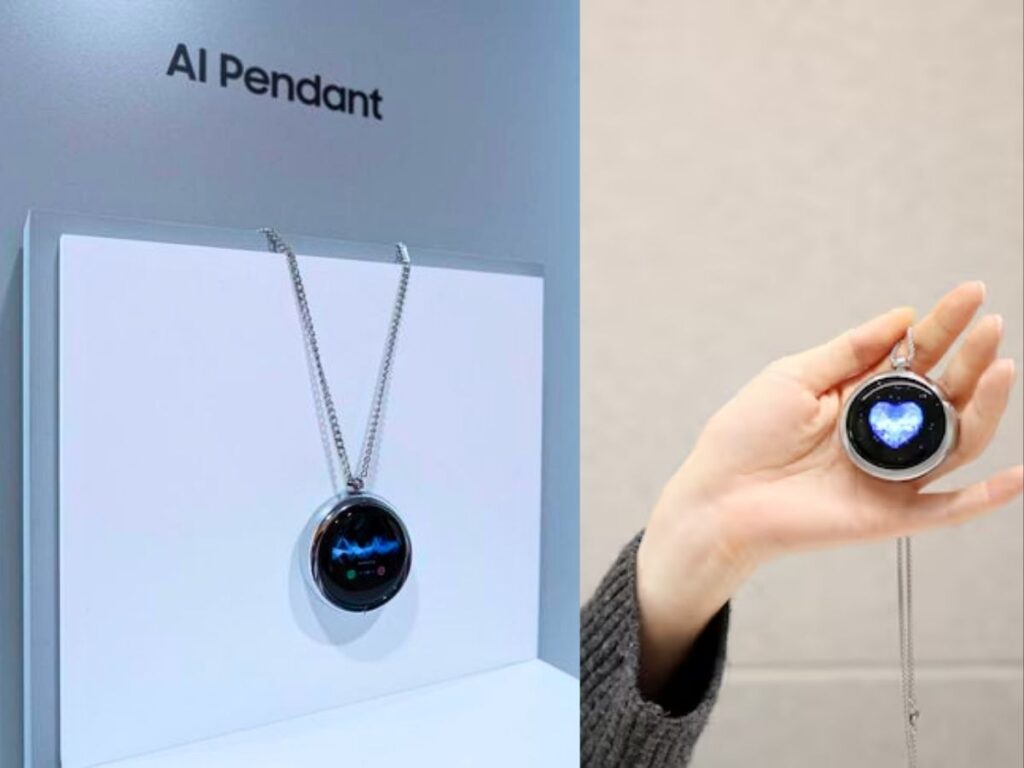
Unlike a smartwatch, which is tethered to your wrist and primarily tracks fitness, the Pendant is designed for communication and assistance. It features a sharp 1.4-inch round OLED panel encased in a sleek, lightweight frame worn around the neck.
The “No-Phone” Philosophy
The core idea is to reduce “screen fatigue.” Instead of pulling your phone out of your pocket 50 times a day to check a notification or change a song, you simply glance down or speak to your pendant.
- Visuals: It shows bite-sized info—weather, texts, navigation arrows.
- Control: It relies heavily on Voice AI, allowing you to make requests (“Call Mom,” “What’s my next meeting?”) without touching a screen.
Key Features & Specifications
Samsung’s new wearable builds on its leadership in OLED technology. Here is what the prototype offers:
- 1.4-inch Circular OLED: High brightness and deep blacks ensure the screen is readable even in direct sunlight.
- Voice-First Interface: Designed to be used with spoken commands, reducing the need for clumsy touch gestures on a small screen.
- Integrated AI Agent: The device doesn’t just show notifications; it proactively suggests alerts using on-device AI.
- Lightweight Aesthetics: Designed to feel like a premium accessory, not a heavy gadget.
Price & Availability: Can You Buy It?
Current Status: Concept Prototype.
Samsung has not officially confirmed a release date or price for the AI OLED Pendant. As is common at CES, Samsung Display uses these devices to showcase what their panels can do, rather than launching a consumer product immediately.

Expected Pricing: If this device does come to market, analysts expect it to sit in the Premium Tier ($300 – $500 range).
- Why? Miniaturized high-quality OLED panels and integrated AI processors are expensive to manufacture. It would likely compete with high-end wearables like the Humane Ai Pin or premium smart jewelry.
Beyond the Pendant: Samsung’s “Everywhere AI” Vision
The Pendant wasn’t the only futuristic concept Samsung Display brought to Las Vegas. They showcased a suite of devices proving that screens are moving into everyday objects:
- AI OLED Remote: A smart controller with a 1.3-inch screen embedded. Instead of a distinct remote, the screen adapts to control whatever smart home gadget you point it at.
- AI OLED Mirror: A large-scale display that doubles as a mirror. It uses cameras for skin analysis, offering beauty insights and virtual makeup trials while you get ready.
- AI OLED Bot: A domestic robot with a 13.4-inch OLED face, designed to be an expressive, interactive home assistant.
Why This Matters
The AI OLED Pendant is significant because it validates a major industry shift: Contextual Computing.
We are moving away from the “one screen does everything” era (the smartphone) to an era where we have specialized screens for different contexts. A pendant for quick alerts, a mirror for health checks, and a large TV for entertainment.
This fragmentation allows technology to blend more naturally into our environment, supporting the “Agentic AI” future where technology acts on your behalf without you needing to stare at a phone all day.
Frequently Asked Questions (FAQ)
Q: Does the Samsung AI OLED Pendant connect to iPhone and Android? As a concept device, compatibility hasn’t been confirmed. However, if launched, it would likely operate via Bluetooth, similar to a Galaxy Watch, requiring a companion app on your smartphone.
Q: Is the screen always on? OLED technology allows for an efficient “Always-On Display” (AOD) mode. It is highly likely the pendant would display a low-power clock or decorative graphic when not in use to act as digital jewelry.
Q: How is this different from a smartwatch? The form factor changes the psychology of use. A pendant is less intrusive than a watch and is positioned closer to the user’s mouth and ears, making it superior for voice commands and audio AI interaction.
About Post Author
