

Contents
Nor-Tec Wireless Weather Station Review: An Affordable Upgrade for Home Climate Monitoring
For several months, I’ve been searching for a solution to simplify managing my home environment, especially with Poland’s famously unpredictable weather. In early February, I decided to visit Action to pick up the Nor-Tec wireless weather station. Priced at just under $17, it promised to address many of my needs at a highly competitive price. Did this new gadget prove to be a worthwhile addition to my home? Read on to find out.
The weather station was purchased by the reviewer. The opinions expressed in this test are solely those of the author.
Your Well-being Starts at Home: Why I Needed a Weather Station
After moving into a new place about a year ago, I became determined to create a truly comfortable living space in my living room and bedroom. The internet is full of advice on “optimal” conditions for homeowners, claiming to improve focus, physical condition, prevent illnesses and allergies, and, of course, enhance sleep quality.
The situation becomes even more complex in winter:
- Using a gas stove? You should air out your home despite the cold to avoid inhaling harmful fumes.
- Aired it out? Now the temperature might be too low, and you might have let in smog.
- Turning up the radiator to warm up? Bad idea – your air humidity will plummet, if it hasn’t already escaped through the window into the freezing cold.
Trying to control all these factors “by eye” felt like a losing battle. While you could theoretically program yourself like a robot to follow specific steps, it’s mechanical and lacks scientific precision. Plus, trying to improve one aspect might inadvertently harm another.
My conclusion was that I needed reliable data. But where to start? I’d tried a few cheaper measuring devices and weather stations, and my satisfaction with them was only moderate. On the other hand, investing several hundred dollars in a more advanced device seemed excessive, especially since reviews for some expensive models still mentioned average sensor accuracy despite the high price. Then, Action came to the rescue.
Nor-Tec Weather Station: First Impressions and Ergonomics
The Nor-Tec station comes in a rather utilitarian package, typical of most electronics available at Action stores. Inside the cardboard box, you’ll find the main unit, a wireless outdoor sensor designed for installation outside a window or on a balcony, and a brief instruction manual.
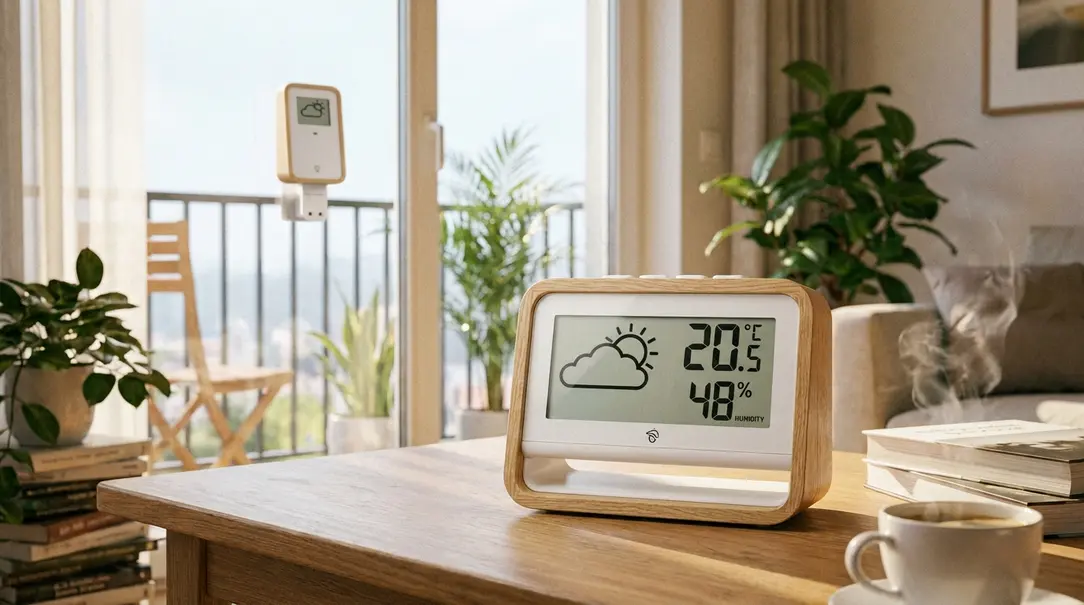
The main unit itself looks decent and should blend well with most interior designs. In my case, the light wood frame and white accents seamlessly fit into the surroundings – whether on a windowsill, desk, or kitchen counter.
A crucial aspect is how the station is positioned. Here, I encountered the first compromise. Using two plastic feet, the device can only be set at a single angle, approximately 60-70 degrees from the surface. I subconsciously hoped for multiple adjustable positions for the feet. Unfortunately, if they aren’t fully extended, the flaps either close, or the device becomes highly unstable, often tipping backward immediately.

Theoretically, you can forego the feet entirely and place the display directly on the frame. This results in a straight 90-degree angle, which isn’t ideal for viewing angles. While the single available setting worked for me, depending on your lighting, glare might appear on the display.
The outdoor sensor isn’t excessively large and requires two AAA batteries to operate. Installation shouldn’t be a problem, as it has a special cutout on the back for a nail or screw. I was surprised that the back cover was secured with a screw, but a small precision screwdriver quickly helped overcome this hurdle.
The fact that the panel is screwed on theoretically allows you to attach the sensor with double-sided tape. This is useful, for instance, when you can’t permanently alter window fittings (e.g., in a rental property).
Setting Up Your Action Weather Station: First Steps
After physically positioning the station, it’s time to set up its parameters. And here’s the first convenience. As Nor-Tec informs, you don’t have to laboriously set all parameters, as the outdoor sensor is designed to receive DCF radio time signals. I must admit, this is probably the first device in my home that boasts such an option, and I quickly grew to appreciate it.
Manually, I would have had to click through 15 different steps, including time zone, current date, date format, DST options, and so on. Instead, after the first power-on, everything synchronized automatically, and I only had to adjust two options: the display language for weekdays (Polish is available) and the 12/24-hour format.
One note here: For radio data reception to work, you need to temporarily keep the device away from other electronics, as per the instructions. In my case, even a single USB-C cable charging the station for the first time caused interference. It’s best to move the device near a window for a few minutes, and everything should work correctly.
Display and Power Options
Regarding charging: It’s worth mentioning that when connected to power, the station features a very bright and sharp display with a blue glow, where numbers are visible even from across the room. However, this is only temporary. Once disconnected from mains power, the device enters an energy-saving mode where the screen is not backlit.
Depending on its placement, visibility is either good or completely obstructed by unfortunate glare and shadows. However, there’s a touch-sensitive area on the top of the wooden frame that illuminates the screen for a few seconds (it also serves as a snooze button if an alarm is set).
Theoretically, you can choose between two solutions. You can have a station with a very bright display, but at the cost of it being constantly plugged in. For me, one of the best aspects is its mobility, so I chose to place it within sight and reach, to manually activate the screen when needed.
Nor-Tec Station Features: Do They Deliver?
The manufacturer boasts that the Nor-Tec station includes several additional features that usually come at a much higher price. For example, the device forecasts weather based on continuous atmospheric pressure changes and internal calculations.
In theory, this means the device not only tells us what’s currently happening outside but also whether rain or snow is gathering, or if cloudiness is expected. Honestly, it’s hard for me to conduct in-depth tests of the accuracy of such forecasts. However, my observations suggest that on rainy days, the station indeed displayed appropriate animations. When it predicted sunshine, the day truly turned out brighter. The manufacturer, however, emphasizes that “in case of discrepancies, priority should be given to forecasts from a local weather service.”
Window Open/Close Recommendations
Nor-Tec also advises whether you should close or open your windows based on current external conditions. According to the manufacturer, this involves “complex calculations and comparisons” of absolute humidity levels. During my tests, however, the relevant message seemed to appear at somewhat random times and indicate rather obvious actions. Is it raining? Close the window. I feel this option might be much more useful in warmer months and without snow cover.
Other Notable Features
Other options seem fairly standard, but not all weather stations in this price range include them. Onboard, you’ll also find a more advanced alarm system (two time settings, with possible repetition, e.g., only on weekdays or weekends). The device also tracks moon phases, remembers maximum and minimum temperature and humidity values, can alert you if the temperature exceeds set maximum or minimum readings, and warns of icing (when temperatures range from 30.2°F to 37.2°F / -1°C to 2.9°C).
Accuracy Test: How Does Nor-Tec Compare?
Now, let’s get to the crux of the matter: why would anyone want a weather station that’s cheap but inaccurate in its measurements? For comparison, I pitted the Nor-Tec station’s results against an IDEENWELT thermometer (available at Rossmann drugstores for about $8), a Meteo SP109 thermometer with humidity measurement (also around $8 online), and a Terrario Exato hygrometer designed for terrariums, which is considered quite accurate among reptile enthusiasts (around $5-$8).
Temperature Readings
In most daytime observations, the devices generally agreed on the outdoor temperature. However, the difference in indoor temperatures could be as much as 3 degrees. The Meteo device was consistently the “coldest” reader.
In terms of humidity, the Meteo device also seemed to underestimate daytime readings, while Nor-Tec showed a reading almost identical to the analog hygrometer. But that’s not all.
In the evening, Nor-Tec and Meteo readings were almost identical, while IDEENWELT potentially overstated the indoor temperature. The analog hygrometer also showed a higher value than its two digital counterparts (which stuck to similar values at that time).
Although this test was rather simple, in my opinion, the Nor-Tec will always show the actual room temperature most accurately, regardless of the other devices. Why? Because it’s the only one not “chained” to the windowsill. The other devices have external probes on rather short cords.
This means they will always show the temperature outside and… right by the window. What’s more, devices placed on the windowsill often failed to register any warming from a radiator turned on at that moment for an hour or more. Nor-Tec, placed half a meter further, closer to the center of the room, could indicate temperatures several degrees higher than those by the windowsill. Its readings also seemed to correspond best to the reality of the room. When I subjectively felt too warm, it showed 75.2°F (24°C). Meanwhile, the windowsill options told me the temperature was around 68°F (20°C).
Conclusion: Is the Nor-Tec Weather Station Worth It?
After a few days with the Nor-Tec, I can confidently say that this device, costing only around $17, represents a significant leap in quality and convenience compared to devices priced around $8 that you might buy on impulse at a physical store or online. In recent months, I developed a strong habit of craning my neck to see the temperature from devices on the windowsill. Now, all the data is directly within my line of sight. Theoretically, with the Nor-Tec station under my arm, I can move around the entire house and place it wherever I please. This is a huge positive change.
The weather station from Action definitely provides me with the most statistics among my available devices. Indoor and outdoor humidity measurements are useful. The air pressure reading gives me greater awareness – including why on earth my head aches today. The general weather forecast, while not infallible, can be helpful.
The Nor-Tec offering appears to be a device that should satisfy the average user – someone who doesn’t expect laboratory precision and accuracy comparable to devices costing thousands of dollars. Yet, they want something more than basic, cheaply constructed gadgets from China. Given all the device’s capabilities, the price of $17 seems reasonable, if not very good. And that’s what consumers often appreciate most about Action’s offerings.
Frequently Asked Questions (FAQ)
1. What is the Nor-Tec Wireless Weather Station?
The Nor-Tec Wireless Weather Station is an affordable home device designed to monitor indoor and outdoor temperature, humidity, atmospheric pressure, and provide basic weather forecasts. It also includes features like alarms and moon phase tracking.
2. How accurate is the Nor-Tec Weather Station?
Based on the review, the Nor-Tec station provides generally accurate readings, especially for indoor temperature when placed away from windows. While not laboratory-grade precise, it’s considered a significant improvement over cheaper alternatives for everyday home use.
3. Does the Nor-Tec Weather Station require constant power?
The station can run on batteries for mobility. When plugged into power, the display is continuously bright and backlit. In battery mode, the screen enters an energy-saving state and needs to be manually activated by touch for a few seconds.
4. Can the Nor-Tec Weather Station set itself up automatically?
Yes, it supports DCF radio time reception, which allows it to automatically set the time and date, minimizing manual setup. However, it’s recommended to initially place it away from other electronics for successful reception.
5. Is the Nor-Tec Weather Station suitable for professional use?
The review suggests it’s best for the “average user” who wants more than basic functionality without needing “laboratory precision.” For professional or highly critical applications, more expensive and specialized equipment would likely be required.
About Post Author
