

Contents
Can You Hear the Difference? Blind Test Challenges Perceptions of Audio Cables, Bananas, and Mud
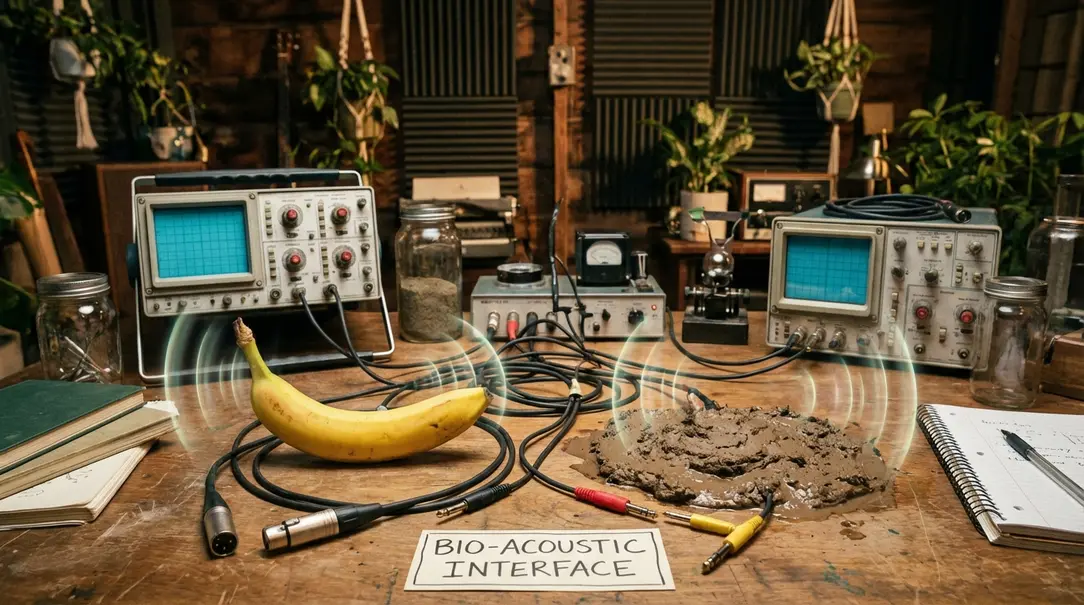
In a fascinating experiment that piqued the interest of the online community, an internet user recently conducted an unconventional audio test. The goal was to challenge listeners’ ability to distinguish between sounds transmitted through three distinct mediums: a classic audio cable, and, surprisingly, connections made from a banana and a patch of mud. What appeared to be a straightforward task proved to be quite difficult for the participants.
The Unusual Audio Experiment: Banana, Mud, and Sound
Some sounds have a remarkable way of surprising us. For instance, the vibrations designed to expel water from smartphones can be effective in some models but less so in others. Extending this curiosity into the realm of audio transmission, a user named Pano, a moderator on the diyAudio forum, decided to undertake a unique sound experiment.
Pano’s test aimed to verify how well listeners could identify the source of audio emitted through three very different conductors: a conventional audio cable, a banana, and mud. The premise was to see if the perceived quality or characteristics of the sound would betray its unusual path.
Surprisingly Poor Performance in Identifying Sound Sources
The outcomes of the study were quite astonishing for many observers. Out of 43 attempts to correctly identify the conductor transmitting the sound, only six were accurate. This low success rate suggested that distinguishing between these vastly different mediums based solely on sound proved exceptionally difficult for the human ear.
Even Pano, the experiment’s creator, expressed his surprise, noting, “the mud should sound perfectly awful, but it ultimately didn’t.” The statistics highlighted that a similar success rate could have been achieved simply by guessing the source at random.
Why Did Banana and Mud Conduct Sound? Understanding the Basics
Explaining the technical background of the study, the diyAudio moderator clarified that both the banana and the mud function similarly to a resistor used in series within an electrical circuit. In such a setup, a resistor will not degrade the audio quality, provided there is no significant signal interference. This principle explains why these unconventional materials could, in fact, transmit audio without immediately sounding “awful.”
- Electrical Conductivity: Both bananas (due to their water and electrolyte content) and mud (containing water and minerals) possess some degree of electrical conductivity. This allows them to act as rudimentary conductors for electrical signals, including audio signals.
- Resistor Analogy: When placed in series, these materials introduce resistance. If the resistance is within a certain range and doesn’t cause excessive signal attenuation or noise, the audio can still pass through, albeit potentially at a lower volume or with subtle changes. The key finding was that these changes were not easily detectable by human listeners in a blind test.
Beyond Audio: The Banana as a Potential Gaming Controller?
Intriguingly, the banana’s role as a conductor in Pano’s audio experiment isn’t its only brush with modern technology. This popular fruit has previously been envisioned as a component in a high-tech setup, courtesy of Sony.
In 2021, the Japanese tech giant filed a patent application outlining a concept where a banana could be utilized as a PlayStation VR controller. The idea was to transform everyday objects into input devices, using a camera to track their movements and map them to in-game actions. While innovative, nearly five years have passed since the patent was filed, and this revolutionary control system has yet to materialize. This suggests that a banana-based VR controller is unlikely to become a full-fledged part of Sony’s VR ecosystem anytime soon.
Frequently Asked Questions (FAQ)
Q: What was the primary goal of the audio test?
A: The test aimed to see if human listeners could distinguish between sounds transmitted through a conventional audio cable, a banana, and mud.

Q: How accurate were the participants in identifying the sound sources?
A: Out of 43 attempts, only six were correct, indicating a very low success rate, comparable to random guessing.
Q: Why could a banana or mud conduct sound?
A: Both bananas and mud contain water and electrolytes/minerals, making them electrically conductive. They acted similarly to resistors in an electrical circuit, allowing audio signals to pass through without significant, audibly detectable degradation in this specific setup.
Q: Has a banana ever been considered for other tech applications?
A: Yes, Sony filed a patent in 2021 for using a banana as a PlayStation VR controller, where a camera would track its movements.
Q: Is a banana VR controller expected to be released soon?
A: Given that nearly five years have passed since the patent was filed without any product development, it’s highly unlikely that a banana-based VR controller will become a commercial product in the near future.
About Post Author
