

Contents
Unveiling Antarctica’s Ancient Past: A Deep-Ice Drilling Breakthrough
Scientists have uncovered a profound secret buried deep beneath the ice of Antarctica, a discovery made possible by the world’s deepest ice-drilling expedition on the continent. The sediment core extracted from this unprecedented effort dates back an astonishing 23 million years, offering invaluable insights into what could happen as Antarctica’s vast ice sheets continue to melt in a warming world.
The Groundbreaking Crary Ice Rise Expedition
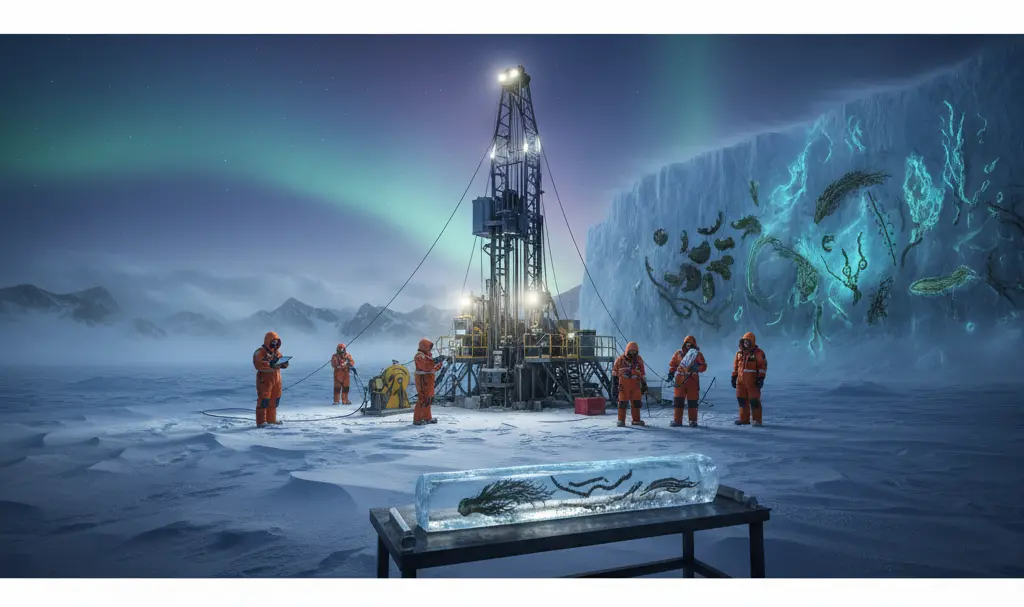
Completed in January 2026, this monumental drilling project took place on the Crary Ice Rise in West Antarctica. Researchers successfully drilled through 523 meters (1,716 feet) of ice to retrieve a record-breaking 288-meter (945 feet) sediment core. This ancient core provides a unique window into Earth’s climate history, stretching back approximately 23 million years.
The endeavor was exceptionally challenging, succeeding only on the third attempt due to the extreme conditions and technical difficulties. The precise location on Crary Ice Rise was strategically chosen for its potential to yield long, undisturbed sediment records crucial for paleoclimate studies.
SWAIS2C: Understanding the West Antarctic Ice Sheet
This ambitious drilling operation was a key component of the international SWAIS2C project (Sensitivity of the West Antarctic Ice Sheet to 2 Degrees Celsius of Warming). The project’s primary objective is to reconstruct the past behavior of the West Antarctic Ice Sheet, particularly during periods when it experienced significant melting.
Understanding the West Antarctic Ice Sheet is critical because if it were to completely melt, global average sea levels could rise by an estimated 4-5 meters (13-16 feet). The extracted sediment core is expected to provide crucial data on how this massive ice sheet responded to past warming events, specifically addressing its stability at critical temperature thresholds, such as a 2°C global temperature increase.
The dedication of the scientific team was immense, with 29 scientists living and sleeping in tents directly on the ice for the duration of the drilling operation, enduring harsh Antarctic conditions to gather this vital data.
Startling Discoveries from the Deep
Perhaps the most astonishing finding within the deepest layers of the sediment core were the remnants of ancient algae and small marine creatures. These organisms are known to thrive in significantly warmer climates than present-day Antarctica, offering compelling evidence that the continent was not always locked in its current frozen state.
This discovery provides concrete proof that parts of Antarctica, even those now covered by thick ice, once supported marine ecosystems indicative of a much milder environment. This past warmth serves as a powerful natural analogue for potential future changes.
The Path Forward: Analyzing the Ancient Core
Currently, the extracted sediment core is undergoing extensive analysis. It has been carefully transported to New Zealand, where it will be further processed and distributed to the various scientists participating in the SWAIS2C project. Researchers worldwide will then undertake detailed studies of the core’s composition, microfossils, and geochemical signatures to draw further conclusions regarding the behavior and future of the West Antarctic Ice Sheet in a warming climate.

Frequently Asked Questions (FAQ)
What is the significance of the 23-million-year-old sediment core?
The sediment core is significant because it provides a direct record of Antarctica’s climate and environment from 23 million years ago. It reveals evidence of ancient marine life that thrived in warmer conditions, indicating that Antarctica was not always covered in ice. This historical data is crucial for understanding how the continent’s ice sheets might respond to future global warming.
What is the SWAIS2C project?
SWAIS2C stands for “Sensitivity of the West Antarctic Ice Sheet to 2 Degrees Celsius of Warming.” It is an international scientific project aimed at studying the past behavior of the West Antarctic Ice Sheet (WAIS). By examining ancient sediment, the project seeks to determine how the WAIS responded to past warming periods, which helps predict its stability and contribution to sea-level rise under future climate scenarios, particularly if global temperatures rise by 2°C.
Why is understanding the West Antarctic Ice Sheet important?
Understanding the West Antarctic Ice Sheet (WAIS) is critically important because it holds enough ice to raise global sea levels by 4-5 meters (13-16 feet) if it were to completely melt. Its stability directly impacts coastal communities worldwide. Research like the SWAIS2C project helps scientists predict the rate and extent of future sea-level rise, providing vital information for climate adaptation and mitigation strategies.
Source: ETH Zurich. Opening photo: Generated by Gemini
About Post Author
