

Contents
Users Massively Uninstall ChatGPT: A Wave of Uninstalls After One Decision
User Backlash Against OpenAI’s Department of Defense Partnership
OpenAI’s recent announcement of a partnership with the U.S. Department of Defense has triggered a significant negative reaction among users in the United States. This collaboration, aimed at integrating advanced AI models for national security applications, has led to a notable shift in user behavior concerning the popular ChatGPT mobile application.
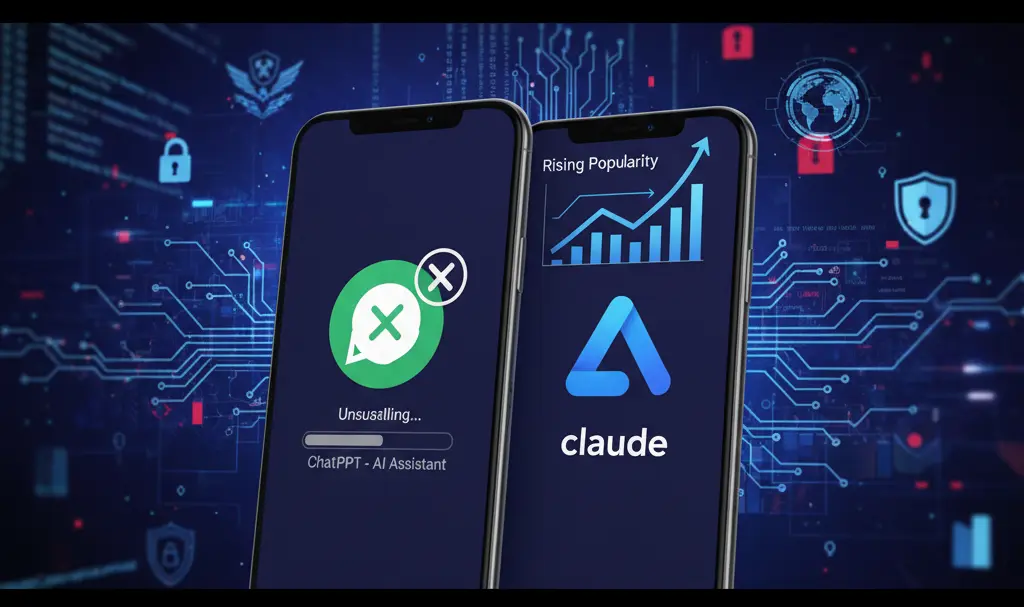
According to data from analytics firm Sensor Tower, as reported by TechCrunch, the number of uninstalls for the ChatGPT mobile app in the U.S. saw an unprecedented surge. On a recent Saturday, shortly after the February 28th announcement of the OpenAI-Department of Defense agreement, daily uninstalls soared by an astonishing 295% day-over-day.
To put this into perspective, the average daily uninstall rate for the preceding 30 days stood at approximately 9%. The scale of this reaction highlights a dramatic departure from typical user trends. Simultaneously, new downloads of the application experienced a decline:
- A 13% day-over-day drop in new downloads was observed on Saturday.
- An additional 5% decrease in new downloads followed on Sunday.
User sentiment was also starkly evident in the application’s ratings. The number of one-star reviews escalated dramatically:
- A staggering 775% increase in one-star reviews was recorded on Saturday.
- This figure doubled again the following day.
Conversely, the number of five-star ratings was cut in half during the same period, underscoring the widespread dissatisfaction among a segment of the user base.
Claude Benefits from Competitor’s Crisis
In contrast to OpenAI, Anthropic, the company behind the AI assistant Claude, took a different approach. Anthropic publicly stated its refusal to collaborate with the U.S. Department of Defense, citing significant concerns about the potential misuse of AI. Their primary worries revolve around the application of AI for citizen surveillance and in fully autonomous weaponry systems.
Representatives from Anthropic emphasized that the technology, in its current state, is not yet prepared for such highly sensitive and responsible applications. This principled stance resonated positively with many users.
Sensor Tower data indicates a direct benefit for Claude from its competitor’s controversy. Downloads of the Claude app in the U.S. increased significantly:
- A 37% day-over-day increase in downloads was observed on Friday.
- A further 51% surge occurred on Saturday.
Furthermore, analysis by Appfigures revealed a pivotal moment: on Saturday, Claude’s daily download figures in the U.S. surpassed those of ChatGPT for the first time. Appfigures estimated Claude’s growth to be as high as 88% on that day, marking a significant shift in the competitive landscape of AI assistants.

Understanding AI Partnerships with the Department of Defense
Collaborations between artificial intelligence development companies and the U.S. Department of Defense typically involve providing AI models and analytical tools for national security applications. These applications are diverse and critical, focusing on enhancing capabilities in areas such as:
- Analyzing vast datasets of intelligence information.
- Supporting complex decision-making processes.
- Conducting strategic simulations for planning and training.
- Improving the efficiency and effectiveness of military logistics.
In essence, these partnerships mean that advanced technologies developed by private companies, such as OpenAI or (hypothetically) Anthropic if they chose to participate, can be leveraged by the Department of Defense for various military and defense objectives. This collaboration raises ethical questions for some users and developers regarding the appropriate use and potential implications of powerful AI tools.
Frequently Asked Questions (FAQ)
What caused the surge in ChatGPT app uninstalls?
The significant increase in ChatGPT app uninstalls was primarily triggered by OpenAI’s announcement of a partnership with the U.S. Department of Defense. Many users reacted negatively to the collaboration between an AI company and a military entity.
How did users react to the OpenAI-DoD partnership?
Users reacted with mass uninstalls, a sharp increase in one-star reviews (up 775% initially, then doubling), and a decrease in five-star reviews for the ChatGPT app. New downloads also saw a decline.
Did any competitor benefit from ChatGPT’s issues?
Yes, Anthropic’s AI assistant, Claude, saw a notable increase in popularity and downloads. Anthropic explicitly refused to partner with the U.S. Department of Defense, which was met with positive user reception, leading to Claude surpassing ChatGPT in daily downloads on a recent Saturday.
What kind of work do AI companies do with the Department of Defense?
These collaborations typically involve providing AI models and analytical tools for national security applications. This includes analyzing intelligence data, supporting decision-making, conducting strategic simulations, and improving military logistics.
Source: TechCrunch, original research. Opening photo: Gemini
About Post Author
