

Contents
The Unfulfilled Promise: How a Hydrogen Car Became a €90 Burden for a Norwegian Couple
Just a few years ago, hydrogen-powered vehicles were heralded as the ecological future of personal transportation. Today, for some owners, they have unfortunately become a significant financial drain and a considerable burden. The story of a Norwegian couple vividly illustrates how quickly an ambitious vision can collide with harsh reality.
The Dream Meets a Dismal Reality: A Hydrogen Car No One Wants to Buy
In 2019, Margrethe and Arvid Wam Solvang, a couple from Norway, invested over €70,000 (approximately $75,000 USD) in a hydrogen car, envisioning a modern, eco-friendly solution for years to come. Their hope was to embrace sustainable travel and the cutting-edge technology of fuel cell electric vehicles (FCEVs). However, their dream has since turned into a nightmare: today, their vehicle is practically worthless.
When the couple recently decided to sell their hydrogen car, they encountered almost no interest. The single offer they received was for a mere €90 (approximately $95 USD). This represents an astonishing market value depreciation of 99.88% in just a few years.
Understanding the Problem: More Than Just the Car
The core issue isn’t the car’s performance or inherent quality; it lies entirely with the external conditions required for its operation. Their vehicle now sits unused in front of their home because utilizing it has become virtually impossible. Even the car dealer offered only a slightly higher sum, but exclusively conditional on the purchase of a brand-new vehicle, providing no real solution for their current predicament.
The Infrastructure Collapse: A Critical Roadblock for Hydrogen Cars
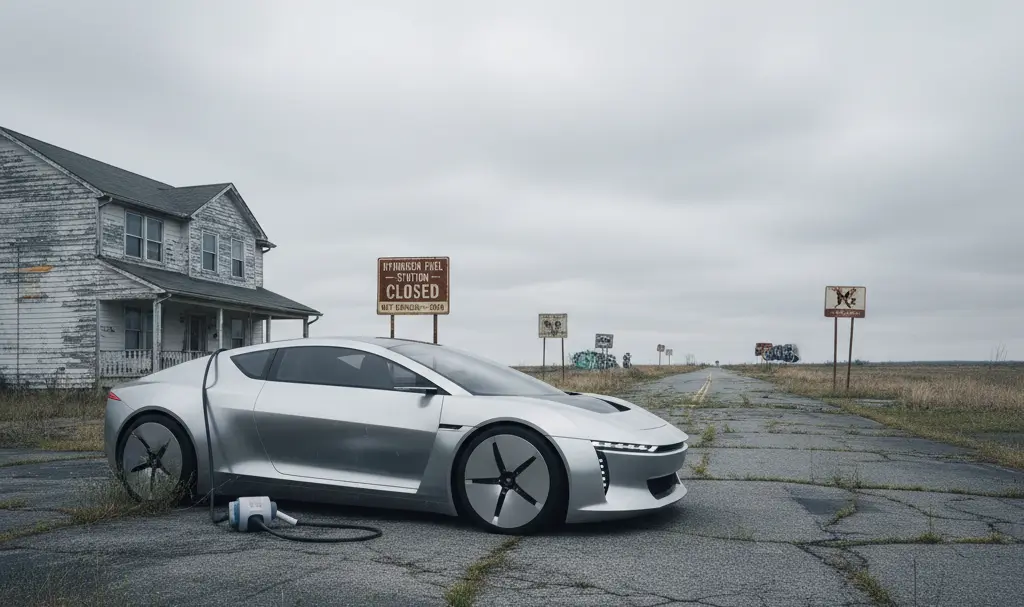
The key reason for this dire situation is the critically inadequate hydrogen fueling infrastructure. In Norway, many hydrogen refueling stations have been shut down, largely due to the financial struggles of their operators. The nearest operational station is now hundreds of kilometers away from the couple’s residence. In practical terms, this means they would have to drive all the way to Sweden just to refuel their vehicle, making daily use impractical and costly.
- What is a hydrogen car? Hydrogen cars, or Fuel Cell Electric Vehicles (FCEVs), generate electricity by combining hydrogen and oxygen in a fuel cell, producing only water vapor as a byproduct. This electricity then powers an electric motor. Unlike battery electric vehicles (BEVs) that charge from the grid, FCEVs are refueled with hydrogen gas.
Hydrogen’s Future: Beyond Personal Passenger Vehicles
While hydrogen continues to be a part of long-term energy transition strategies, its viability in passenger cars faces increasing skepticism. Experts point out that hydrogen fuel cell technology for personal vehicles is currently losing ground to battery electric counterparts due to higher costs and lower overall energy efficiency.
However, hydrogen holds significantly greater potential in sectors where conventional batteries are not sufficient or practical. This primarily includes:
- Heavy-duty transport: Long-haul trucks, buses, and trains.
- Aviation: Aircraft requiring high energy density for extended flights.
- Shipping: Large maritime vessels.
- Industrial applications: Manufacturing processes requiring high heat or as a feedstock.
In these specific sectors, hydrogen’s unique properties, such as its high energy density by weight and rapid refueling capabilities, can genuinely deliver substantial benefits.
A Cautionary Tale: The Importance of Infrastructure
The experience of this Norwegian couple serves as more than just a personal financial setback; it symbolizes a broader, ill-fated aspect of the energy transition. Without robust and accessible infrastructure, even the most promising and environmentally friendly technologies struggle to achieve widespread adoption and success in everyday life. This story underscores the critical need for a holistic approach that considers not just the technology itself, but also the entire ecosystem required for its practical implementation.

Frequently Asked Questions (FAQ)
Hydrogen cars face significant challenges in the passenger vehicle market primarily due to the lack of a widespread refueling infrastructure, high vehicle purchase costs, and the inefficiency of producing, transporting, and storing hydrogen compared to direct electricity for battery electric vehicles.
Hydrogen’s potential is much greater in sectors where battery electric solutions are less viable, such as heavy-duty transport (trucks, buses), aviation, shipping, and certain industrial processes. These applications benefit from hydrogen’s high energy density and faster refueling capabilities compared to large-scale battery systems.
Based on current market trends and infrastructure development, investing in a hydrogen passenger car carries considerable risk. Owners may face issues with vehicle depreciation, limited access to refueling stations, and higher operating costs compared to more established electric vehicle technologies.
Infrastructure is paramount for the success of any new automotive technology. Without a readily available and convenient network for fuel or charging, consumer adoption remains low, regardless of the technology’s environmental benefits or performance. The availability of charging/refueling points directly impacts a vehicle’s usability and resale value.
Source: Chip.de
Opening photo: Gemini
About Post Author
