

Contents
Is Aluminum Foil the Secret Weapon Against Keyless Car Theft?
Keyless entry has revolutionized how we interact with our cars, offering unparalleled convenience. However, this advanced technology also presents a significant vulnerability: modern vehicles equipped with keyless systems are increasingly susceptible to sophisticated cyber attacks. Fortunately, there’s a surprisingly simple and cost-effective method to protect your vehicle from these high-tech thieves: ordinary aluminum foil.
Understanding the Threat: How Keyless Car Theft Works
Modern cars are packed with connectivity systems, and keyless entry is a prime example. While convenient, these systems operate by emitting a signal from your car key fob that the vehicle recognizes. Cybercriminals exploit this by using “relay attack” devices. These devices can capture the signal from your key fob, even when it’s inside your home, amplify it, and relay it to an accomplice near your car. The car then “thinks” the legitimate key is present, allowing thieves to unlock and start the vehicle without ever touching your actual key.
The Simple Solution: Aluminum Foil as a Faraday Cage
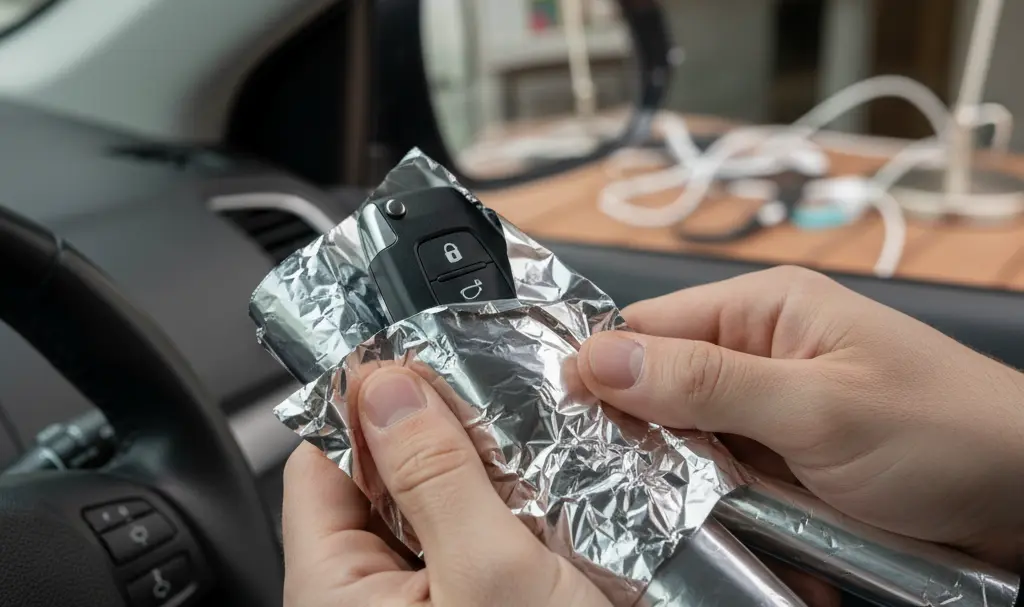
It might seem counterintuitive to fight high-tech theft with something as basic as aluminum foil, but the science behind it is sound. Aluminum is an excellent electrical conductor that can effectively block radio waves. When you wrap your key fob in aluminum foil, you are essentially creating a makeshift Faraday cage. A Faraday cage is an enclosure that blocks electromagnetic fields, preventing radio signals from entering or escaping.
In the context of keyless car theft, this means the aluminum foil acts as a barrier, stopping your key fob’s signal from being intercepted by thieves’ relay devices. Without a signal to capture and relay, criminals cannot trick your car into unlocking.
Practical Steps to Protect Your Car
Protecting your vehicle from keyless theft doesn’t require expensive security upgrades. Here’s how to use aluminum foil and other strategies effectively:
- Wrap Your Key Fob Thoroughly: Ensure your key fob is completely covered with at least two layers of aluminum foil. Make sure there are no gaps or tears.
- Regular Replacement: Over time, the foil can wear and tear. It’s a good practice to replace the aluminum foil wrapping periodically to maintain its integrity.
- Secure Storage at Home: When not in use, store your wrapped key fob inside a metal box (like an old tin or a dedicated Faraday box) within your home. Avoid placing it near external walls, windows, or doors, as signals can sometimes penetrate even these barriers.
- Strategic Parking: Whenever possible, park your vehicle in well-lit, visible areas. Thieves prefer working in the shadows.
- Disable Keyless Access: If your vehicle allows it, consider disabling the keyless entry feature entirely, especially if you’re leaving your car unattended for extended periods. Consult your car’s manual or dealership for instructions on how to do this.
Beyond Traditional Keys: Smartwatch and Smartphone Car Access
The evolution of vehicle access technology is truly remarkable, with many popular electronic devices now capable of serving as car keys. Tesla, for instance, allows owners to unlock and start their vehicles using an Apple Watch or an iPhone. This integration extends beyond Tesla; many other prominent manufacturers are embracing similar solutions.
The “Car Key” feature in digital wallets (such as Apple Wallet) supports vehicles from various brands, including BMW, Hyundai, KIA, and Mercedes-Benz, allowing drivers to use their smartphones to lock, unlock, and even start their cars. This demonstrates a growing trend towards integrating car access into our daily digital lives.
Frequently Asked Questions (FAQ)
How does aluminum foil prevent car theft?
Aluminum foil acts as a Faraday cage, blocking the radio signals emitted by your key fob. This prevents thieves from using “relay attack” devices to intercept and amplify your key’s signal, which they would otherwise use to unlock and start your car.

Is wrapping my key fob in aluminum foil completely foolproof?
While highly effective, no single security measure is entirely foolproof. Aluminum foil significantly reduces the risk of relay attacks, but it’s essential to ensure the key fob is completely and securely wrapped. Combining this method with other security practices, such as storing your key in a metal box and parking in well-lit areas, provides even greater protection.
Are there any commercial products that offer better protection than aluminum foil?
Yes, specialized Faraday pouches or Faraday boxes are commercially available. These products are designed specifically to block electromagnetic signals and can offer a more durable and convenient solution than aluminum foil, although they operate on the same principle. They are often made from materials woven with conductive threads to create a robust signal-blocking enclosure.
What are the potential downsides of using aluminum foil for key fob protection?
The main downside is that aluminum foil can tear or wear out over time, compromising its effectiveness. It also requires careful and consistent wrapping to ensure full coverage. While a practical DIY solution, it may not be as durable or aesthetically pleasing as purpose-built Faraday pouches or boxes. Always check the foil for damage and rewrap as needed to maintain protection.
Source: Nők Lapja. Opening photo: macherstudio / Shutterstock
About Post Author
