

Contents
The Resurgence of Game Piracy: A Double-Edged Sword for Gaming Preservation
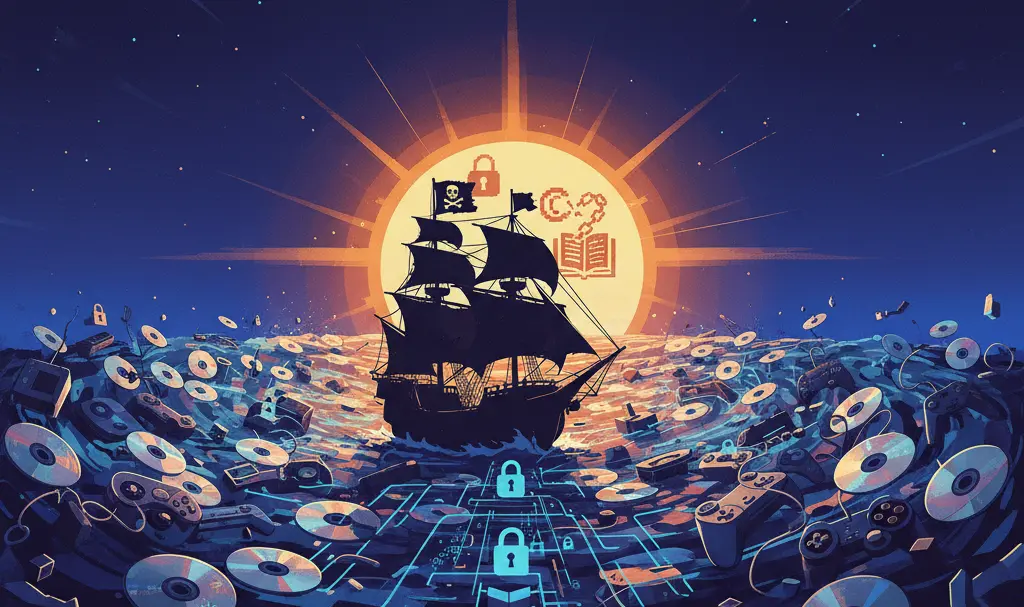
Despite the immense popularity of official gaming ecosystems like Steam, PlayStation, and Nintendo, video game piracy is far from over. In fact, it often feels more convenient and audacious than ever before. While there are numerous reasons for this trend, one thing remains certain: the legal teams of international corporations are vigilant, and some pirates are flying too close to the sun.
The New Face of Game Piracy: Embracing Abandonware
Retrogaming, the hobby of playing older video games, can be one of the most challenging pursuits in technology and gaming. While it’s true that the availability of classic titles through official distribution channels has significantly improved over the last decade, the situation is still far from perfect.
We now have numerous re-releases of classic games, including collections of specific series, subscriptions offering entire catalogs, and individual remasters of titles once confined to decades-old arcade machines. For instance, a beloved PlayStation 1 game like *Fighting Force* only recently became legally playable again after years of obscurity.
On the other hand, the market is rife with peculiarities from platform owners and game publishers. Many struggle to properly maintain their extensive back catalogs, leaving the playability of numerous titles—especially those from the late Xbox One and PlayStation 4 generations—wanting.
Bloodborne’s Enduring Dilemma
A prime example is *Bloodborne* (2015), a critically acclaimed game that remains constantly available for purchase but is technologically outdated. The publisher, Sony, has actively resisted releasing a performance patch for PlayStation 5 that would boost its default 30 frames per second (FPS) to a smoother 60 FPS. This lack of action reportedly led to the closure of Bluepoint Games, a 70-person studio, simply because the Japanese developer FromSoftware, creators of titles like *Elden Ring* (2022) and *Sekiro: Shadows Die Twice* (2019), did not consent to any modifications to *Bloodborne*, despite Sony owning the full rights to the brand.
The gaming community waited for years, and eventually, patience wore thin. A PlayStation 4 emulator was primarily developed to enable playing *Bloodborne* at 60 FPS. Professional gaming publications began testing this version in late 2024 and early 2025, hoping to highlight the demand for an official release. Unfortunately, as of 2026, there are no rumors of *Bloodborne* receiving a new official release.
A similar wave of enthusiasm erupted when *Driveclub* (2014) also achieved 60 FPS on the same emulator, shadPS4. Today, *Driveclub* is no longer available for digital purchase, and even purchasing a physical copy won’t grant access to its many delisted add-ons.
The case of *Bloodborne* is not isolated. Many other PlayStation 5 titles, such as *Need for Speed: Heat* (2019), *Crash Bandicoot: N.Sane Trilogy* (2017), *Crash Team Racing: Nitro-Fueled* (2019), *Spyro: Reignited Trilogy* (2018), and *Red Dead Redemption 2* (2018), face similar issues. *Red Dead Redemption 2* has the strongest chance of eventually receiving a current-generation update.
Here, we must commend French publisher Ubisoft, which has diligently patched its catalog of Xbox One and PlayStation 4 games for several years. Recently, *Assassin’s Creed: Unity* (2015) even received a free 60 FPS patch. This initiative has made returning to classics like *Far Cry 3* (2012) and *The Division* (2016) a seamless experience. The *Tomb Raider* series has also been well-maintained, with the first eight adventures of Lara Croft (1996-2007) released as simple remasters, and the modern trilogy (2013-2018) receiving current-generation console updates for an enjoyable replay.

Today, game piracy often revolves around these very issues: providing access to classics no longer available for digital purchase and enhancing games for which players have requested updated versions for years. It less frequently involves cracking the copy protection of brand-new titles. While communities surrounding console emulators often shy away from using the term “piracy,” the atmosphere in the PC gaming community is quite different. For those interested in optimizing their retro gaming experience, there are resources available on integrating emulators with modern platforms, such as making PS3 games appear as shortcuts in Steam, enhancing accessibility for these classic titles.
The Growing Audacity of Online Pirates
For years, an unwritten rule, a paraphrase of the first rule of Fight Club, governed the internet: “You don’t talk about where to get old games.” The illegal downloading of such titles, even those unavailable for digital purchase, was simply not discussed. Forum administrators would ban users for any such suggestion, and similar policies were enforced on social media.
However, something has shifted. Particularly on the social media platform X, content creators now openly share links to game folders on the Internet Archive and promote their free services.
“Archiving and sharing abandonware as a hobby,” reads the description of one such profile, boasting over 86,200 followers. Each of these “releases” is often enhanced with community-made modifications, creating an ultimate version of the game that surpasses its original form.
An even greater level of audacity is demonstrated by one of this archivist’s followers, who created a dedicated launcher for the games he distributed. In essence, it’s an unauthorized, illegal Steam-like platform for titles no longer available for sale.
A screenshot from this launcher, circulated on X, reveals a list of “releases” that bring tears to the eyes of nostalgic gamers. It includes the complete *Need for Speed* series, archival installments of *FIFA* and *Pro Evolution Soccer*, and the delisted *Deadpool* (2013). However, there’s a touch of arrogance from the creator in including *Forza Horizon 4* (2018)—a title delisted in late 2024, relatively recently. All titles within this specific launcher share one characteristic: their unavailability through official PC sales channels.
This situation presents a strong dilemma. On one hand, such actions can be seen as a last bastion of a free, decentralized internet, preserving gaming history that publishers have abandoned. On the other hand, we are discussing active copyright infringement, with no pretense or alternative interpretation. It’s no secret that corporate lawyers actively seek out such projects and are uninterested in the fact that a game like *Blur* (2010), a racing game similar to *Mario Kart* but with real cars, has been unavailable for purchase for 16 years due to short-term car licensing agreements.
Ultimately, I believe this convenience will only lead to more problems. Projects like those mentioned above are already grappling with rising server maintenance costs. This factor contributed to the planned shutdown of the Myrient service on March 31, 2026, though an early warning allowed hobbyists to transfer 390 terabytes of data to other locations.
Such blatant disregard—manifested in the creation of simple launchers for downloading pirated content—could prompt corporations to intensify their efforts to restrict the availability of classic games outside of official digital platforms. This would be a significant blow to those who, a decade from now, wish to replay beloved titles like *Need for Speed: Most Wanted* or *The Lord of the Rings: Battle for Middle-earth*. Because one thing is certain: official re-releases for these titles are unlikely. Furthermore, understanding the challenges and benefits of digital distribution, such as those related to Steam’s regional pricing updates for international gamers, highlights the complex landscape publishers navigate when managing their game catalogs globally.
Frequently Asked Questions (FAQ)
What is abandonware, and why is it relevant to game piracy today?
Abandonware refers to software, particularly video games, that is no longer officially supported, sold, or maintained by its copyright holder. It becomes relevant to game piracy because, in the absence of legal ways to acquire and play these titles, communities often turn to unauthorized distribution to preserve and experience them. This grey area highlights the tension between copyright enforcement and cultural preservation.
Are game emulators legal, and how do they relate to piracy?
Game emulators themselves are generally legal, as they are software designed to mimic the hardware of older gaming consoles, allowing games to run on modern computers. The legality often becomes complex when discussing the game ROMs or ISOs (digital copies of games) used with emulators. Distributing or downloading copyrighted game ROMs without permission is illegal, constituting piracy. However, if a user legally owns a game and creates a personal backup copy for use with an emulator, this is typically considered legal in many jurisdictions.
What are the risks associated with downloading pirated games or using unauthorized launchers?
Downloading pirated games or using unauthorized launchers carries several risks. Legally, it exposes users to potential copyright infringement lawsuits or penalties. Technically, pirated software often comes bundled with malware, viruses, or other malicious code that can compromise personal data and system security. Such software also lacks official support, meaning no updates, bug fixes, or online features, and can lead to unstable performance or corrupted files.
How can players legitimately access and preserve classic video games?
Players can legitimately access and preserve classic games through several official channels. These include purchasing remastered versions or collections released by publishers, subscribing to services like PlayStation Plus Premium or Xbox Game Pass, which offer access to retro titles, or buying games through digital storefronts that still carry older titles. Supporting platforms and initiatives focused on digital preservation and licensing older titles encourages legitimate access and helps ensure that gaming history is not lost to time or legal complexities.
Source: Original content. Opening photo: Gemini
About Post Author
