

Contents

Submarine Discovered Strange Structures Under Antarctic Ice, Then Lost Contact
Beneath the frozen, seemingly impenetrable surface of Antarctica, scientists have uncovered structures that are completely upending our understanding of how glaciers melt. However, the groundbreaking research mission ended abruptly with the mysterious disappearance of the autonomous underwater vehicle (AUV) responsible for delivering these revolutionary insights.

The Uncharted World Beneath Antarctica’s Ice
For several weeks, an advanced uncrewed submarine named Ran explored the dark, frigid waters beneath the Dotson Ice Shelf in West Antarctica. Its primary mission was to map the hidden topography beneath a massive sheet of ice and to analyze the complex basal melting processes occurring from the bottom up.
This ambitious expedition was part of a broader study led by Professor Anna Wåhlin from the University of Gothenburg. Her international research team has been analyzing the critical impact of warm ocean currents on the long-term stability of Antarctic glaciers. Operating in one of the most hostile environments on Earth, the Ran submarine navigated autonomously beneath the ice, continuously gathering high-resolution data for hours without any direct contact with the surface world.
During one of its most extensive dives, the high-tech robot spent a staggering 27 days under the ice. It ventured roughly ten miles (sixteen kilometers) deep into the unmapped subglacial cavity. It was during this extended journey that the AUV discovered extraordinary ice formations—features completely invisible to traditional satellite imaging.
Groundbreaking Discoveries: Ice Terraces and Subglacial Highways
Before this mission, many glaciological models assumed the underside of an ice shelf was a relatively smooth, continuous surface. The data retrieved by Ran proved the exact opposite. Researchers discovered a highly textured, chaotic environment shaped by aggressive and uneven melting.
Key findings from the submarine’s sonar mapping included:
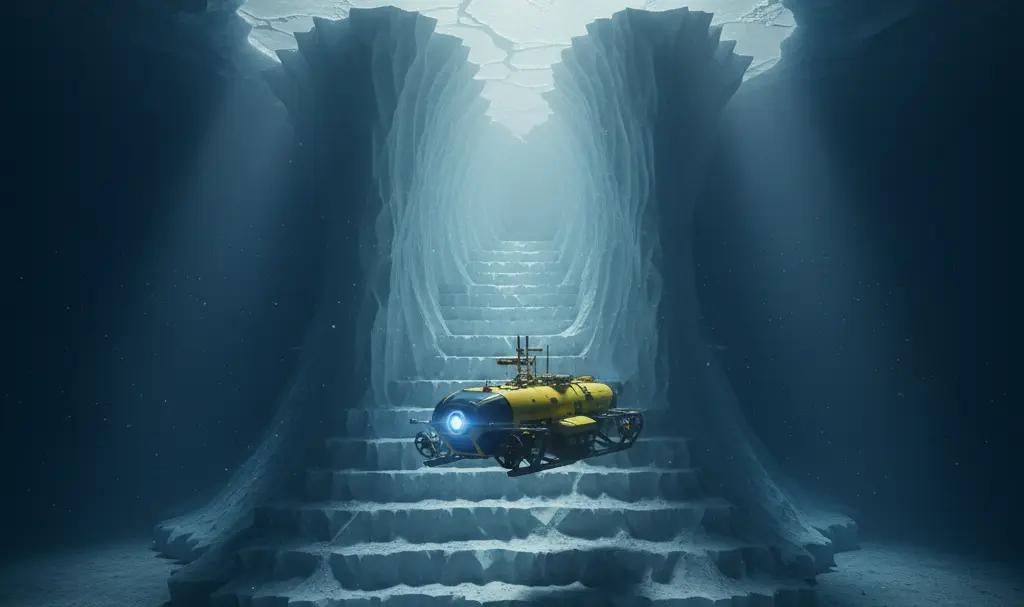
- Terraced Structures: Massive, stair-like formations carved into the ice, created by the interaction of flowing water and the Earth’s rotation.
- Deep Channels: Gouged pathways where rapid water flow accelerates erosion.
- Subglacial Crevasses: Deep fractures extending through the entire thickness of the ice shelf.
The research indicates that warm deep-water currents from the ocean are the primary culprits. As this warmer water intrudes beneath the glacier, it erodes the ice from below. Interestingly, the western flank of the Dotson Ice Shelf is experiencing rapid melting, while the eastern section remains relatively stable due to the presence of cooler water currents.
Furthermore, the deep fractures discovered by the submarine act as “superhighways” for the warm water. This internal circulation violently intensifies the melting process, accelerating the glacier’s degradation. Historically, these intricate subglacial dynamics have been absent from standard climate models. Without accurate data from the undersides of glaciers, researchers risk severe miscalculations, which can easily lead to sea-level rise studies errors and inaccurate coastal threat maps.
The Mysterious Disappearance of the Submarine
Following its initial success, Ran was deployed for a follow-up mission aimed at expanding the survey area and capturing even more detailed topographic data. Unfortunately, the AUV failed to return to its programmed rendezvous coordinates. All frantic attempts to re-establish acoustic contact with the multi-million-dollar vessel failed.
With no distress signal and absolutely no physical traces left behind, the exact cause of Ran’s disappearance remains a mystery. Scientists suspect a few plausible scenarios:
- A sudden mechanical or software failure that disabled its navigation systems.
- A fatal collision with the jagged, unpredictable ice structures it was attempting to map.
- Entrapment within a collapsing ice cavity or shifting subglacial currents.
A Lasting Legacy for Climate Science
Despite the heartbreaking loss of the equipment, the data retrieved prior to Ran’s disappearance is considered scientifically invaluable. These findings have pulled back the curtain on the incredibly complex processes dictating glacier health and will fundamentally improve how scientists project future global sea levels.
Tackling the global climate crisis requires a multi-faceted understanding of our planet. While terrestrial environmental efforts, such as China’s Great Green Wall in the Taklamakan Desert, focus on mitigating atmospheric changes on land, understanding the oceanic forces dismantling our polar ice caps is equally vital. The brief but historic journey of the Ran submarine proves just how many deep, impactful secrets Antarctica continues to hide.
Frequently Asked Questions (FAQ)
How do autonomous vehicles navigate under Antarctic ice where GPS signals cannot penetrate?
Submarines like Ran rely on highly advanced Inertial Navigation Systems (INS), combined with Doppler Velocity Logs (DVL) that track the vehicle’s movement relative to the seafloor or the ice ceiling. Since GPS radio waves are instantly blocked by water and thick ice, these onboard acoustic and motion sensors continuously calculate the drone’s exact position relative to its initial deployment point.
Why does the underside of the Dotson Ice Shelf feature terrace-like structures instead of a smooth surface?
These terraced structures are sculpted by a combination of the Earth’s rotation (the Coriolis effect) and complex ocean currents. As warm, salty water rises and travels along the underside of the ice, it doesn’t melt the surface evenly. Instead, water flow dynamics and temperature gradients carve out distinct, stair-like layers and deep erosion channels.
What makes the West Antarctic Ice Sheet more vulnerable to rapid melting than its eastern counterpart?
A significant portion of the West Antarctic Ice Sheet rests on bedrock that lies below sea level and slopes downward inland. This geological setup creates a “marine ice sheet instability.” It allows warm ocean currents to easily slip beneath the ice shelves, driving aggressive basal melting and threatening to detach massive glaciers from their grounding lines.
Source: Earth.com. Opening photo: Gemini.
About Post Author
