

Contents

Revolutionary Hypotheses Challenge Everything We Know About Pyramid Construction
Recent findings regarding the construction of the Giza pyramids have reignited one of the greatest mysteries in archaeology. Researchers are now suggesting that ancient Egyptians may have utilized much more advanced engineering methods than previously assumed, shifting the focus away from traditional external ramps.

Just as modern researchers rely on advanced scientific methodologies to uncover ancient mysteries—such as the fascinating Oviraptor dinosaur nest incubation experiment—Egyptologists are constantly re-evaluating historical evidence to better understand the ingenuity of the ancient world.
The New Hypothesis: Internal Mechanisms Over Ramps
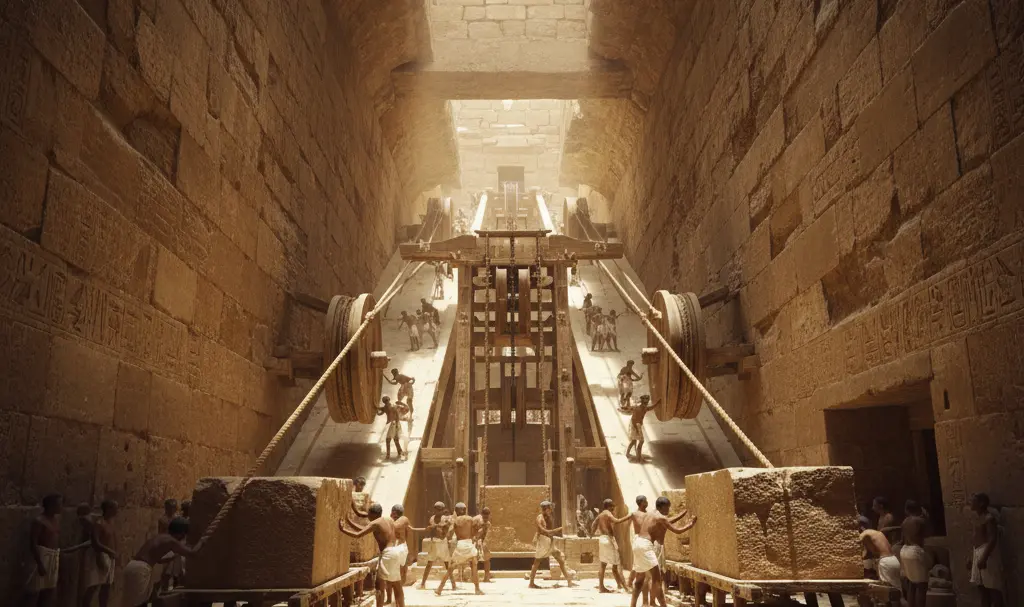
A groundbreaking theory has recently emerged concerning the construction techniques used for the Great Pyramids. Moving away from the classic belief in miles-long external ramps, modern researchers point to the potential use of sophisticated internal mechanisms based on counterweights and block-and-tackle systems.
According to this concept, the interior architecture of the pyramids played an active and crucial role during the building process. Particular attention has been drawn to the Grand Gallery inside the Great Pyramid. Proponents of this hypothesis argue that this massive, corbelled space could have functioned as a highly efficient, inclined transport corridor. It is within this gallery that mechanisms for hoisting colossal stone blocks were likely operated.
This new interpretation helps answer some of Egyptology’s most pressing questions by introducing several practical engineering solutions:
- Counterweight systems: Utilizing gravity and heavy wooden sleds on tracks to pull massive granite and limestone blocks—weighing up to 80 metric tons—up steep internal inclines.
- The Grand Gallery’s true purpose: Suggesting the magnificent space served not merely as a ceremonial passage, but as a functional freight elevator shaft during construction.
- Precision engineering: Explaining how builders managed to position multi-ton megaliths with millimeter accuracy deep within the structure.
Between Science and Speculation: What Do We Know for Sure?
Of course, this internal ramp and counterweight theory is just the latest in a long history of pyramid research. For decades, the monumental structures at Giza have inspired both rigorous academic study and wild conspiracy theories. Concepts have ranged from massive external dirt ramps and complex spiral scaffolding to the highly speculative and debunked involvement of extraterrestrials.
Despite the continuous influx of new ideas, certain historical facts remain absolutely undisputed among legitimate scholars. It is universally accepted that the Great Pyramid was constructed around 2560 BC, during the reign of Pharaoh Khufu. This timeline is heavily supported by a wealth of evidence, including ancient workers’ logbooks (such as the famous Diary of Merer) and radiocarbon dating of organic materials found within the pyramid complex.
Calculating the architectural alignment of these immense structures required profound mathematical and astronomical precision, much like how the Easter date is determined using algorithms and astronomy. The ancient Egyptians meticulously aligned the pyramids with the cardinal points, proving their advanced grasp of the stars.
The True Builders of Giza
Equally important are the discoveries concerning the builders themselves. Contrary to the outdated myth perpetuated by early historians and pop culture, the pyramids were not built by enslaved people. Archaeological evidence confirms they were constructed by a well-organized workforce of highly skilled, well-fed workers.
These specialized laborers lived in a dedicated settlement near the Giza plateau. They received excellent medical care, enjoyed a protein-rich diet, and left behind personal inscriptions. Most importantly, they were granted honorable burial sites near the very monuments they helped raise—a privilege never afforded to slaves.
Frequently Asked Questions (FAQ)
How did the internal counterweight system in the Grand Gallery theoretically work?
The theory posits that the Grand Gallery housed a massive wooden cart loaded with stones that acted as a counterweight. Connected by a sophisticated system of heavy ropes and rudimentary wooden pulleys, this heavily loaded cart would descend the gallery. The gravitational pull generated by its descent would be used to haul massive building blocks up the central axis of the pyramid.
Why are traditional external ramp theories heavily criticized by modern engineers?
To reach the apex of the Great Pyramid with a gentle enough slope for hauling 80-ton stones, a straight external ramp would need to be over a mile long. This ramp would actually contain more raw material and volume than the pyramid itself. Additionally, a wrap-around spiral ramp would make maneuvering massive stone blocks around tight, 90-degree corners incredibly difficult, prompting engineers to search for internal construction methods.
What specific archaeological evidence proves that skilled workers, rather than slaves, built the pyramids?
Excavations at the workers’ village on the Giza plateau have revealed thousands of animal bones, indicating a premium diet rich in prime beef and sheep—food typically reserved for the elite or highly valued individuals. Furthermore, skeletons of these workers show healed fractures that were meticulously set by advanced medical care. Their proximity to the pharaoh’s tomb in respectful, well-prepared burial sites definitively indicates they were honored citizens and skilled craftsmen.
Source: Aventuras na Historia, independent elaboration. Opening photo: Gemini
About Post Author
