

Contents

Exploring GJ 251c: The Newly Discovered Super-Earth Just 18 Light-Years Away
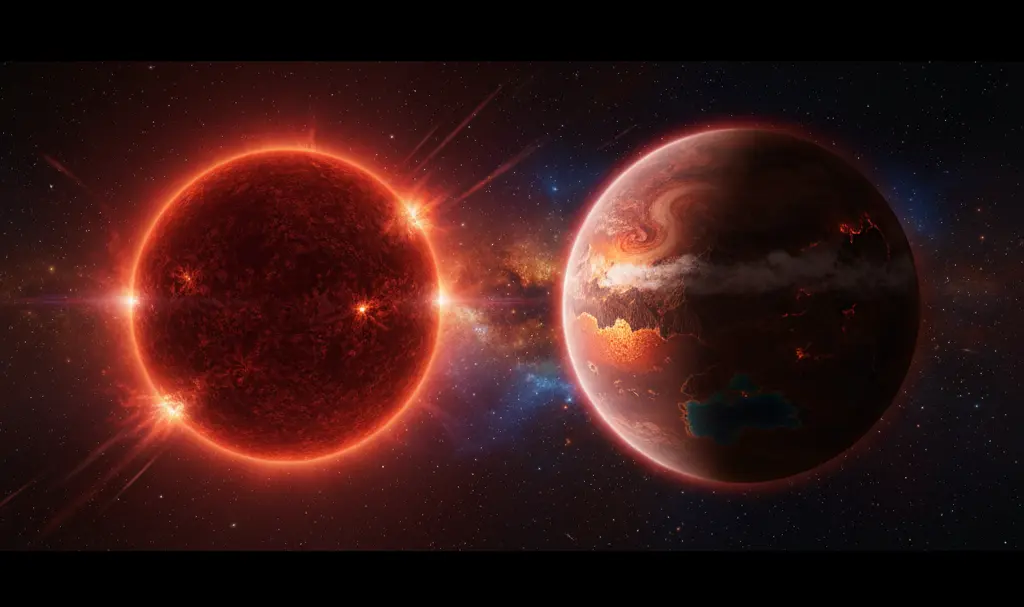
Just 18 light-years from Earth, astronomers have made a groundbreaking discovery: GJ 251c. This rocky “super-Earth” is approximately four times more massive than our planet and orbits a nearby red dwarf star. While scientists do not yet know the exact composition of its atmosphere or whether liquid water flows on its surface, early climate simulations indicate that it is one of the most promising nearby worlds in the ongoing search for extraterrestrial life.

Where is the Super-Earth GJ 251c Located?
GJ 251c orbits the star GJ 251, a cool M-type red dwarf situated approximately 18 light-years (about 5.5 parsecs) away in the constellation Gemini. To put this into perspective, on a cosmic scale, this planetary system is practically our next-door neighbor.
Key characteristics of GJ 251c include:
- Mass: Estimated to have a minimum mass of 3.8 to 4 times that of Earth.
- Size: Roughly 1.8 times the diameter of Earth.
- Classification: A “super-Earth”—a class of rocky planets larger than Earth but significantly smaller than ice giants like Neptune.
- Orbit: It takes about 53 to 54 days to complete a full orbit around its host star.
- Distance from Star: It orbits at a distance of approximately 0.196 Astronomical Units (AU), which is much closer than Earth is to the Sun.
Although GJ 251c orbits much closer to its star than Earth does to the Sun, the red dwarf GJ 251 emits only a fraction of the Sun’s energy—roughly 1 to 2 percent of its brightness. Because of this lower energy output, the star’s “habitable zone” is pulled much closer inward. This allows GJ 251c to potentially maintain temperate climate conditions, provided it has the right atmosphere.
How Was the New Exoplanet Discovered?
Unlike stars, exoplanets are incredibly dim and easily overpowered by the glare of their host stars. Therefore, GJ 251c was not photographed directly. Instead, its existence was confirmed through highly precise measurements using the radial velocity method.
This discovery is the culmination of more than 20 years of meticulous observations. As a planet orbits a star, its gravitational pull causes the star to “wobble” ever so slightly. By analyzing the star’s light, astronomers can detect measurable Doppler shifts caused by this wobble. These subtle shifts in the light spectrum, known as radial velocity signatures, serve as definitive proof of an orbiting celestial body.
While the astronomical community frequently observes dynamic and explosive stellar events—such as when astronomers witness a planetary collision like ASASSN-21qj—the discovery of GJ 251c required decades of quiet, patient tracking.
To pinpoint the planet, scientists utilized the Habitable-zone Planet Finder (HPF) and NEID—two advanced spectrographs specifically engineered to hunt for exoplanets. The data aggregated from various observation programs allowed researchers to confidently isolate the planet’s 53.6-day orbital period and confirm the presence of this new super-Earth.
“Just Right” for Liquid Water: The Habitable Zone
The most compelling aspect of GJ 251c is its location within its host star’s habitable zone. This is the orbital region where a planet receives just enough stellar energy for liquid water to potentially exist on its surface.
Many known planets orbiting small red dwarf stars are located so close to their host that they suffer from extreme radiation or become tidally locked (where one side perpetually faces the star, roasting it, while the other freezes). GJ 251c, however, sits slightly further out. This provides an excellent compromise between receiving adequate solar energy and maintaining atmospheric stability.
“Although we cannot yet confirm the presence of an atmosphere or life on GJ 251c, this planet is a highly promising target for future studies. We have made an exciting discovery, but there is still much to learn about this world.”
— Suvrath Mahadevan, Pennsylvania State University
The Role of Atmosphere and Climate Models
Being in the habitable zone does not automatically make a planet hospitable to life. The true potential for habitability relies heavily on the planet’s atmospheric composition, density, water presence, magnetic field, and the star’s activity. Red dwarfs are notorious for frequent stellar flares, which can strip away a planet’s atmosphere over time.
Climate modeling conducted by the research team presents several potential scenarios for GJ 251c:
- Earth-like Atmosphere: The planet’s surface would likely freeze over, with average temperatures dropping below -100°C (-148°F).
- High Carbon Dioxide Atmosphere: If the atmosphere has ten times the CO2 of Earth, models suggest the presence of open liquid oceans and temperate conditions, making it highly favorable for life.
- Hydrogen-Rich Envelope: A thick layer of hydrogen would result in a “thermal hell,” trapping too much heat for life as we know it to survive.
An Ideal Target for the Search for Alien Life
Currently, the exact density, internal structure, and atmospheric makeup of GJ 251c remain a mystery. The researchers published their initial findings in The Astronomical Journal, detailing the planet’s mass, orbit, and location. However, its close proximity to Earth makes it one of the best candidates for follow-up observations.
“We have discovered so many exoplanets now that finding a new one isn’t the main hurdle. What makes this discovery particularly valuable is that its host star is close by, just about 18 light-years away. Cosmically speaking, that is practically right next door.”
— Paul Robertson, UC Irvine, Study Co-author
Because the star is relatively close and has a favorable spectral type, the angular separation between the star and the planet is wide enough that next-generation telescopes may be able to separate the planet’s reflected light from the star’s glare. Astronomy enthusiasts looking forward to using future optics to view a total solar eclipse will appreciate the massive leap in technology required to image these distant worlds.
The Future of Exoplanet Observation
If advanced instruments—such as space telescopes equipped with coronagraphs or starshades—can capture the spectrum of light reflecting off GJ 251c, scientists will be able to scan for atmospheric biosignatures. These include traces of water vapor, carbon dioxide, methane, and oxygen, which are chemical footprints of biological processes.
“The TMT [Thirty Meter Telescope, currently under construction and slated for the late 2020s] will be the only telescope with sufficient resolution to directly image exoplanets like this one. It is simply impossible with smaller telescopes.”
— Corey Beard, Lead Author of the Study
As major space agencies like NASA and the European Space Agency (ESA) bring massive new telescopes online, GJ 251c is poised to be one of the very first nearby worlds scrutinized to determine if it truly harbors oceans, a stable atmosphere, and potentially, life itself.
Frequently Asked Questions (FAQ)
Why is the radial velocity method crucial for discovering exoplanets like GJ 251c?
The radial velocity method allows astronomers to detect planets that do not transit directly in front of their host stars from our perspective. By measuring the minute gravitational “wobble” a planet induces on its star, scientists can accurately determine the planet’s minimum mass and orbital period, even when the planet is entirely invisible to direct imaging.
How do stellar flares from red dwarf stars impact the habitability of super-Earths?
Red dwarf stars are highly active and frequently emit powerful ultraviolet and X-ray flares. Over billions of years, this intense radiation can slowly strip away a nearby planet’s atmosphere and vaporize surface water. For a planet like GJ 251c to remain habitable, it likely needs a strong magnetic field to deflect stellar winds and retain a thick protective atmosphere.
What role will next-generation telescopes like the Thirty Meter Telescope (TMT) play in studying GJ 251c?
Current telescopes lack the optical resolution to separate the faint light of GJ 251c from the overwhelming glare of its host star. Next-generation extremely large telescopes (ELTs) like the TMT will utilize advanced adaptive optics and coronagraphs to block the star’s light. This will allow scientists to directly image the planet and analyze its atmospheric spectrum for biosignatures like oxygen and methane.
Source: NASA, Space, Earthsky, University of California News, Gizmodo, ScienceAlert & Opening photo: Gemini
About Post Author
