

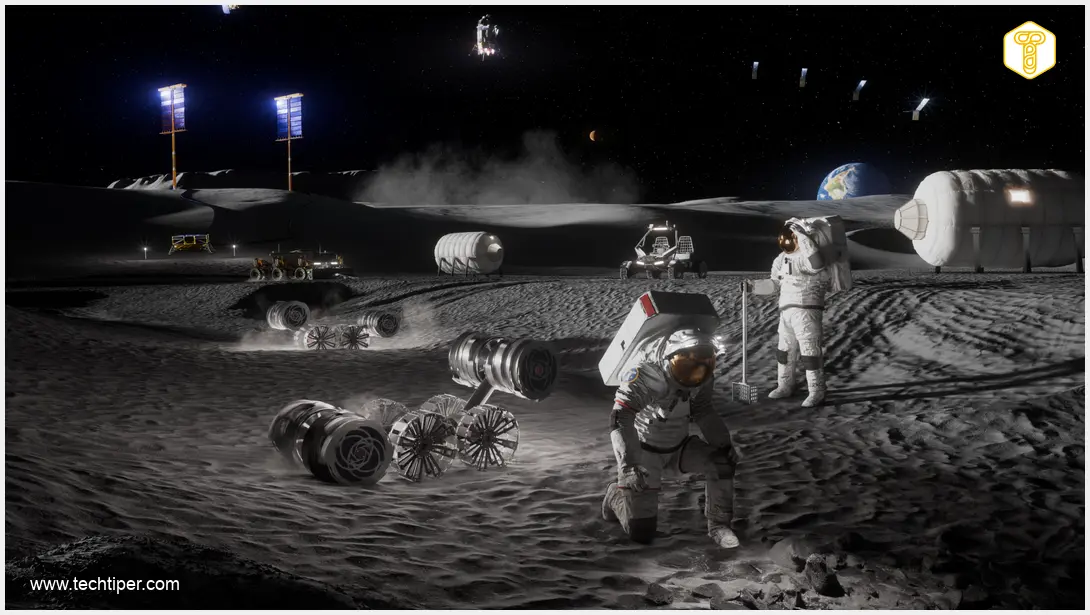
NASA has announced a major return to lunar exploration, initiating the first phase of constructing a permanent base on the Moon. This ambitious undertaking includes awarding contracts worth nearly a billion US dollars to four American space companies. The agency anticipates monthly lander missions starting from 2027, with the ultimate goal of establishing a base at the Moon’s south pole that could eventually rival the size of a large city. Here are the detailed plans.
Contents
NASA’s Ambitious Lunar Base Project Takes Shape
A Radical Shift in Strategy
NASA is fundamentally changing its approach to lunar exploration. The agency is moving away from the previously planned orbital Gateway station and instead prioritizing the construction of a full-fledged crewed base directly on the lunar surface. Resources originally allocated for the Gateway project will now be redirected to support the development of this surface base as part of the broader Artemis program.
Existing components and technologies from the abandoned Gateway project will be repurposed for the construction of this new US lunar base, estimated to cost 20 billion US dollars. The agency plans for the base to be operational within the next seven years. The entire development plan is structured into three distinct phases.
Key Contracts Awarded for Lunar Rovers and Drones
To kickstart this ambitious endeavor, NASA has awarded significant contracts to several leading aerospace companies:
- Astrolab: Received 219 million US dollars for the development and delivery of the initial phases of Lunar Terrain Vehicles (LTVs).
- Lunar Outpost: Awarded 220 million US dollars, also for the development and delivery of LTVs.
- Firefly Aerospace: Contracted to provide the first set of lunar drones.
- Blue Origin: Secured a contract worth 188 million US dollars for the delivery of landers to the Moon’s surface.
All these critical pieces of equipment are slated to reach the Moon before the first crewed Artemis missions, which are currently scheduled for 2028.
Phase 1: Establishing Foundational Infrastructure (2026-2029)
The initial phase of the lunar base construction program spans from now until 2029. Its primary focus is on intensive technology testing and the delivery of essential infrastructure to the Moon’s surface. The inaugural mission for this phase, dubbed “Moon Base 1,” is provisionally scheduled for autumn 2026.
Starting in 2027, robots and rovers are expected to land on the Moon almost every month as part of the Commercial Lunar Payload Services (CLPS) program. This first phase anticipates 21 landings, which will collectively deliver approximately 4 metric tons of cargo. Additionally, two telecommunication satellites will be deployed to aid in navigation and communication across the lunar landscape.
Phase 2: Building Permanent Lunar Habitats (2029-2032)
This second phase of the program covers the period from 2029 into the early 2030s. The emphasis here is on building permanent infrastructure, including the establishment of a robust power grid on the Moon’s surface. During this phase, NASA projects 27 landings, delivering a total of 60 metric tons of equipment to the lunar surface. The goal is to create early “semi-habitable” infrastructure and secure a specific location for the future permanent base.
Phase 3: Towards Permanent Human Habitation (2032-2036)
The third and final phase, spanning from 2032 to 2036, signifies a pivotal transition from periodic human expeditions to continuous human residency on the Moon. This phase will leverage high-capacity landing systems to deliver a substantial 150 metric tons of cargo to the surface.

Key deliveries during this phase will include multipurpose habitats provided by the Italian Space Agency (ASI) and a Canadian utility vehicle. Ultimately, the base is designed to support four-person crews during four-week missions and evolve into a self-sufficient outpost. It will feature an “industrial district” enabling the on-site production of materials, reducing reliance on Earth-based supplies. This international collaboration highlights the global effort to return to the Moon, with countries like Poland also contributing significantly to the broader Artemis program, such as in the Artemis II mission.
The Lunar Race: China vs. USA
While NASA accelerates its lunar ambitions, the United States is in a burgeoning space race with China, which also harbors extensive plans for lunar exploration and settlement. China, in collaboration with Russia, aims to complete a basic model of its International Lunar Research Station (ILRS) by 2035. Both global powers are targeting the Moon’s south pole, a region believed to hold the largest reserves of water ice, crucial for sustaining human life and facilitating in-situ resource utilization.
The basic model of China’s ILRS at the south pole is intended to be operational by 2035, with significant expansion planned over the subsequent decade. This expansion aims to ensure long-term usability and self-sufficiency, reducing dependence on supplies from Earth. A critical component of the Sino-Russian ILRS base will be a nuclear reactor, providing a stable and powerful energy source for the outpost. China’s National Space Administration is preparing to send astronauts to the Moon before 2030, a timeline that suggests China could potentially land humans on the Moon earlier than the United States, intensifying the competition in lunar exploration.
Beyond government-led initiatives, private sector innovators are also pushing the boundaries of space technology. Visionaries like Elon Musk, for instance, are driving advancements in areas like manufacturing and AI, with projects such as the Terafab semiconductor factory in Texas, which could indirectly contribute to the technological prowess needed for future space exploration and robotics.
Frequently Asked Questions (FAQ)
What is the main objective of NASA’s new lunar strategy?
NASA’s primary objective is to transition from a planned orbital Gateway station to establishing a full-fledged, permanent human base directly on the Moon’s surface as part of the Artemis program, enabling sustained human presence and scientific exploration.
How much is NASA investing in the initial phase of lunar base construction?
NASA has awarded contracts worth nearly a billion US dollars (specifically, 917 million US dollars mentioned across various contracts) to four American space companies for developing and delivering crucial components like lunar rovers, drones, and landers.
What role will the Commercial Lunar Payload Services (CLPS) program play in establishing the Moon base?
The CLPS program is crucial for Phase 1, starting in 2027, with almost monthly missions. It involves 21 landings to deliver approximately 4 metric tons of cargo, along with telecommunication satellites, to the lunar surface, providing essential infrastructure and testing capabilities.
What are the key differences in the long-term lunar strategies of the USA and China?
Both the USA (Artemis program) and China (International Lunar Research Station – ILRS with Russia) aim for permanent human presence at the Moon’s south pole to access water ice. A key difference lies in their immediate timelines and proposed infrastructure. China aims for a basic ILRS model by 2035 with a nuclear reactor for power and potentially a crewed landing before 2030, possibly preceding the US. NASA’s plan is phased for a self-sufficient base by 2036, with crewed landings projected for 2028.
Source: NASA, Science Alert, The Register, Interesting Engineering.
Opening photo: NASA
About Post Author
