

Contents
Revolutionizing Space Exploration: NASA’s Next-Gen Rover, Ernest
Future missions to Mars and the Moon are poised for a dramatic transformation, moving beyond the capabilities of current technology. NASA is at the forefront of this evolution, actively testing a groundbreaking new rover prototype designed to navigate extraterrestrial terrains with unprecedented speed and agility. This advanced vehicle promises to redefine how we explore distant celestial bodies.
Overcoming Current Rover Limitations
For decades, Mars exploration has relied on increasingly sophisticated robotic rovers. While these machines have yielded invaluable scientific data, they operate under significant constraints. Key challenges include their relatively slow maximum speeds, which limit the area they can cover, and their difficulty in traversing demanding landscapes filled with rocks, deep sand, and steep inclines. These factors often necessitate extensive remote planning and slow, deliberate movements, hindering the pace of discovery.
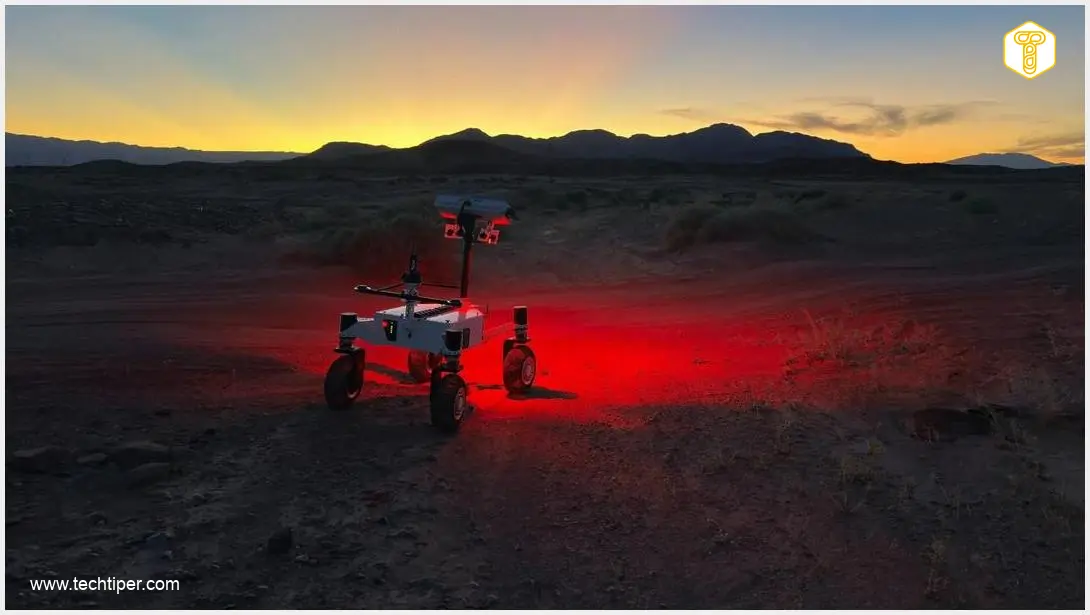
Recognizing these limitations, NASA has unveiled significant progress on an experimental vehicle named the Exploration Rover for Navigating Extreme Sloped Terrain (Ernest). This innovative project is being developed with future Mars and Moon missions in mind, aiming to enable the exploration of vast distances with reduced reliance on direct, real-time control from Earth-based operators.
Ernest: A Leap in Rover Technology
The Ernest prototype is currently undergoing rigorous testing in the arid, desert environments of Colorado in the United States, simulating the challenging conditions found on other planets. During a recent series of trials, Ernest successfully covered approximately 26 kilometers (about 16 miles) over seven test days, operating for a total of more than 37 hours. Crucially, it achieved a maximum speed of about 1 kilometer per hour (0.6 mph), a significant improvement over the operational speeds of existing Martian rovers. The current iteration of Ernest is a four-wheeled vehicle, measuring approximately 1.2 meters (about 4 feet) in length.
Active Suspension: The Game-Changer
The most pivotal innovation in the Ernest prototype is its active suspension system. Traditional Martian rovers, such as Perseverance and Curiosity, utilize a passive “rocker-bogie” suspension. While this design is highly effective at distributing the vehicle’s weight and maintaining stability over uneven ground, it inherently limits maneuverability and speed. The rocker-bogie system, with its six wheels, is designed to keep all wheels on the ground and allow the rover to climb over obstacles up to a certain height, but it does so slowly and deliberately.
In contrast, Ernest’s active suspension allows each of its four wheels to be independently lifted and positioned. This revolutionary capability means the rover can not only avoid obstacles but also actively drive over them with greater ease. NASA engineers are exploring various novel modes of locomotion, including movements that resemble crawling or “walking” on its wheels. These advanced strategies are designed to dramatically enhance the rover’s ability to operate effectively in terrains that are currently impassable for existing rovers.
Furthermore, Ernest’s design allows for the seamless transition between active and passive suspension modes, optimizing performance based on the specific terrain and energy requirements of a given task. Adding to its agility, all four of Ernest’s wheels are steerable, providing unparalleled directional control. These advancements are crucial for missions that require traversing large, complex areas and for facilitating potential human exploration efforts on the Moon, such as those envisioned by the Artemis program. Learn more about international contributions to the Artemis program here.
A Vision for Autonomous Exploration
NASA initiated the Ernest program in 2022, and since then, several prototype versions have been developed. Engineers have meticulously tested nearly a dozen different suspension configurations to refine the system. The latest iteration of the vehicle incorporates more advanced autonomous decision-making capabilities, enabling it to make smarter choices about its path and actions without constant human intervention. This push towards greater autonomy is a significant step towards enabling future missions where communication delays with Earth make real-time remote control impractical, especially for missions deeper into the solar system.
The ultimate objective of the Ernest project is to engineer a new generation of rovers that can explore expansive regions of other worlds faster, more efficiently, and with significantly greater independence than their predecessors. This paves the way for ambitious goals, from discovering signs of ancient life on Mars to establishing sustainable human outposts on the Moon. Advanced robotics and AI are at the heart of this future. Discover how AI and robotics are transforming other industries, including space.

Frequently Asked Questions (FAQ)
Current Mars rovers are limited by their relatively slow speeds and their difficulty in traversing challenging terrains such as steep slopes, deep sand, and large rock fields. These limitations restrict the total area they can explore and require extensive, time-consuming remote operation from Earth. Ernest addresses these by offering higher speeds, superior obstacle negotiation through active suspension, and increased autonomy.
The “rocker-bogie” system is a passive design that focuses on weight distribution and stability, allowing rovers to slowly climb over obstacles while keeping all wheels on the ground. Ernest’s active suspension, however, allows each wheel to be independently controlled and lifted. This enables the rover to actively “step” over or onto obstacles, employ novel movement techniques like crawling, and adapt its stance to navigate much more complex and inaccessible terrains.
Increased speed and autonomy are crucial for future missions, especially those requiring coverage of larger areas or operating in regions with significant communication delays (e.g., deeper into the solar system). Faster traversal allows for more ground to be covered and more scientific data to be collected. Enhanced autonomy reduces the need for constant human intervention, making missions more efficient and enabling operations in environments where real-time control is impractical, ultimately accelerating discovery.
Absolutely. The advancements in active suspension, enhanced mobility, and increased autonomy developed for Ernest are highly relevant for supporting human exploration. Such rovers could scout ahead for safe paths, transport equipment and supplies, assist in site preparation for habitats, and explore areas too dangerous or difficult for astronauts to reach directly, significantly extending the capabilities and safety of human missions.
Source: Engadget, original content. Opening photo: NASA / press materials.
About Post Author
