

Contents
GJ 3378b: A Potentially Habitable ‘Super-Earth’ Just 25 Light-Years Away
Just 25 light-years from Earth, within a region where liquid water could theoretically exist, orbits GJ 3378b – a potentially habitable “super-Earth.” Scientists are now scrutinizing this intriguing exoplanet, but more questions currently outweigh the answers. One of the primary unsolved mysteries is the nature of the planet’s atmosphere – or, indeed, if it possesses one at all.
The Closest Candidate for a Second Earth
GJ 3378b (Gliese 3378b) is a rocky exoplanet classified as a “super-Earth.” Its diameter is roughly twice that of our planet, and its mass, after recent corrections, is approximately 2.3 times the mass of Earth.
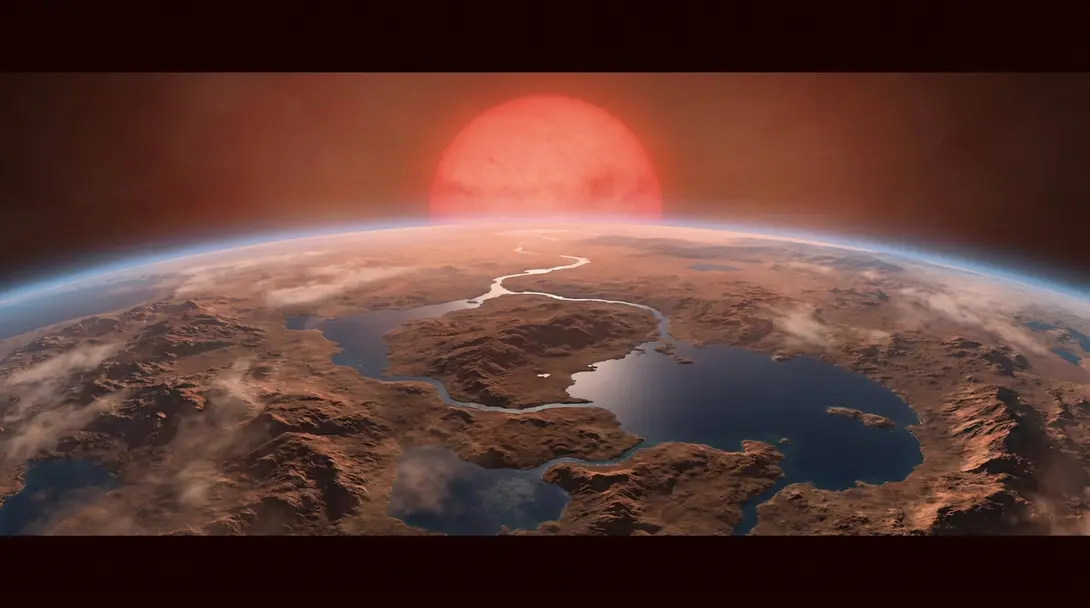
This celestial body orbits GJ 3378, a cool red dwarf star located in the constellation Camelopardalis (the Giraffe). At a distance of about 25 light-years from our Solar System, it stands as one of the closest known worlds situated within a star’s habitable zone.
“This is one of our closest cosmic neighbors. Twenty-five light-years sounds like a long distance, but the Milky Way is about 100,000 light-years in diameter, so in that respect, it’s our next-door neighbor.”
— Paul Robertson, Professor of Astronomy at the University of California, Irvine, lead author of the study
GJ 3378b completes an orbit around its star in approximately 21.45 Earth days. The planet receives about 90% of the stellar radiation that Earth receives from the Sun, placing it comfortably within the zone favorable for the existence of liquid water on its surface – provided it possesses a suitable atmosphere.
Researchers Refine Understanding of the Planet
GJ 3378b was initially reported in 2015 as a planet with a minimum mass of approximately 5.3 Earth masses. However, new analyses of radial velocity and photometric data have significantly revised its parameters. Recent astronomical observations often lead to such refinements as data collection and analysis techniques improve.
A team of researchers from the University of California, Irvine, and other institutions published their peer-reviewed findings in The Astrophysical Journal. Their work demonstrated that the planet’s actual minimum mass is closer to 2.3 Earth masses, and its orbit is nearer to its star than previously thought. Crucially, these updated parameters still firmly place the planet within the habitable zone.
The authors describe GJ 3378b as an object residing on the “cosmic shoreline.” This concept connects a planet’s mass, density, and radiation levels to estimate whether it can retain an atmosphere or if its atmosphere would be stripped away by stellar winds.
“If we were to shrink Earth down to the size of an apple, its atmosphere would be about as thick as the apple skin. That’s enough to maintain surface pressure that allows for liquid water.”
“That’s enough to have breathable air, and it provides perhaps a little bit of protection from harsh cosmic radiation.”
— Paul Robertson, Professor of Astronomy at the University of California, Irvine, lead author of the study
In the case of GJ 3378b, it is classified among super-Earths that are massive enough to potentially retain an atmosphere and water, yet not so large as to accumulate a crushing, thick gaseous envelope that would preclude surface habitability.
Does GJ 3378b Have an Atmosphere?
For GJ 3378b to host liquid water, an atmosphere would need to exist, providing adequate protection from the radiation emanating from its nearby red dwarf star. Unfortunately, there is currently no direct evidence confirming the presence of an atmosphere around GJ 3378b. Current telescopes lack the capability to definitively measure the chemical composition and pressure profile of gases around such a small, relatively cool planet located tens of light-years away.

Consequently, the study’s authors emphasize that while GJ 3378b is a “potentially habitable world,” it is not yet a planet where life has been proven to exist. Rather, it represents a highly promising target for future astronomical observations and characterization. Advancements in space technology, like those contributing to missions such as Artemis, will be crucial for pushing the boundaries of exoplanet research.
At current spacecraft speeds, a journey from Earth to a planet 25 light-years away would take thousands, even tens of thousands, of years. Such interstellar travel remains far beyond our present technological capabilities, requiring entirely new propulsion systems and multiple generations to complete the voyage.
The vast distance separating us from GJ 3378b – approximately 237 trillion kilometers (about 1.5 million times the Earth-Sun distance of 150 million kilometers) – underscores this challenge. For the foreseeable future, the most realistic approach remains the remote characterization of such worlds from Earth-orbiting observatories.
Frequently Asked Questions (FAQ)
GJ 3378b is classified as a “super-Earth” because it is a rocky exoplanet with a mass greater than Earth’s but significantly less than that of the gas giants in our Solar System. Specifically, it has about 2.3 times the mass of Earth and roughly twice its diameter.
An atmosphere is crucial for several reasons: it can maintain surface pressure allowing liquid water to exist, it provides thermal insulation to regulate temperature, and it can offer protection from harmful stellar radiation. Without a suitable atmosphere, liquid water would likely evaporate or freeze, making the planet uninhabitable despite being in the habitable zone.
The “cosmic shoreline” is a theoretical concept that helps scientists predict whether a planet can retain its atmosphere. It considers factors like a planet’s mass, density, and the intensity of radiation it receives from its host star. Planets like GJ 3378b are on this “shoreline” where they are massive enough to hold onto an atmosphere but not so massive that they become gas giants, making them prime candidates for further study regarding habitability.
Direct travel to GJ 3378b is currently impossible. Future studies will rely on advanced space-based telescopes and spectroscopic analysis. Instruments like the James Webb Space Telescope (JWST) and upcoming next-generation telescopes are designed to detect atmospheric components of exoplanets by observing how stellar light passes through or is reflected by their atmospheres, allowing scientists to infer composition, temperature, and pressure without needing to visit the planet directly.
Source: NASA, McDonald Observatory, SciNews, Futurism, UC Irvine News. Opening photo: Gemini.
About Post Author
