

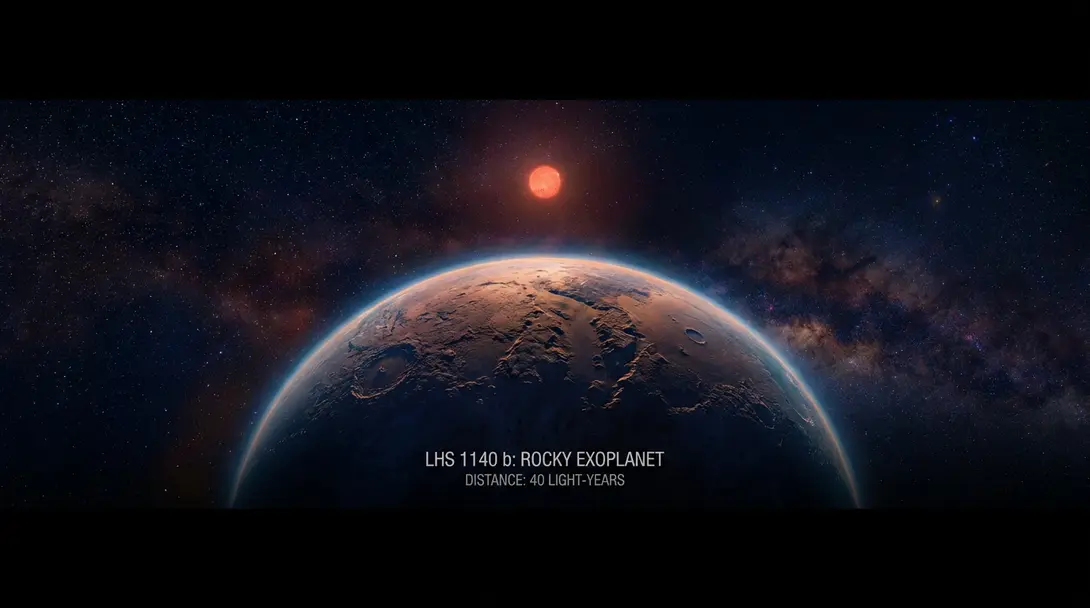
The quest for life beyond our solar system has reached a pivotal new stage. For the very first time, astronomers have confirmed the existence of an atmosphere around a rocky exoplanet located within its star’s habitable zone. This groundbreaking discovery offers unprecedented insights into the potential for life on worlds far beyond Earth.
Contents
First Confirmed Atmosphere Detected Around a Rocky Exoplanet
Astronomers have achieved a significant breakthrough concerning the exoplanet LHS 1140 b. Situated approximately 48 light-years from Earth, this celestial body orbits a red dwarf star. Its position within the star’s habitable zone – the region where conditions might allow for liquid water to exist on a planet’s surface – has long captivated researchers.
The findings, published in the esteemed journal Science, indicate the first successful detection of a helium-rich atmosphere enveloping a rocky exoplanet of this type. This achievement represents a crucial step forward in the study of Earth-like planets and their potential to harbor life. The detection of an atmosphere is a fundamental requirement for understanding a planet’s climate and its capacity to sustain biological processes.
This discovery builds on decades of exoplanet research, which has identified thousands of worlds outside our solar system. However, confirming the presence and composition of atmospheres, especially on rocky planets, remains a significant challenge. For instance, the dynamic nature of planetary systems, as exemplified by events like astronomers witnessing a planetary collision, underscores the complex processes shaping these distant worlds.
How Scientists Unveiled LHS 1140 b’s Atmosphere
The new data was gathered as the exoplanet transited, or passed in front of, its host star from our perspective. During this event, light from the star filters through the planet’s atmosphere, allowing scientists to analyze its chemical composition.
The observations utilized the Warm Infrared Echelle Spectrograph (WINERED), a highly sensitive instrument capable of detecting specific elements. This advanced spectrograph enabled researchers to identify helium escaping from the planet’s atmosphere into space. Interestingly, prior to these findings, scientists had theorized that LHS 1140 b’s atmosphere might be predominantly composed of nitrogen.
The ability to detect such subtle atmospheric signatures is a testament to significant advancements in astronomical instrumentation and observational techniques. Efforts like those contributing to missions such as Poland’s contribution to the Artemis II mission and broader space industry highlight the global commitment to pushing the boundaries of space exploration and scientific discovery.
LHS 1140 b: A World of Enduring Mysteries
LHS 1140 b is considerably larger than Earth. It boasts a mass approximately 5.6 times that of our planet, and its radius is nearly 70% greater. Despite these differences, it is still categorized as a rocky exoplanet and continues to be one of the most compelling candidates for further investigation into conditions conducive to life.
Scientists hypothesize that vast oceans could potentially exist on the planet’s surface, though definitive evidence to confirm this theory is currently lacking. Similarly, many questions persist regarding the actual composition of its atmosphere, which is most likely quite different from Earth’s.

Researchers emphasize that continued observations using a variety of instruments will be essential for a more comprehensive understanding of LHS 1140 b. Only through more detailed analyses will it be possible to precisely determine the atmospheric composition, verify the presence of water, and ultimately assess whether this exoplanet truly offers conditions favorable for the emergence or sustenance of life.
Frequently Asked Questions (FAQ)
Detecting an atmosphere around a rocky exoplanet in its star’s habitable zone is a monumental step in the search for extraterrestrial life. An atmosphere is crucial for regulating planetary temperature, protecting against radiation, and potentially harboring the conditions necessary for liquid water and biological processes. This discovery provides a tangible target for further study regarding habitability.
The habitable zone, often called the “Goldilocks zone,” is the region around a star where conditions are just right for liquid water to exist on a planet’s surface. This is considered vital for life as we know it. LHS 1140 b’s location within its red dwarf star’s habitable zone means it receives an appropriate amount of heat, making it a prime candidate for further investigation into life-supporting conditions.
Despite this breakthrough, significant challenges remain. Scientists need to conduct further observations to precisely determine the full atmospheric composition, as only helium has been detected so far. Verifying the presence of liquid water, understanding the planet’s surface conditions, and assessing long-term atmospheric stability are critical next steps to truly evaluate LHS 1140 b’s potential for hosting life.
Source: Notebookcheck
Opening photo: Gemini
About Post Author
