

Contents

Run Robotics Unveils Centaur-Inspired Robot for Extreme Environments
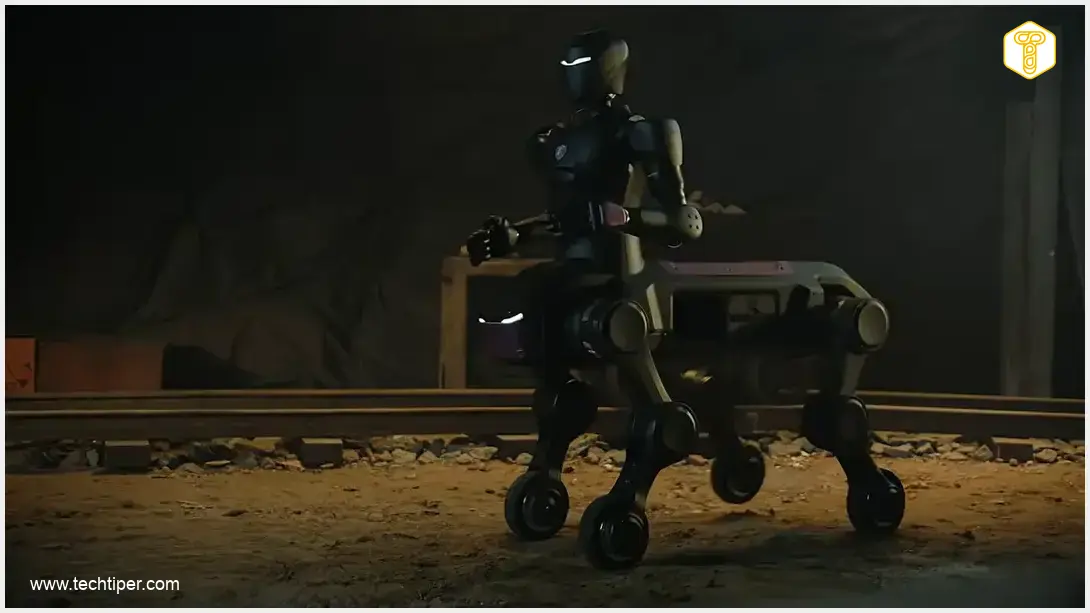
Shanghai-based Run Robotics has introduced a groundbreaking centaur-like robot, a marvel of engineering that merges a humanoid upper body with a distinctive four-legged, wheeled base. This innovative machine is specifically designed to tackle difficult terrains, transport heavy loads, and operate in perilous settings such as mines, industrial facilities, and emergency rescue operations. The robot made its debut at the World Artificial Intelligence Conference 2026 in Shanghai.

A Hybrid Design for Superior Performance
Humanoid Dexterity Meets Wheeled Mobility
Run Robotics presents its creation as the world’s first hybrid “centaur” robot, although similar designs have been explored by research institutions globally, like the European CENTAURO robot, which also features four wheeled legs and a humanoid upper body. However, Run Robotics distinguishes its project through its strong focus on industrial applications and its readiness for mass production.
The robot’s design features a human-like upper torso complete with two mechanical arms. Instead of traditional legs, it moves on four wheels, offering several advantages. This wheeled locomotion allows it to travel faster, consume less energy, and navigate uneven terrain more effectively than purely legged robots.
Robust Capacity and Modular Versatility
According to the manufacturer, this robotic platform can continuously carry between 100 to 120 kilograms (approximately 220 to 265 pounds), with a maximum static load capacity of 210 kilograms (about 463 pounds). Its modular construction is a key feature, enabling it to be equipped with a variety of tools and functionalities, including two robotic arms, grasping hands, force sensors, and specialized toolkits tailored for specific tasks.
Engineered for the World’s Most Challenging Workplaces
Run Robotics engineered this machine to operate in environments that are often unsafe or inaccessible for humans. The robot is intended for deployment in critical sectors such as mines, oil fields, smelters, power plants, chemical facilities, and disaster zones.
In these hazardous settings, the robot could perform a range of vital tasks autonomously or semi-autonomously. This includes monitoring pipelines, reading gauges, operating valves, transporting equipment, or clearing obstacles. During fires and rescue missions, it could serve as an invaluable vanguard, entering dangerous zones before human responders to relay critical information about the situation back to emergency services.
Run Robotics also asserts that the robot’s design adheres to strict requirements for operation in explosive atmospheres. However, independent test results confirming the robot’s efficacy and safety under real-world industrial conditions have not yet been presented. This commitment to safety and capability underscores a broader trend in robotics, as seen in developments like Amazon investing in child-sized robots for new era homes, where specialized robots are being designed for specific, often challenging, environments.
Advanced Navigation and Intelligence
The centaur robot is equipped with Run Robotics’ proprietary environment recognition system. This sophisticated system integrates LiDAR technology, depth-sensing cameras, and an advanced vision system to perceive its surroundings comprehensively.
The data gathered by these sensors allows the robot to accurately identify people, obstacles, pipelines, valves, and measurement instruments. This perception capability enables the system to then plan optimal routes, circumvent obstacles, and precisely pinpoint locations where tasks need to be performed.
However, the extent to which the robot can operate fully autonomously versus requiring operator control or supervision remains unclear. The manufacturer has also not disclosed pricing details or specific battery life performance on a single charge.
Localized Production and Future Outlook
Run Robotics emphasizes its commitment to local supply chains, stating that over 95% of the machine’s components are sourced from Chinese suppliers. The company has strategically established its research, development, and production facilities within Shanghai’s Zhangjiang Science City, a hub for technological innovation.
An automated assembly line for the robot is projected to be completed in the fourth quarter of 2026. The manufacturer has also confirmed securing initial commercial orders, although specific client names and the number of contracted units have not been publicly revealed. The commercialization of such advanced robotic systems for industrial use reflects significant advancements, paralleling the revolution in transport with commercial robotaxis arriving in Europe, indicating a growing trust and integration of autonomous technologies across various sectors.
Frequently Asked Questions (FAQ)
While similar “centaur” robot designs have been explored, Run Robotics distinguishes its robot by its strong focus on industrial applications and its advanced stage of preparation for mass production, aiming for widespread commercial deployment in hazardous environments.
The robot is designed to perform tasks such as monitoring pipelines, reading gauges, operating valves, transporting equipment, clearing obstacles, and relaying critical information during emergency response in locations like mines, oil fields, chemical plants, and disaster zones.
The robot utilizes an advanced environment recognition system combining LiDAR technology, depth-sensing cameras, and a vision system. This allows it to identify objects like people, obstacles, and industrial equipment to plan routes and execute tasks.
While Run Robotics states that the robot meets requirements for explosive atmospheres, independent test results confirming its efficacy and safety under real-world industrial conditions have not yet been publicly presented.
Source: Cyfrowa RP
Opening photo: RunRobotics / YouTube (screenshot)
About Post Author
