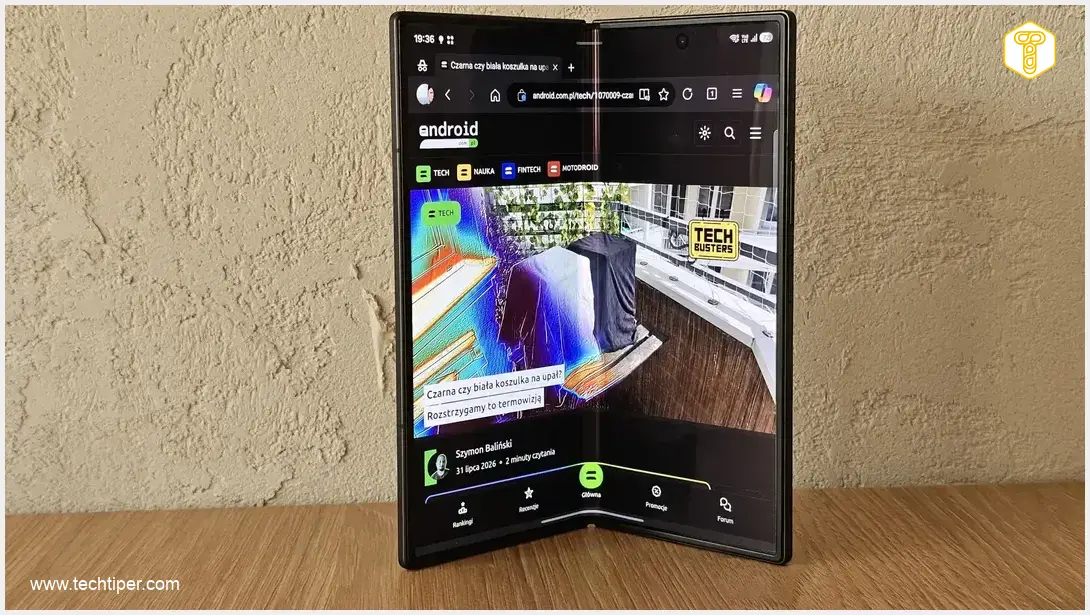
My pockets have hosted a fair share of smartphones over the years, including the foldable Samsung Galaxy Z Fold4. Back then, I thought that after four generations, it might finally be the right time to embrace this type of device. Oh, how wrong I was. So wrong, in fact, that I didn’t give Samsung’s foldables another chance until four years later, with the purchase of the Galaxy Z Fold8 Ultra.
Contents
From Fold4 Failure to Fold8 Ultra: Has Samsung Mastered the Foldable?
A Catastrophic Encounter with My Galaxy Z Fold4
The Samsung Galaxy Z Fold4, released in 2022, was generally described as a “good” device. There weren’t widespread reports of problems at the time. However, I had particularly bad luck. In December of that year, I even wrote about how my Samsung Galaxy Z Fold4 broke down just 24 hours after I got it.
When I first bought the device, my initial excitement over the large, flexible screen quickly turned to disappointment. After just one day, I noticed a small bulge along the crease. This immediately raised my concerns, and as it turned out, my fears were justified. After a few more openings, the small issue escalated into a strip of dead pixels and a complete failure of the internal screen.
Reluctantly, I had to return the device. A Samsung expert assessment later confirmed that the defect was not my fault, allowing me to get a full refund. In the interim, I discovered that many other users had reported similar issues – from bulges to peeling screen protectors – and some were even forced to pay for repairs themselves, despite the malfunctions not being their fault.
This experience solidified my belief that Samsung’s Fold series was still technologically immature, vulnerable to dust, and prone to mechanical problems. At that moment, I vowed not to buy another foldable until the company perfected its design. Since then, I’ve frequently advised everyone against the Galaxy Z Fold4.
Four Years Later: Giving Foldables Another Chance
I decided to purchase the Galaxy Z Fold8 Ultra, investing a significant amount of money, because I chose to trust Samsung again after four years. I reasoned that despite the relatively minor annual updates, 48 months and four generations should be more than enough time for the Fold series to mature. Here’s what convinced me to take the plunge:
- IP48 Certification vs. IPX8: Dust Resistance Added. The Z Fold8 Ultra now boasts IP48 certification, a significant upgrade from the Z Fold4’s IPX8 rating. This means the new model offers protection against dust. The first digit (4) indicates, at least on paper, protection against solid objects larger than 1 mm. This shields the phone from larger particles like fibers or bigger grains of sand, though fine dust could still potentially enter. However, this level of protection was enough to earn my trust.
- 5000 mAh Battery: Powering Through the Day. Samsung’s presentation highlighted that the new device finally features a 5000 mAh battery, a substantial increase from the 4400 mAh capacity in the Z Fold4. Coupled with a significantly more efficient processor, this theoretically promises a satisfyingly long battery life.
- Minimally Visible Crease on the Inner Screen. On the Galaxy Z Fold4, the crease was prominent and highly visible. On the new device, I genuinely don’t perceive it. It’s practically non-existent, even when I view the screen from various angles. Moreover, the inner screen no longer looks “plastic” or as if it could be damaged by a fingernail – which was a real concern with the Galaxy Z Fold4.
- Finally, a “Normal” Outer Screen. The Z Fold4’s outer screen was practically useless. At 6.2 inches with an awkward 23.1:9 aspect ratio, it was uncomfortable to view content on. Even during my brief 24 hours with the old Fold, I was highly irritated by how it forced me to open the internal screen constantly. With the latest generation, I don’t feel that inconvenience at all.
Enhanced Durability and Design
Furthermore, it’s evident that over four generations, Samsung has significantly improved the device’s folding and unfolding mechanism. It now feels exceptionally rigid, conveying a strong sense of solidity. The tech giant has implemented a “Dual-rail hinge” system, which distributes the load across two parallel guides. Theoretically, this allows for a tighter, more enclosed hinge design, reducing the risk of screen delamination and minimizing gaps where particles could enter. Given that I live by the coast and often visit the beach, I look forward to thoroughly testing this new sealing – hopefully with positive results.
You can learn more about how Samsung has been evolving its foldable technology and responding to market demands with devices like the upcoming Galaxy Z Fold models.
Slimmer Profile for Enhanced Usability
Another factor that convinced me to trust Samsung’s foldable again is its significantly slimmer profile, though this isn’t a “must-have” for me. Still, I appreciate the 4.1 mm thickness when unfolded and a mere 8.9 mm when folded. Browsing content in any form is genuinely enjoyable on this device.

A Persistent Flaw: The Telephoto Lens
To keep things balanced, I’ll reiterate a point I shared during my first impressions of the Galaxy Z Fold8 Ultra: the telephoto lens remains a significant disappointment. Over four generations, it has seen little to no meaningful transformation. We still have a 10 MP sensor with f/2.4 aperture, 67mm focal length, 1/3.94″ sensor size, and 1.0 µm pixels. The Galaxy Z Fold4’s specifications were remarkably similar: 10 MP, f/2.4, 66mm, 1/3.94″, and 1.0µm.
It’s frankly a shame that only the focal length has minimally changed, and this alteration is practically imperceptible in real-world use. One could argue the telephoto lens is essentially identical. Photos taken with more than 5x zoom are truly subpar, and the “Ultra” moniker certainly implies higher expectations.
Frequently Asked Questions (FAQ)
Based on the author’s experience, newer models like the Galaxy Z Fold8 Ultra show significant improvements in durability, especially with added dust resistance (IP48) and a more robust hinge mechanism. While no device is indestructible, the concerns from earlier generations, such as screen bulges and delamination, appear to have been largely addressed, making them much more suitable for daily use.
Significant improvements include enhanced ingress protection (e.g., IP48 for dust and water resistance), larger battery capacities (e.g., 5000 mAh), a less visible and more durable screen crease, a more functional and “normal-sized” outer display, and a more robust Dual-rail hinge design. These collectively address many of the pain points from earlier models like the Z Fold4.
While the main and ultra-wide cameras generally perform well, the telephoto lens on models like the Galaxy Z Fold8 Ultra has seen minimal improvement over several generations. The author notes that its specifications are nearly identical to the Z Fold4, leading to subpar photo quality beyond 5x zoom and falling short of “Ultra” expectations, making it a persistent drawback.
Source: Self-developed content.
Opening photo: Adam Lulek
About Post Author