

Contents
AMD EPYC 9006: A Strategic Answer to the Global Memory Crisis
The cost of operational memory is soaring, and prospects for immediate price cuts in consumer markets are dim. This isn’t a random market fluctuation but a direct result of an intense global race for silicon manufacturing capacity. This race is primarily driven by the escalating demand for artificial intelligence (AI) computing power. In response, AMD’s latest EPYC 9006 processors are introducing a new strategy specifically designed to address the fundamental causes of this market challenge.
The Soaring Cost of Silicon: Why AI’s Appetite for Memory Impacts Everyone
All operational memory modules worldwide originate from a handful of key manufacturers, primarily Samsung, Micron Technology, and SK hynix. These factories operate with limited production capacities. The production of advanced memory chips for servers, particularly High Bandwidth Memory (HBM), yields significantly higher profit margins compared to manufacturing consumer-grade DDR5 memory for personal computers.
Despite the current difficulties, the memory market remains remarkably stable, with DRAM and HBM solutions already sold out through 2027. Server solutions, in particular, offer a consistent market demand. Consequently, manufacturers are increasingly shifting their production lines towards professional and data center markets. As an example of this trend, Micron Technology officially exited the consumer memory market in December 2025 to fully concentrate on server solutions.
These higher margins and the enormous demand for HBM directly impact consumers. When factory capacities are reserved for server infrastructure needs, the supply of memory for traditional applications drops dramatically. This reduced availability of silicon wafers in the consumer market leads to higher prices on store shelves. The industry is caught in a vicious cycle where the seemingly endless appetite of data centers for RAM directly translates into increased costs for individual customers. For a deeper look into the broader market implications, consider the struggles of the PC market and the profitability crisis facing manufacturers due to rising RAM costs.
More RAM in a Server Doesn’t Always Mean Better Performance
For years, a prevailing belief in the IT industry was that fully populating a server’s memory banks with the largest possible modules was the simplest way to boost performance. However, in an era of constrained supply and escalating costs, this approach has become astronomically expensive and can even be technologically detrimental.
Filling all available memory slots on a motherboard often forces the memory controller to switch from a 1DPC (DIMM Per Channel, one module per channel) configuration to a 2DPC (two modules per channel) mode. This transition can drastically reduce the maximum clock frequency, increase latency, and slow down data transfer rates. AMD advocates for a fundamentally different approach, prioritizing the “memory-per-core” metric. This strategy focuses on precisely balancing memory capacity and bandwidth allocated to each specific processor core, ensuring optimal efficiency rather than just brute-force capacity.
AMD EPYC 9006: A Targeted Solution to the Memory Challenge
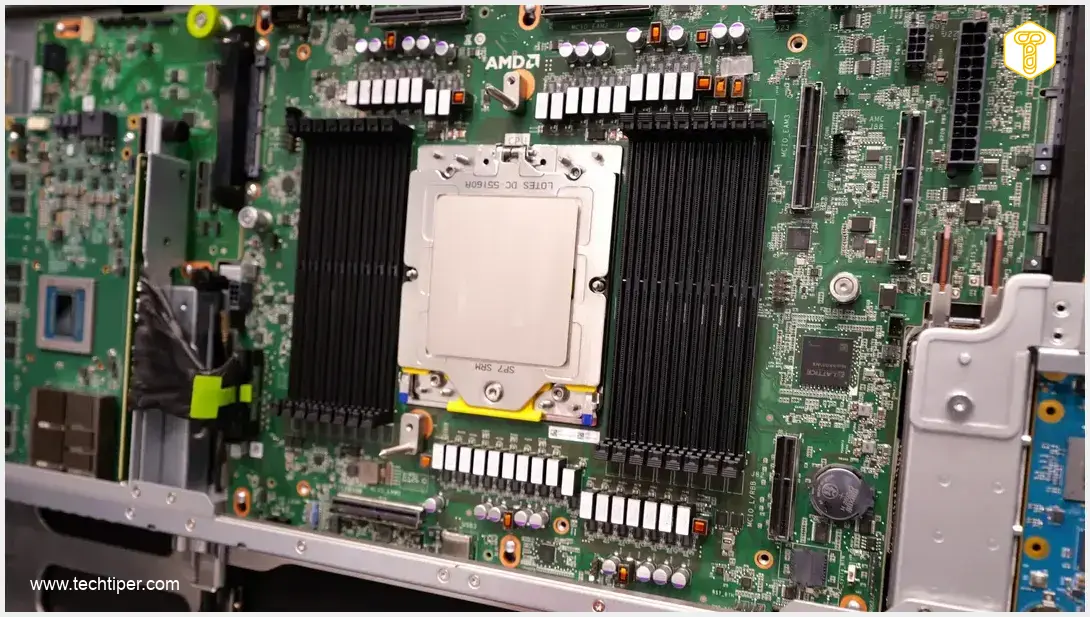
The new sixth-generation server processors, the AMD EPYC 9006 series, are a direct result of this refined strategy. Codenamed “Venice,” these processors are built on Zen 6 cores and highly dense Zen 6c cores. AMD is moving away from the concept of a single, universal processor and instead offers specialized variants tailored for specific workloads. The AMD EPYC 9006 generation includes several distinct versions:
- AMD EPYC 9006 SP7 (Venice SP7): Designed for scaling AI agents and parallel processing of multiple threads. The most powerful configurations boast up to 256 Zen 6c cores and 512 threads, supporting 16-channel DDR5 memory. The primary goal of this architecture is to maximize computational density and bandwidth.
- AMD EPYC 9006 SP8 (Venice SP8): A versatile unit created for traditional enterprise environments and virtualization. These chips offer up to 128 cores and an 8-channel memory controller, which helps to reduce the overall cost of the platform and motherboards. This represents an economical compromise for businesses that require stable performance but not extreme core density.
- AMD EPYC 9006X SP7 (Venice-X): This variant utilizes 3D V-Cache technology, making it ideal for high-performance computing (HPC) tasks. These processors offer a maximum of 96 Zen 6 cores but operate at higher clock speeds, reaching up to 5 GHz.
- AMD EPYC 9006 LP (Verano): A specialized unit dedicated to supporting AI host nodes in server racks that integrate AI accelerators, such as the AMD Helios platform.
These new processors also introduce support for PCIe Gen 6, which doubles the bus throughput compared to the previous generation to 64 Gbps per lane, and CXL 3.1 (Compute Express Link).
CXL is a critical interface that allows for low-latency sharing and expansion of operational memory directly between processors and accelerators. This means data centers no longer need to install redundant RAM modules in each server individually; instead, they can dynamically allocate resources from a shared pool. This significantly improves efficiency and reduces hardware overhead.

The AMD Helios Ecosystem and MI455X: Where Massive Memory Makes Sense
There are indeed specific areas where colossal bandwidth and memory capacity are not just beneficial but absolutely essential. Modern data centers are evolving beyond simple file storage facilities; they are transforming into genuine “AI factories.” This term describes ecosystems solely dedicated to the continuous processing of raw data into refined artificial intelligence models. In such environments, memory latency and data transfer bottlenecks can lead to significant financial losses.
AMD Helios is the answer to these demanding requirements. This impressive solution, not only in size but more importantly in capability, represents a complete, rack-scale integrated infrastructure specifically designed for intensive AI tasks.
These servers utilize next-generation AMD Instinct MI455X graphics accelerators, based on the CDNA 5 microarchitecture. Each MI455X chip is equipped with 432 GB of HBM4 memory, boasting a bandwidth of up to 19.6 TB/s. HBM is created by vertically stacking silicon dies connected by advanced interconnects. This innovative approach enables data transfer rates that are impossible to achieve with traditional DDR5 memory modules.
The centralized network structure of the Helios platform is built upon the Pensando DPU (Data Processing Unit) chip. A DPU is a dedicated auxiliary processor that offloads network traffic management, encryption, and storage management from the main CPU. This specialized solution ensures hardware isolation, high scalability, and a secure infrastructure, crucial for the demanding needs of AI workloads.
From Server Farms to Robotics: Practical and Physical Artificial Intelligence
Intelligent management of silicon resources also requires sophisticated software solutions. During the “AMD Advancing AI 2026” event, AMD unveiled its open-source ROCm.ai environment. This new platform integrates AI assistants that automatically optimize code, meticulously managing memory allocation and preventing waste at the instruction execution level.
Furthermore, the Ryzen AI Embedded X100 chips and the Kria platform demonstrate that handling physical artificial intelligence in industrial robotics or autonomous vehicles does not necessitate gigantic, resource-intensive memory setups. These precisely engineered chips are capable of making thousands of decisions per second in real-time.
These solutions collectively prove that the key to overcoming the silicon market crisis lies in architectural innovation and intelligent design, rather than simply increasing capacity without thoughtful optimization.
Optimization: The Essential Lifeline for IT and Consumers Alike
The memory market crisis is not expected to disappear overnight. Shifting the focus from excessive RAM allocation to precise architecture and advanced optimization represents the only rational path forward for the industry. AMD has effectively demonstrated that moving away from the conventional approach of simply purchasing larger memory modules is not only possible but also beneficial.
The new EPYC 9006 processors, integrated server platforms, and intelligent software solutions collectively prove that the performance of modern data centers is defined by precision and efficiency, rather than mere silicon capacity. There is considerable hope that expensive memory modules will cease to be the sole currency in the fiercely competitive race for AI computing power.
Frequently Asked Questions (FAQ)
RAM prices are high due to a global race for silicon production capacity, primarily driven by the massive demand for AI computing in data centers. Manufacturers are prioritizing high-margin server-grade memory like HBM, leading to reduced supply and increased prices for consumer-grade memory. Key manufacturers have even shifted focus away from consumer markets.
AMD EPYC 9006 processors address the crisis by moving away from simply increasing memory capacity. Instead, they focus on optimized architectures with specialized variants for different workloads, promoting a “memory-per-core” approach. They also introduce technologies like CXL 3.1, which allows for dynamic, shared memory allocation across servers, reducing the need for redundant, expensive RAM in each unit.
HBM (High Bandwidth Memory) is a type of RAM that uses vertical stacking of silicon dies to achieve significantly higher bandwidth compared to traditional DDR memory. It’s crucial for AI applications because AI models require massive amounts of data to be processed quickly. High bandwidth allows for faster data transfer to and from the processor, reducing bottlenecks and accelerating AI training and inference.
Software plays a critical role in AMD’s approach to memory optimization. Environments like ROCm.ai integrate AI assistants that automatically optimize code and manage memory allocation. This ensures that memory resources are used efficiently, preventing waste and maximizing the performance of AI workloads without relying solely on brute-force hardware capacity.
While primarily targeted at enterprises and data centers, AMD’s innovations indirectly benefit consumers by stabilizing the overall memory market. By optimizing server memory usage and promoting efficiency, these solutions reduce the insatiable demand that drives up costs for everyone. For consumers, this could eventually lead to more stable and potentially lower prices for traditional RAM as production capacity is better managed across the industry.
Source: AMD, Our Research. Opening photo: Krzysztof Wilamowski
About Post Author
