

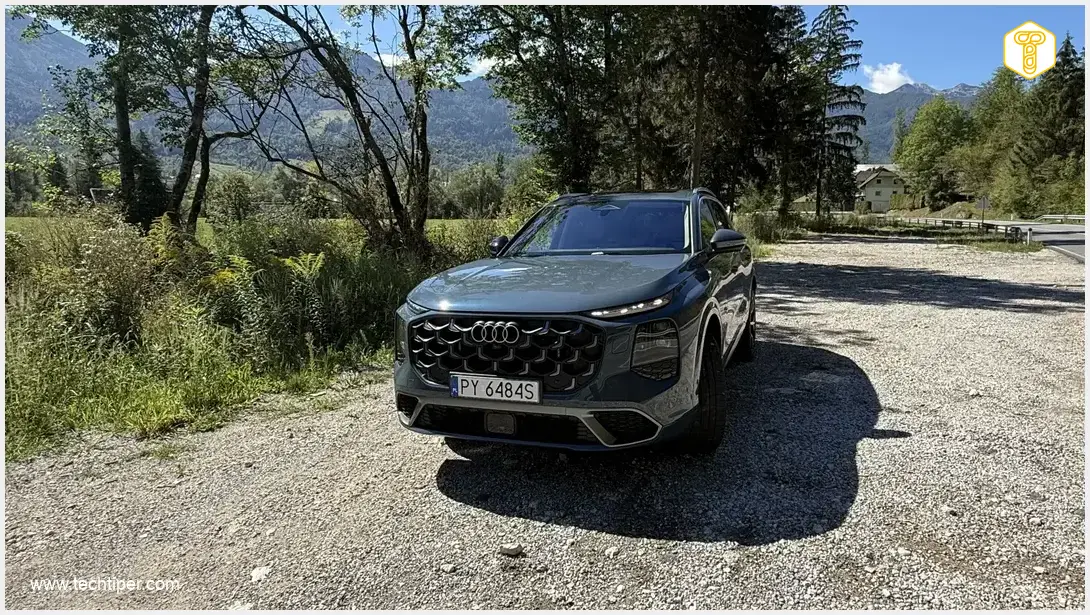
Third-Generation Audi Q7 Review
-
Exterior Design
-
Innovative Lighting Systems
-
Interior Comfort & Versatility
-
Powertrain & Performance
-
Advanced Driver Assistance & Tech
-
Value for Price (Premium Segment)
A Legacy Redefined: The Third-Generation Audi Q7
The third-generation Audi Q7 redefines its legacy with a focus on considered evolution. While maintaining its substantial luxury and capability, it truly shines with revolutionary lighting systems that enhance safety and communication. The interior offers sophisticated comfort and impressive versatility, complemented by a robust mild-hybrid diesel powertrain. Though its premium price escalates quickly with options, the Q7 delivers a meticulously refined experience for those who value advanced technology and uncompromising quality in a large SUV.
Advantages
- Revolutionary and safety-enhancing lighting systems (micro LED, OLED, ground projection).
- Luxurious, versatile, and spacious interior with flexible seating configurations.
- Robust 3.0 V6 TDI mild-hybrid powertrain for commanding performance.
- Refined driving dynamics and comfortable long-distance cruising with pneumatic suspension.
Disadvantages
- High premium price tag, which escalates significantly with optional packages.
- Some ergonomic compromises, such as touchscreen climate control airflow adjustments.
- Third-row seating is best suited for children or occasional short journeys.
Contents
A Legacy Redefined: The Third-Generation Audi Q7
For twenty years, the Audi Q7 has held its own in the fiercely competitive premium large SUV segment, consistently challenging vehicles like the Mercedes GLE, BMW X5, and Volvo XC90. Over this time, it has solidified its reputation as an SUV that needs no introduction, a benchmark of luxury and capability. The brief for the third-generation model was clear: maintain what already works impeccably while integrating cutting-edge digitalization and advanced driver-assistance systems to keep pace with an evolving market. Audi’s approach is one of considered evolution, where the most captivating advancements are not found in the engine bay, but rather in its revolutionary lighting systems.
Exterior Design: Evolution, Not Revolution
The exterior design of the new Q7 embraces refinement rather than radical change. It remains a substantial, angular SUV, but now boasts more robust proportions than its predecessor. A wider front fascia and more sculpted side panels contribute to a commanding presence. The signature Audi grille dominates the front, and the wheel arch lines are now more pronounced, adding to its muscular stance. On the road, the Q7 is unmistakable, though its design language naturally aligns with the larger Audi Q9, sharing a cohesive stylistic vision across the family lineup.
Innovative Lighting: Where Technology Speaks Volumes
It is in its lighting technology that the new Q7 truly shines, setting itself apart from many rivals. Audi has pushed boundaries in this area, offering optional headlights with micro LED modules that communicate with driver-assistance systems with remarkable precision. These lights transcend their traditional role of merely illuminating the road, becoming an integral channel for conveying crucial information to the vehicle’s surroundings.
Advanced Headlights for Enhanced Safety
Consider a practical scenario: if another vehicle enters your blind spot during a lane change, the Q7’s system can project an appropriate light pattern onto the road surface. This visual cue alerts the driver to the potential hazard even before they check their mirror. Furthermore, on roads where icy conditions are detected, the car can momentarily display a warning symbol on the pavement, proactively enhancing safety for both the driver and other road users.
Customizable Digital OLED Rear Lights
At the rear, the Q7 features digital OLED lights, offering owners the choice of several distinct light graphics. This innovation means that the appearance of the taillights is no longer uniform across all models, allowing for a degree of personalization. Additionally, these lights incorporate dynamic animations that play when entering or exiting the vehicle. While primarily a stylistic touch, this feature aligns perfectly with Audi’s long-standing philosophy: treating lighting as a critical element of brand identity, as significant as the vehicle’s silhouette itself.
Ground Projection Signals for Clearer Communication
A particularly intriguing innovation lies in the turn signals. Audi has engineered the Q7 to project indicator signals directly onto the road surface adjacent to the vehicle. This means a pedestrian waiting at a crossing or a cyclist at an intersection receives an unambiguous visual cue of the driver’s intentions before the steering wheel is even turned. Similarly, the central stop light on the rear window is projected onto the road. These solutions are designed to significantly improve the clarity of signals communicated by the car, especially in busy urban environments where every fraction of a second in reaction time from other road users can make a difference. For a broader perspective on automotive innovation, you might be interested in the Lexus LBX e-Four review or the Toyota Corolla Cross GR Sport test, which also highlight how manufacturers are responding to evolving customer needs with advanced features.
Luxurious and Versatile Interior
Stepping inside the Q7 reveals an interior that meets the high expectations of its class. The cabin is adorned with generous leather upholstery, complemented by elegant light wood inserts, creating an atmosphere of sophisticated comfort. The orderly arrangement of screens, a design familiar from Audi’s smaller models, is here presented on a larger scale, befitting the Q7’s expansive cabin.

Flexible Seating and Ample Cargo Space
The Q7 is available in five-, six-, or seven-seater configurations. Notably, the six-seater variant, featuring two individual captain’s chairs in the second row, makes its debut in this model, offering enhanced comfort for rear passengers. In its five-seater configuration, the boot capacity is a substantial 806 liters (approximately 28.4 cubic feet), expanding to over 2,000 liters (approximately 70.6 cubic feet) with the rear seats folded down. This cavernous space is more than sufficient for sports equipment, large shopping hauls, or even an adventurous road trip without requiring creative packing solutions.
As is common with most vehicles of this size, the third row of seats is primarily suited for children or for occasional, shorter journeys, rather than as a permanent seating option for adult passengers. The second row, however, offers exceptional versatility: the seats can be slid longitudinally over a considerable range, allowing each passenger to optimize their legroom without compromising the comfort of others.
Ergonomics and Thoughtful Features
While the cabin is largely impressive, not every design choice fully convinces. Adjusting the airflow direction for the climate control, for instance, is now managed via the touchscreen rather than physical rotary knobs. In practice, this translates to additional taps where a simple turn of a dial once sufficed. Far more commendable is the electric door operation: a mere press of a button or a pull of the handle causes the doors to open or close automatically. Crucially, Audi has avoided the recent trend of flush-fitting door handles, which can prove problematic in colder climates.
Robust Powertrain: The Enduring Appeal of Diesel
Upon its launch, the new Q7 is offered with the proven 3.0 V6 TDI engine, available in two power outputs: a 245 horsepower (183 kW) version delivering 500 Nm (369 lb-ft) of torque, and a more potent unit offering 299 horsepower (223 kW) and 630 Nm (465 lb-ft) of torque. Both engines are paired with an eight-speed Tiptronic automatic transmission and Audi’s permanent quattro all-wheel drive system. Enhancing this powertrain is a mild-hybrid (MHEV plus) technology, which can briefly provide an additional 24 horsepower (18 kW) boost to the internal combustion engine. An electric compressor is also employed to mitigate the typical turbo lag associated with diesel engines, an impressive feat considering the Q7 weighs well over two metric tons (approximately 4,400 pounds).
Commanding Performance and Driving Dynamics
The more powerful variant accelerates from 0 to 100 km/h (0 to 62 mph) in a swift 6.2 seconds and reaches a top speed of 235 km/h (146 mph). These figures are impressive given the Q7’s substantial size, though the vehicle itself encourages a composed rather than aggressive driving style. It excels as a comfortable, high-speed long-distance cruiser, with the pneumatic suspension effectively smoothing out road imperfections and ensuring a refined ride.
The Test Model: A Premium Price Tag
The specific Audi Q7 TDI quattro Tiptronic model I tested featured the more powerful 299 horsepower engine and was configured with nearly every available equipment package. This comprehensive list included the Comfort suspension package with rear-axle steering, the full Tech pro package with advanced driver assistance and parking systems (including remote-controlled parking assist and 360-degree cameras), an S line Exterior styling package, ambient lighting both inside and out, leather-trimmed sports seats with ventilation and massage functions, a panoramic roof, a Bang & Olufsen sound system, and a Head-up display.
Investment in Luxury and Technology
It is precisely this extensive suite of features that makes the price point so striking. While the base model starts at just over 400,000 Polish Złoty (approximately 100,000 US Dollars, subject to exchange rates), the tested configuration was ultimately valued at 619,130 Polish Złoty (approximately 155,000 US Dollars). This example clearly illustrates how quickly costs escalate in the premium segment when additional packages are selected. A Q7 so richly equipped is certainly not for those counting every penny. Instead, it is a vehicle for those who value making a significant impression, whether pulling up to a business meeting or parking at a family gathering.
Who is the Audi Q7 Truly For?
In the segment of large premium SUVs, it’s easy to find vehicles that primarily aim to impress with raw power or audacious design. The new Q7, however, takes a different approach: it focuses on the consistent refinement of every element, from its groundbreaking lighting to the consideration given to the third passenger row. It is this meticulous attention to detail and honest craftsmanship that truly stands out.
This is a vehicle for the business owner who might use it for a client meeting during the day and then pick up children from activities in the evening. It’s for the family that values spaciousness but refuses to compromise on comfort during long journeys. And it’s for anyone who appreciates a car that can communicate more to its surroundings than just a simple “I’m driving straight ahead.”
Because in this Audi Q7, light genuinely has something profound to say – and given the sophisticated segment in which it competes, that’s not something to be taken for granted.
Frequently Asked Questions (FAQ)
The third-generation Audi Q7 features advanced micro LED headlights that integrate with driver-assistance systems to project warning signals directly onto the road, such as blind spot alerts or ice warnings. It also includes customizable digital OLED taillights with unique light signatures and animations, and innovative ground-projection turn signals that communicate intentions clearly to pedestrians and cyclists.
The Audi Q7 is available in five-, six-, or seven-seater configurations. A new addition for this generation is the six-seater option, which includes two individual captain’s chairs in the second row for enhanced passenger comfort. The second-row seats are also highly adjustable for legroom.
Yes, the tested Audi Q7 included a comprehensive “Tech pro” package with advanced driver-assistance and parking systems. This includes features like remote-controlled parking assist, 360-degree cameras, and the innovative integration of the micro LED headlights for projecting safety warnings onto the road surface.
The Q7 offers a 3.0 V6 TDI engine available in two power variants: 245 horsepower (500 Nm of torque) and a more powerful 299 horsepower (630 Nm of torque) version. Both are paired with an eight-speed Tiptronic automatic transmission, quattro all-wheel drive, and mild-hybrid technology to enhance performance and efficiency.
Source: Own elaboration & Opening photo: Anna Szczepanska
About Post Author
