

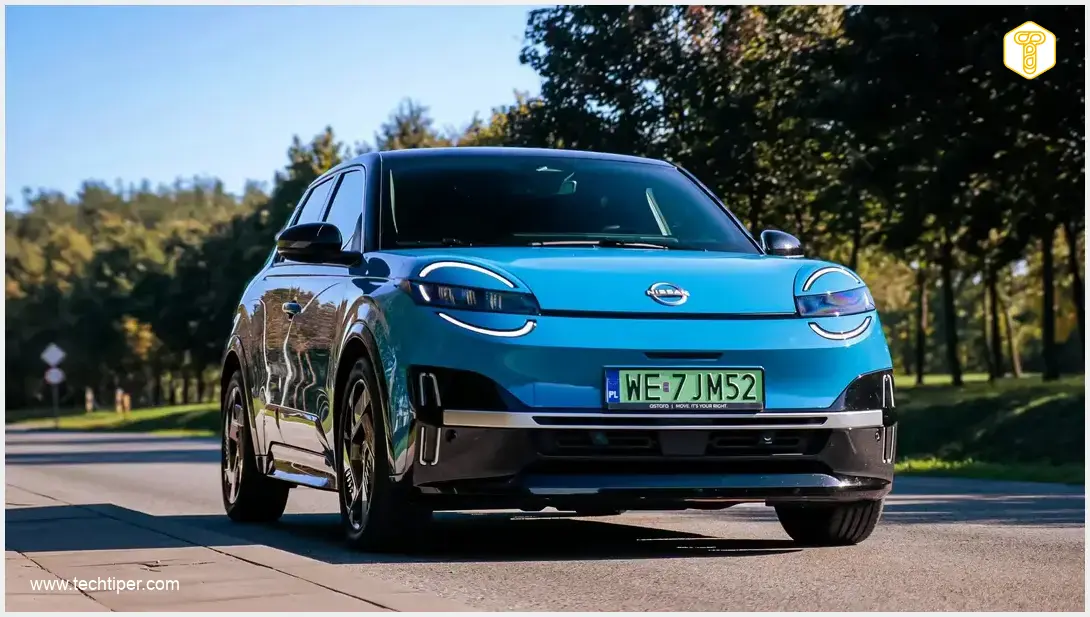
Nissan Micra K15 Electric Review
-
Infotainment & Technology
-
Interior Comfort & Design
-
Driving Dynamics & Performance
-
City Energy Consumption & Range
-
Charging Capabilities
-
Driver Assistance Systems
Nissan Micra K15: A Spirited Electric City Car with Smart Tech
The 6th generation Nissan Micra makes a strong return as an electric city car, impressing with its agile driving dynamics, excellent Google-powered infotainment, and remarkable urban energy efficiency. While its price reflects its modern EV nature, it delivers a comfortable, tech-rich experience ideal for urban living, albeit with typical city car limitations for longer journeys.
Advantages
- Excellent Infotainment with Google Services
- Agile and engaging urban driving dynamics
- Remarkable city energy consumption and range
- Comfortable front seats and quality interior design (front)
- Comprehensive and customizable driver assistance systems
- Good trunk capacity for a city car
- High-quality audio system (Harman Kardon)
Disadvantages
- Higher price compared to ICE predecessors
- Limited rear passenger space
- Lack of manual battery pre-conditioning
- Increased road/wind noise at higher speeds
- Hard plastics in rear cabin
- Rearview mirror visibility issues
We’re finally getting to test the 6th generation Nissan Micra, a car we’ve eagerly awaited. After a nearly four-year break, the Japanese automaker has brought its iconic brand back to life, but in a distinctly modern form. We’re talking about an electric vehicle, which could prove to be a sensible idea. The Micra remains a city car, where this type of powertrain truly shines.
Modernity is also evident in the completely redesigned technologies, a direct result of the platform used to underpin its cheerful body. The Nissan Micra K15 is closely related to the well-received Renault 5 E-Tech (and Alpine A290). Let’s take a closer look at what this Japanese electric city car can do. We warmly invite you to this comprehensive review of the Micra.
Contents
Price and Trim Levels
At the time of this review’s publication, Nissan offers the Micra with two powertrain options across four trim levels. Essentially, you decide whether to pay more for a more powerful motor and a larger battery. Prices are structured as follows (approximate conversions from original prices, using a general exchange rate for context, actual prices may vary by region):
- 40 kWh (122 HP):
- Engage: Starting around $30,000
- Advance: Starting around $32,500
- Evolve: Starting around $34,000
- 52 kWh (150 HP):
- Advance: Starting around $35,500
- Evolve: Starting around $37,500
- Evolve Plus: Starting around $39,500
These prices can often be reduced by promotional offers (e.g., ~$1,250), though this typically excludes the base Engage version. The pricing is competitive within the electric city car market, although naturally higher than their internal combustion engine counterparts. Nissan provides a 5-year warranty on the entire Micra, limited to 100,000 kilometers (approximately 62,000 miles). The traction battery is covered for 8 years or 160,000 kilometers (approximately 100,000 miles). Paintwork and body perforation warranties are standard, at 3 and 12 years respectively, with no mileage limit.
Insurance Cost
According to industry data, comprehensive insurance for the tested Micra for a driver with several years of experience could be around $700 annually for full coverage. Basic liability might be closer to $110. It’s always recommended to check specific quotes in your region.
Tested Model Details
The Nissan Micra tested here is the most powerful and best-equipped variant, the Evolve Plus (52 kWh), with a starting price of approximately $39,500. Additional paid options primarily include premium paint (e.g., Authentic Blue for an extra ~$500) and a Sport package (e.g., blue synthetic leather interior + different wheel design for an extra ~$750).
In total, with discounts, the price remains consistent. Without discounts, it would be about $40,800. This represents the maximally equipped Micra offered in the market. Various accessories, including a tow hitch, can also be added.

Technical Specifications
Given the platform’s capabilities, Nissan has chosen sensible options for the Micra. Both powertrain versions are perfectly suited for city driving, with the more powerful option also enabling longer trips. In both cases, performance will not disappoint, as everything has been tailored to meet the needs of most buyers.
The dimensions of the Nissan Micra are typical for its segment. While city car segments, like others, are growing, the Micra’s length of just under 4 meters (approximately 13 feet) combined with a reasonable height makes it ideal for urban environments. It’s not a crossover, but its practicality is undeniable. The trunk space is also respectable. However, it’s worth remembering that the batteries significantly increase the vehicle’s weight.
History of the Nissan Micra
The Micra has been a popular car for many years. While the first generation (K10) debuted in 1982 (initially as a Datsun), it was the second generation (K11), produced for 11 years from 1992, that truly gained widespread recognition, even winning ‘Car of the Year’ in 1993.
The third generation (K12) stood out with its distinctive ‘frog-eye’ headlights, though its popularity waned slightly. This generation holds personal sentiment for many, having been a common vehicle for driving tests. Its presence in numerous driving schools contributed to its memorability, as did the unique C+C version, a convertible with a rigid roof.
The fourth (K13, 2010-2017) and fifth (K14, 2017-2022) generations of the Nissan Micra adopted a more subdued design, but their popularity declined, leading Nissan to temporarily exit this segment.
Its return occurred in early 2026, as the Renault-Nissan-Mitsubishi alliance found a new niche for urban cars. This revival is part of a trend to resurrect legendary models as retro-styled electric vehicles, all based on the AmpR Small platform. This platform underpins models like the Renault 5 E-Tech, Renault 4 E-Tech, Alpine A290, and now the 6th generation Nissan Micra (K15). This largely reflects a French influence, with technologies familiar from other Renault models, not necessarily electric or urban.
As repeatedly noted, the tested Nissan Micra remains a B-segment city car, but exclusively in its electric iteration. Alongside its Renault competitors, it faces rivals from the Stellantis group, such as the Citroen e-C3, Peugeot e-208, and Opel Corsa Electric. Other contenders include the Kia EV2, Skoda Epiq, VW ID.Polo, Cupra Raval, Hyundai Ioniq 3, MINI Cooper E, and the unique Lancia Ypsilon. Some of these options are larger or faster, but also more expensive. This shows that despite the shrinking urban segment, electric vehicles are driving a kind of renaissance.
Nissan Micra Infotainment System with Google Services
Both Nissan and Renault are heavily invested in Android, especially with Google Services. This is precisely the system you’ll find in the Micra, styled with a typical French aesthetic but naturally combined with Japanese branding.
The platform used is far from clunky; alongside extensive multimedia capabilities, it features pleasing colors and animations. Crucially, the entire system operates very smoothly. There are no noticeable slowdowns or screen freezes. Internet connectivity is equally seamless, which is particularly important for this system. In other words, the Micra is clearly ready for further software development, and even today, it meets all essential needs and more.
In the most affordable Engage version, the Nissan Micra features a 7-inch digital instrument cluster and a 4-speaker sound system. Higher trim levels upgrade to a 10-inch screen behind the steering wheel and 6 speakers. The top-tier Evolve Plus, however, boasts a 9-speaker Harman Kardon sound system. Regardless of the trim, the central infotainment display is always 10 inches, although the Engage version lacks Google Services.
Central Display – Intuitive and User-Friendly
As is common with modern systems, you’ll need to log in to the software. In this case, you simply connect your Google account to access all services, including the Play Store and Google Maps. The entire process takes just a moment, making it worthwhile. Additionally, driver profiles are available, which can be linked to specific Google accounts. Remote access is also possible via Nissan Connect Services and a dedicated smartphone app.
Operating the Micra’s system interface is very straightforward. The left section always displays visible shortcuts to specific screens. The bottom bar is reserved for climate control information and quick shortcuts for seat/steering wheel heating. Meanwhile, the top bar expands to reveal notifications and additional quick actions. The main screen primarily features a map and two configurable widgets, along with an app list.
Interestingly, I couldn’t find a built-in user manual, but individual elements within the system are well-described. Details regarding the car itself are primarily found online. The voice assistant is excellent, as it’s essentially Google Assistant (gradually transitioning to Gemini). With constant internet access, its capabilities are quite extensive.
Climate control in the tested Nissan is managed almost entirely outside the central screen, making it very convenient. On the screen, you’ll primarily find set temperatures and additional buttons for controlling steering wheel/seat heating. A separate air purification system is also present. Beyond this, comfort-related settings aren’t overly extensive. A configurable button on the steering wheel is a notable feature. Other options include various animations, sound control (e.g., turn signals or external sounds), and basic settings for central locking or mirrors. Ambient lighting management is personalized within the drive mode settings.
Multimedia and Audio
As I’ve noted repeatedly, Google Services come hand-in-hand with extensive multimedia capabilities, largely centered around apps from the Play Store. It’s constantly evolving, but in practice, this means the need to connect a smartphone is minimal, as external maps or music can be played directly from the system. You just need to ensure constant internet access, which can be provided via the built-in 4G/5G module. If your data plan runs out, you can connect to external Wi-Fi networks. Communication can also go the other way, with a hotspot option available.
In the tested Nissan Micra, the top-tier trim features the most advanced audio system, branded by Harman Kardon. Honestly, having experienced cheaper solutions (e.g., in the Renault 4 E-Tech review), I didn’t expect such high sound quality. It arguably exceeds the needs of city driving. The 9 speakers in such a small car can generate an abundance of bass, so much so that I found the maximum settings to be overkill. However, the extensive configuration options (beyond just the equalizer) allow for a wide range of sound staging adjustments to suit specific musical tastes. In short, many manufacturers in higher segments could learn a thing or two from this system.
Navigation, Android Auto, and Apple CarPlay
The navigation system in the reviewed Nissan Micra can be summarized simply: it’s excellent. We’re talking about Google Maps, which recognizes that you’re driving an electric car and is fully optimized for it. All databases (maps, charging stations) and route planning methods are fully consistent with what we’re used to from smartphones. If you don’t like this program, you can easily install Waze from the Play Store without losing any functionality.
Of course, you can also connect your smartphone wirelessly to use Android Auto or Apple CarPlay. In this case, you also get full compatibility with the entire platform, including transferring navigation directions and even full maps to the digital instrument cluster.
Digital Instrument Cluster – Functional and Stylish
Moving to the second screen, the digital instrument cluster, which in our tested Micra is the larger 10-inch version. Here too, we see solutions familiar from Renault, although Nissan has applied its own visualizations and animations. They are undoubtedly calmer, but I still consider the overall design very well balanced between functionality and stylish flair.
You can choose from four themes, each with a distinct purpose. You can opt for a minimalist display, mimic traditional dials, activate a navigation preview, or view driver assistance systems. Regarding the latter – even without cruise control engaged – I appreciate the display showing the distance to the vehicle ahead in seconds.
As mentioned before, the maps visible on the digital instrument cluster are fully integrated with whatever is running on the central screen. By default, this is Google Maps, but if you download Waze from the store, it will also be displayed in front of the driver. The same applies to applications launched via external platforms like Android Auto.
The right section of the digital instrument cluster is dedicated to widgets. While not numerous, they can be completely disabled but are genuinely useful and well-chosen. You can preview media, eco-driving results, distance traveled, and energy consumption. Contextual messages also appear. However, I want to draw particular attention to the projected range, which is displayed as a range, a crucial detail for electric vehicles. Especially since Nissan’s software provides highly precise and realistic values depending on driving style (city or highway).
Interior – A Modern City Car Example
City cars are typically among the most affordable. While the electric powertrain means the tested Nissan Micra isn’t cheap, it still represents almost the lowest segment of the market. Therefore, hard plastics will be present in the cabin, especially in the rear, but overall, the entire design makes a good impression. There’s a clear stylistic intent, and the fit and finish are mostly very good.
True to Renault and, by extension, the Nissan Micra, you get a unique keyless entry system that doesn’t require pressing any buttons. With the card on your person, approaching the car unlocks the central locking. Walking away locks it. There’s no option to lock or unlock the car from the door handle itself. So, to double-check, you simply press the buttons on the remote.
First Row – Designed with Purpose
Entering the front of the Nissan Micra is typical for a city car. It’s not a crossover, so you need to duck slightly, but it’s not an inconvenient process. The doors, which are quite thin, partially obscure the sill, which is relatively high due to the batteries housed in the floor.
The door panel presents well, though it can sometimes creak when opening and closing. Hard plastic is naturally present, but only in areas you don’t directly interact with – unless you prefer to rest your elbow on cold surfaces. Most of the surface is covered with a pleasant-to-touch material with minimal padding. It could use a bit more padding on the armrest. The storage compartment is essentially just a slightly longer shelf.
Seats – Emphasizing Urban Comfort
The tested Micra features the most advanced, sport-inspired seats, finished in eco-leather and very comfortable. They offer exceptionally good lateral support, even beyond the sport package. Overall, the seats perform very well in the city and remained comfortable on longer journeys.
However, keep in mind that seat adjustments are strictly trim-dependent. In the most basic Micra, neither front seat has height adjustment. The driver gains this option as standard only in the Evolve trim, and the passenger in Evolve Plus. The Evolve also adds 3-stage heating and adjustable lumbar support for the driver (electric), while Evolve Plus adds passenger seat height adjustment. A significant plus is the presence of ISOFIX anchor points.
Steering Wheel – Comfortable with Advanced Controls
The Micra’s steering wheel features a distinctive double-flat-bottomed rim with subtle contours. It’s covered in eco-leather, and from the Evolve trim upwards, it’s heated as standard. Adjustment is manual (2-way), and I had no issue finding a comfortable driving position. Initially, it might seem large, but in practice, its usability is excellent.
Regarding the switches on the spokes, the piano black finish might be a minor complaint, but operation is convenient. These are physical buttons, clearly separated. The left section controls cruise control, while the right manages the digital instrument cluster, phone, voice assistant, and a customizable action. Below that, a button for selecting the drive mode is also present.
Initially, you’ll undoubtedly need to get used to how much is happening on the right side behind the steering wheel, even beyond the regenerative braking paddles. Alongside the standard wiper stalk, you get a very convenient multimedia control module, plus the drive direction selector. With time, as you develop muscle memory, you’ll instinctively reach for the correct lever.
It’s also worth noting the physical button near the driver’s left knee, specifically one that activates the ‘Perso’ profile. This isn’t a drive mode but a pre-programmed set of driver assistance systems. This allows you to quickly disable potentially irritating features and keep only those you wish to use.
Dashboard – Practical Modernity
The Micra’s dashboard design also draws from Renault’s earlier work, but Nissan has added its own stylistic touches. From a practical standpoint, it’s the same effective concept, featuring convenient solutions. You won’t even complain about the materials used, as the front is covered in a soft, pleasant-to-touch material. The top and other elements are, by necessity, hard.
The A-pillars house speakers from the Harman Kardon system. On the left side, there’s also a camera monitoring driver attention. The prominent screen cluster is framed, and at the top, above the central touchscreen, you’ll find physical buttons for volume control. This isn’t the most convenient location, but drivers get a much better solution in the form of the steering wheel remote.
Below the central screen, there’s a very convenient panel with physical switches for climate control. This solution deserves significant praise in an era where many competitors sacrifice physical controls for in-system adjustments.
The center console starts with a simple, square storage compartment alongside the parking brake and auto-hold switches. Beneath it are two USB-C ports, a 12V socket, and a wireless charging pad. Between the seats, you’ll find two cup holders. Their divider can be removed to create a larger storage space. The Micra’s armrest is non-adjustable and quite firm, but it works perfectly well for city driving. Lifting it reveals a deep but generally average-sized space for small items.
The headliner of the tested Nissan features square patterns, similar to its Renault counterparts. The rearview mirror is auto-dimming (frameless in Evolve Plus), but provides limited visibility, mainly due to the prominent rear headrests.
Second Row – Designed for Younger Passengers
Given that the Micra is a city car, opening the rear doors (with handles integrated into the C-pillar) reveals a noticeably smaller entry and exit aperture. Nevertheless, it remains acceptable. However, the door panel in this case is entirely hard plastic, with no storage, indicating cost-saving measures.
In the rear seat of the Micra, I could theoretically fit behind myself (at 1.8 meters / 5’11” tall), but it was a tight squeeze. Legroom will be the main issue, so the tested Micra is not a car for very tall individuals. The Nissan’s second row is primarily for children and teenagers being driven to school. Accordingly, ISOFIX anchors are present behind convenient, flip-up covers.
You won’t find many additional amenities in the second row. You simply get seatback pockets, and that’s largely it. There’s no armrest, no additional power sources, and not even grab handles.
Lighting – Visually Appealing but Not Overly Extravagant
Nissan doesn’t offer any additional exterior lighting, though the headlights do illuminate (animate) when you approach the Micra. The charging port is also partially lit, and that’s about it. Inside, don’t expect powerful or extensive basic lighting. However, there are plenty of ambient lighting sources. You can manage both their color and brightness.
Trunk – Surprisingly Practical
The Micra’s tailgate is manual but light, making it easy to lift and close. The opening for loading and unloading groceries or other luggage is quite generous. However, you should be aware of a relatively high loading sill. There’s no front trunk (frunk) or even a simple compartment for charging cables.
The basic trunk capacity of the tested Nissan is 326 liters (approximately 11.5 cubic feet), which is a respectable figure for a B-segment car, especially given its very usable shape. With the rear seatbacks folded (60:40 split, no pass-through), you get over 1,100 liters (approximately 39 cubic feet) of space. However, expect a non-flat load floor. Under the floor, you should theoretically be able to store charging cables, but in the tested model, a significant amount of space was occupied by the subwoofer. Practical features include two hooks for grocery bags. Additionally, an accessory tow hitch can be added, allowing for towing trailers up to 500 kg (approximately 1,100 lbs).
Driving Impressions – Agile and Engaging
The first few kilometers in the electric Nissan Micra revealed that… it’s quite a spirited car. Above all, it’s very compact and nimble, capable of delivering a surprisingly engaging driving experience, despite being just a city car with no sporting aspirations. Nevertheless, you can feel the spirit of the Alpine A290, with which it shares a platform, albeit in a more conservative, comfort-oriented guise.
Let’s start with the suspension, which is pleasantly firm. It handles bumps well, although more significant road imperfections are noticeable in the cabin, partly due to the wheelbase. However, the low center of gravity means dynamic urban maneuvers are not daunting, but rather encouraging. There’s no body roll, just complete stability.
The steering system complements the suspension, offering more than adequate precision. On the other hand, it allows for convenient parking. After all, it’s a city car, so its turning circle (10.3 meters / 33.8 feet) enables it to fit into almost any space. Again, we’re talking about a well-balanced system that works well in all conditions, not just the urban jungle.
Driving Dynamics – Electric Power Excels in the City
Regardless of the chosen engine version, the Micra K15 is a front-wheel-drive car. Your choice primarily determines the power output. The less powerful variant offers 122 HP (225 Nm / 166 lb-ft), while the more powerful one provides 150 HP (245 Nm / 181 lb-ft). These figures should not deter, as we must remember the car’s primary urban purpose.
The tested Nissan Micra is the more powerful variant, which officially accelerates from 0 to 100 km/h (0-62 mph) in 8 seconds. The less powerful version does it in 9 seconds, and regardless of the choice, the top speed is limited to 150 km/h (93 mph). The reviewed car matched the manufacturer’s acceleration claims in my tests, sometimes even shaving off 0.1-0.2 seconds.
Nissan offers four drive modes in the Micra: Eco, Comfort, Sport, and Perso. These are self-explanatory, but importantly, each can be partially customized. This includes not only ambient lighting but also the throttle response and power steering assistance. Thus, the key difference between modes boils down to available power. Full power can always be accessed via kickdown. In Eco mode, the Micra is more subdued but still provides sufficient dynamism. However, it also limits the top speed to 115 km/h (71 mph). Notably, there’s a clear difference in energy consumption between modes, where the driver’s driving style becomes less of a factor.
A significant part of the Micra’s software related to driving is a comprehensive driver evaluation system. Theoretically, it’s just a check of acceleration and braking patterns, but in practice, it provides a whole set of concrete recommendations. These highlight not only eco-driving benefits but also real gains depending on current conditions. Therefore, it’s worth checking occasionally how you’re performing according to Nissan’s algorithms.
I mentioned earlier that the Micra is spirited in its own way. In the city, the tested Nissan truly moves quickly and efficiently, where the dynamics of the electric powertrain can surprise many on the road (and in the cabin). We’re talking about a car that has nothing to do with sports performance, but in practice, it can bring a smile to your face. On the other hand, in Eco mode, it can maintain calm and full driving comfort.
Is the Micra suitable for longer trips? Theoretically, highway driving poses no concerns, although, of course, you must remember the limited top speed. These shouldn’t be very long journeys, but we’ll discuss energy consumption shortly. Aside from these two points, the Nissan feels very confident on expressways and motorways.
The electric powertrain further contributes to the vehicle’s quietness, which in a natural urban scenario also improves driving comfort. However, at higher speeds, you will hear more road and wind noise inside the cabin – mainly from around the doors. Nevertheless, this is not an obstacle that would deter you from driving.
Nissan hasn’t forgotten about the regenerative braking system, which has also been adopted from Renault models, and it’s a good solution. You can adjust the electric motor’s braking force using the paddles or activate One Pedal Driving. I highly recommend the latter, as it not only significantly reduces energy consumption but primarily improves driving comfort. Once you fully master braking by lifting off the accelerator, which doesn’t take long, the smoothness of your journeys will directly correlate with the range. You won’t even have to try hard to achieve low consumption figures on the trip computer. Moreover, the maximum braking power is practical enough that you’ll only use the physical brake in emergency situations.
Energy Consumption, Charging, and Range (52 kWh)
The tested Micra is the variant with the larger battery, offering a usable capacity of 52 kWh (net, ~55 kWh gross). A heat pump is standard, which generally creates favorable conditions for an urban electric car. According to the manufacturer, it should achieve 416 km (258 miles) WLTP range, so let’s check the real-world results. During my measurements, the air temperature was around 12 degrees Celsius (53.6 F) – generally, warmer temperatures yield better results for EVs.
Initial city driving showed me that the tested Nissan Micra has the potential for excellent energy consumption. I didn’t need long to adapt to driving this car to achieve results around 13 kWh/100 km (approximately 4.8 miles/kWh). Over time, 11 kWh/100 km (approximately 5.6 miles/kWh) became the norm (range: ~470 km / 292 miles), but that’s not the Micra’s absolute limit.
If you really try and plan your braking well using One Pedal Driving, you can even get down to 9.5 kWh/100 km (approximately 6.5 miles/kWh). My personal best was exactly 9 kWh/100 km (approximately 6.9 miles/kWh), though at that point, I might have been considered a slow driver. On the other hand, even dynamic driving isn’t too detrimental, as consumption peaks at around 16 kWh/100 km (approximately 3.9 miles/kWh).
For suburban journeys at a constant speed (around 80 km/h / 50 mph), the Nissan Micra records energy consumption of 13.5 kWh/100 km (approximately 4.6 miles/kWh), yielding a range of approximately 380 km (236 miles). On highways, the results are as follows:
- 100 km/h (62 mph): 14.7 kWh/100 km (approximately 4.2 miles/kWh), range: ~350 km (217 miles)
- 120 km/h (75 mph): 18.4 kWh/100 km (approximately 3.4 miles/kWh), range: ~280 km (174 miles)
- 130 km/h (81 mph): 20.2 kWh/100 km (approximately 3.1 miles/kWh), range: ~250 km (155 miles)
- 140 km/h (87 mph): 22 kWh/100 km (approximately 2.8 miles/kWh), range: ~230 km (143 miles)
Remember that at 120 km/h, you can no longer use Eco mode, which significantly impacts results. On the motorway, you’re traveling almost at the Micra’s top speed, but still, the figures shown by the trip computer are very respectable. Of course, it’s still a city car, because the range is… relatively small – it will be slightly better in summer. However, there’s certainly no deterrent against traveling between larger cities on expressways.
After a trip, it’s time to charge the battery. The Micra can accept a maximum of 100 kW (80 kW in the less powerful version, CCS, DC) on a 400 V architecture. This isn’t exceptionally high, but remember the battery itself isn’t massive. Therefore, you won’t have trouble finding a suitable fast-charging station to achieve full power, and you’ll spend approximately 35 minutes to recover 10% to 80% charge.
For home or hotel charging, you can connect to an 11 kW source (Type 2, AC). This translates to a full charge in just under 6 hours. In other words, a day at work or an entire night allows the Micra to be fully ready to achieve the ranges mentioned earlier.
Unfortunately, the software doesn’t offer many energy management options. You naturally get basic control over target charging capacity and charging schedules. Indirectly, V2L (vehicle-to-load) support is available. However, what I missed most was one simple button.
This refers to the ability to manually pre-condition the battery for charging. Without it, the entire energy recovery process significantly lengthens (several times over). Therefore, always remember to set your navigation to a charging station. Without a route planner, it’s best not to approach DC chargers, as you’ll waste time and money.
Driver Assistance Systems – Beyond City Limits
Opting for the top-tier Micra gives you everything you should expect from such a car in terms of driver assistance systems, and even more. The organization of individual elements within the software is simple and well-structured, although the number of available switches is minimal.
However, the ‘Perso’ mode is crucial here, allowing you to customize everything, including audible warnings, to your preference. This means you don’t have to scroll through menus on the central display; everything is set with one physical button. I don’t know a more convenient solution on the market.
The Nissan’s traffic sign recognition system can occasionally make mistakes. Therefore, the characteristic sound for alleged speed limit violations appears relatively rarely. It’s not irritating, but it’s the first element you can adjust within the Perso mode settings.
The Micra’s mirrors are, in my opinion, appropriately sized. They allow for effortless maneuvering. They also incorporate blind-spot monitoring and rear cross-traffic alert indicators. I honestly have no complaints in this area.
Similarly, the cruise control in the top-tier Micra is very comprehensive. This includes not only adaptive speed adjustment to the vehicle ahead (with Stop&Go functionality) but also reacting to intersections and speed limits. Naturally, all reactions can be personalized.
Additionally, there’s a well-functioning lane-keeping assist system. Sometimes the Nissan needs a bit more time to recognize lane markings on the road, but once it does, the system works flawlessly. There’s no overzealousness or jerky movements.
The Micra earns another point for its headlights. Right from the start, Nissan greets you with elaborate animations and a playful ‘wink,’ which can be charming. However, you’ll appreciate the exceptional quality of the light beam even more during driving. It’s very bright, wide, and relatively long-reaching. In this case, I’m not just looking through the prism of a city car; you’ll appreciate the visibility during night journeys even on longer routes.
Naturally, don’t expect matrix headlights, so there’s no segmented high beam mode. There’s simply an automatic switching function between high and low beams. In this scenario, however, Nissan sometimes reacts a bit late, so it’s wise to take control yourself. Fortunately, controlling everything is very simple and always at hand.
City cars are characterized by unusually good visibility, and it’s easy to judge their dimensions. This is certainly true for the Micra, although the available rearview camera definitely helps with tighter maneuvers. You won’t find a 360-degree view, but parking sensors are included.
The image quality provided by the single camera is perfectly adequate. In city lighting, visibility is very good, and even in complete darkness, you’ll spot obstacles. There are no automatic parking systems, although I didn’t miss them at all.
Conclusion
We’ve completed our review of the Nissan Micra, which, in its electric iteration, presents itself very favorably. It’s a well-tuned car that is both sprightly and economical. Additionally, it features excellent technologies with Google Services, which are not overloaded yet enhance the car’s multimedia capabilities. Nissan has also not held back on driver assistance systems.
Of course, these are no longer the days when the Micra was relatively affordable, as the electric powertrain has significantly increased prices compared to its predecessors. Nevertheless, they align with market standards. Regardless, we must remember that this is primarily a city car, and longer journeys come with additional limitations (average noise insulation, energy consumption, battery capacity itself).
Source: Original content. Opening photo: Lukasz Pajak
Frequently Asked Questions (FAQ)
The electric Nissan Micra offers excellent software with Google Services, a relatively spacious and ergonomic interior, well-tuned suspension and steering, more than sufficient urban dynamics, and advanced driver assistance systems. Its energy consumption in city driving is particularly impressive.
The Micra truly excels in city driving, where it can achieve an impressive real-world range of up to 470 km (292 miles) with careful driving. On highways, the range decreases due to higher energy consumption, for example, around 280 km (174 miles) at 120 km/h (75 mph). While capable of occasional longer trips, it remains primarily optimized for urban use.
The Micra supports DC fast charging up to 100 kW (52 kWh variant) via CCS, allowing a 10% to 80% charge in approximately 35 minutes. For AC charging, it supports up to 11 kW, which can fully charge the battery in under 6 hours, making it convenient for overnight home or workplace charging.
While the electric powertrain has increased its price compared to previous generations, the Micra’s pricing is competitive within the electric city car segment. It offers a strong package of technology, driving comfort, and efficiency, especially for urban environments. Its close relation to the well-received Renault 5 E-Tech also adds to its appeal, positioning it as a strong contender despite not being a budget option.
About Post Author
