

Hyundai MobED Platform Review
-
Curb-Defying Capability
-
Maneuverability & Agility
-
Energy Efficiency
-
Versatility & Modular Design
-
Autonomy (Pro Model)
-
Payload Capacity & Speed
Hyundai MobED: The Future of Flexible, Autonomous Urban Mobility
The Hyundai MobED offers a revolutionary approach to urban and industrial logistics with its unique “Drive and Lift” eccentric mechanism, ensuring stability over varied terrain. Its modular design and autonomous capabilities (in the Pro version) make it an incredibly versatile platform for a wide array of applications, from last-mile delivery to factory logistics. While its market success hinges on pricing and superstructure development, its innovative engineering and energy efficiency position it as a significant contender in the evolving mobility landscape.
Advantages
- Proprietary “Drive and Lift” eccentric mechanism for maintaining level platform on uneven terrain (curbs up to 20cm).
- Exceptional maneuverability: 360-degree rotation and “crab-walk” mode.
- More energy-efficient than legged robots, leading to longer operating times and higher speeds on flat surfaces.
- Highly versatile and modular design, allowing for diverse superstructures and applications.
- MobED Pro offers full autonomy with advanced sensors (LiDAR, depth cameras).
- Good payload capacity (80 kg).
- Smooth movement, enhancing transport of sensitive items.
Disadvantages
- Market success is contingent on the availability of diverse superstructures and competitive pricing.
- Expected to have a non-modest price point.
- MobED Basic lacks advanced autonomous systems, requiring direct operator control.
- Current maximum speed (10 km/h) is relatively low, though anticipated to increase in production.
- Limited details provided on battery range or typical operating duration.
- Demonstrations did not showcase capabilities on multi-level obstacles, relying on visualizations.
Contents
A Deeper Look at the Hyundai MobED: The Curb-Defying Mobility Platform
While Hyundai is primarily known for its passenger vehicles, the South Korean conglomerate has been consistently investing in autonomous solutions for years. The Hyundai MobED platform stands as a testament to the engineers in Seoul thinking about urban mobility in an entirely new way. This compact device, featuring four independent wheels, offers a glimpse into the future of intelligent transport. I had the opportunity to witness its capabilities firsthand in Frankfurt.
What is the Hyundai MobED Platform?
The initial vision for the Hyundai MobED platform was introduced in 2021, and by the CES 2026 trade show, the Korean manufacturer showcased functional prototypes. My visit to Frankfurt allowed me to observe this innovative vehicle up close.
The name MobED is an abbreviation for Mobile Eccentric Droid. At its core, the vehicle consists of a flat, rectangular platform that moves on four independently controlled wheels. The most significant advantage of this device lies in its proprietary eccentric mechanism, dubbed “Drive and Lift.”
This ingenious solution integrates the drive, steering system, and independent adjustment of ground clearance and tilt into a single wheel hub. In practice, this means that each of the four wheels can alter its vertical and horizontal position completely independently of the others. This unique design ensures that the platform’s top surface remains perfectly level, even when traversing sloped terrain, speed bumps, or curbs up to 20 centimeters (approximately 8 inches) high.
The integrated electronics continuously analyze the ground’s angle and adjust the position of each suspension arm in real-time. Furthermore, the platform boasts exceptional maneuverability. It can rotate 360 degrees in place around its own axis and even move sideways in a “crab-walk” mode, enhancing its agility in tight spaces.
During the demonstration in Frankfurt, multi-level obstacles were absent, and the display took place on a flat surface. However, the functionality of the drive system can be vividly understood through provided visualizations.
While legged robots excel in extremely challenging terrain, wheeled platforms like the MobED often outperform them in everyday applications. Primarily, they are significantly more energy-efficient, as rolling requires only a fraction of the energy needed for continuous balance. This directly translates to longer operating times on a single charge and higher speeds on flat surfaces. Other significant advantages include a greater payload capacity and much smoother movement.

The Hyundai MobED platform is a meticulously engineered base, with its ultimate purpose largely determined by the modules attached. Depending on the specific requirements, a simple transport platform, a cargo box, or even an operator cabin can be mounted on the universal chassis. This transforms the compact device into a fully functional means of transport tailored for diverse tasks.
Measuring 115 centimeters (approximately 45 inches) in length and 75 centimeters (approximately 30 inches) in width, the four-wheeler is considerably smaller than typical urban cars like the Hyundai Inster or the i10 model.
Two Models, Different Tasks
The Korean manufacturer has divided the production version of the device into two variants, each addressing distinct market needs:
1. Hyundai MobED Basic
- This variant lacks advanced autonomous systems.
- It is primarily designed as a research and development base and a tool for direct operator control.
- The Basic model serves external companies, universities, and system integrators who wish to build their own applications and custom superstructures without needing to modify the fundamental chassis mechanics.
2. Hyundai MobED Pro
- In this version, the platform achieves full autonomy.
- This is made possible by an extensive suite of sensors, including LiDAR and depth cameras.
- The MobED Pro can independently map its environment, determine optimal routes, and safely navigate around dynamic obstacles.
- The Pro variant is a ready-to-deploy commercial solution, suitable for immediate integration into logistics operations, internal transport within factories, or public utility services.
Hyundai MobED with Practical Applications
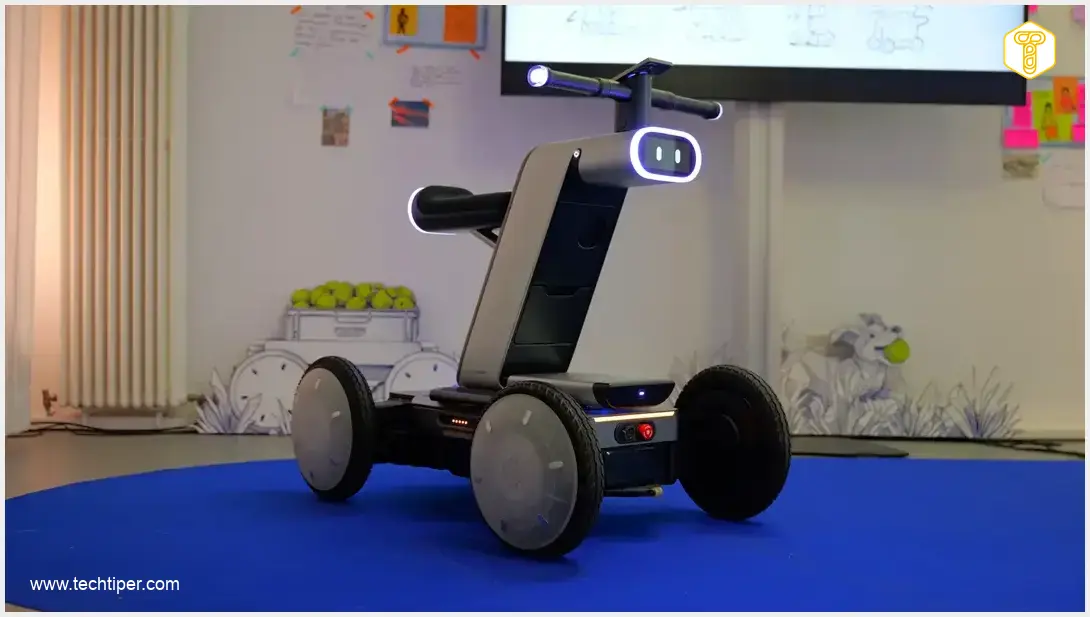
During the demonstration, Hyundai presented the device with two functional superstructures. The most intriguing was the Hyundai MobED Basic model with a full personal transport enclosure, visually resembling a cross between a futuristic micro-car and a scooter.
In this configuration, a comfortable seat and handlebars (reminiscent of motorcycle controls) were mounted on the standard MobED chassis. While still in its development phase, the attention to detail and playful elements, such as smiling emoticons integrated into the design, were notable.
As I learned, the showcased vehicle offers an 80-kilogram (approximately 176 pounds) payload capacity and currently moves at a maximum speed of 10 kilometers per hour (about 6 mph). The production version is anticipated to reach speeds typical for electric scooters, around 25 kilometers per hour (about 15.5 mph).
The second fully operational structure was based on the Hyundai MobED Pro. At the event, this unit was controlled via specialized equipment, though its integrated cameras and sensors are designed to enable fully autonomous driving. This particular MobED Pro was equipped with a table featuring a television.
The platform’s open architecture and modular design make its applications virtually limitless. From serving as a mobile courier robot delivering packages directly to doorsteps in urban environments to enhancing internal logistics within highly automated factories and warehouses, where it can precisely transport heavy components in areas traditional forklifts might struggle – the MobED offers significant advantages. Its potential even extends to emergency services, where it could carry medical equipment or sensors into hazardous zones, much like the evolving landscape of commercial robotaxis seen recently with developments like those in Zagreb where Europe’s first commercial robotaxi service has launched, or the broader discussion on the revolution in transport as commercial robotaxis arrive in Europe. This adaptability underscores its role as a versatile solution for a wide array of demanding tasks.
Hyundai MobED: A Platform with Immense Potential
The Hyundai MobED undeniably demonstrates that the future of mobility lies in flexible, autonomous platforms. Instead of developing numerous dedicated vehicles for specific tasks, the Korean manufacturer has created a universal base with impressive versatility. However, its market success will ultimately depend on the availability of diverse superstructures and, of course, the pricing of the device itself, which is not expected to be modest.
Frequently Asked Questions (FAQ)
The MobED features a proprietary “Drive and Lift” eccentric mechanism, allowing each of its four wheels to adjust its vertical and horizontal position independently. This ensures the platform remains perfectly level even on slopes, speed bumps, or curbs up to 20 cm high.
The MobED Basic is designed for research and direct operator control, serving as a versatile base for custom applications without autonomous capabilities. In contrast, the MobED Pro is fully autonomous, equipped with advanced sensors like LiDAR and depth cameras, enabling it to map environments, plan routes, and avoid obstacles independently for commercial deployment in logistics and service roles.
The MobED’s modular design and versatility allow for numerous applications, including last-mile delivery as a mobile courier, internal logistics in automated factories for transporting heavy components, and even for emergency services to carry medical equipment or sensors into hazardous areas where human access might be dangerous.
The MobED’s independent wheel control and eccentric mechanism provide superior maneuverability, allowing it to rotate 360 degrees in place and move sideways. Unlike larger vehicles, its compact size and advanced suspension make it highly efficient in navigating urban environments and tight industrial spaces, often consuming less energy than legged robots while offering higher payload capacity and smoother movement.
Source: Hyundai
Opening photo: Krzysztof Wilamowski
About Post Author
