

Contents
Understanding Cruise Control: Your Guide to Enhanced Driving
Cruise control is a widely adopted feature in modern vehicles, designed to make driving more convenient and comfortable, especially on longer journeys or highways. This innovative system allows a car to maintain a set speed without constant pedal input from the driver. But not all cruise control systems are the same. This article will explain how cruise control works, highlight the crucial differences between standard (conventional) and active (adaptive) cruise control, and provide essential tips for safe usage.
Standard vs. Adaptive Cruise Control: The Key Differences
Standard Cruise Control
In vehicles equipped with standard cruise control, the system maintains a specific speed previously set by the driver. Once activated, there’s no need to press the accelerator pedal; your car will continue at the chosen velocity. The speed will only change if the driver manually applies the brakes or the accelerator, or deactivates the system. This type of cruise control is best suited for open roads with minimal traffic, where a consistent speed can be maintained for extended periods.
Adaptive (Active) Cruise Control
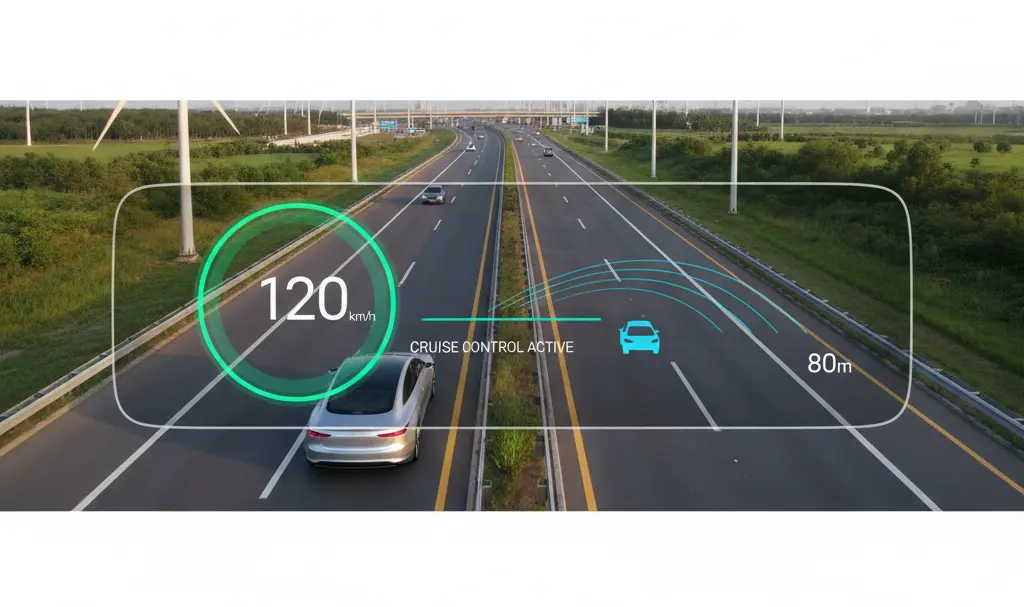
Adaptive Cruise Control (ACC), also known as active cruise control, builds upon the functionality of its standard counterpart. Like standard cruise control, the driver sets a desired speed, and the vehicle maintains it without requiring accelerator input. However, ACC offers a significant enhancement: it automatically adjusts the car’s speed to maintain a predetermined safe distance from the vehicle directly ahead.
How does this work in practice? While a car with standard cruise control set to, for instance, 60 mph (approximately 97 km/h) would simply continue at that speed, requiring the driver to manually brake if a slower vehicle appears ahead, an ACC-equipped car behaves differently. With ACC properly configured, if the vehicle ahead slows down, your car will automatically reduce its speed to maintain the safe following distance you’ve selected. Once the path ahead clears or the preceding vehicle speeds up, your car will smoothly accelerate back to the driver’s set speed. This intelligent system utilizes radar, cameras, or a combination of sensors to monitor road conditions and traffic flow in real-time, greatly enhancing convenience and safety.
When is Cruise Control Most Useful?
Cruise control, particularly the adaptive variant, is most appreciated by drivers who frequently embark on long-distance journeys, such as highway trips. It allows the driver’s feet to relax, reducing fatigue on monotonous stretches of road while the car independently maintains the set speed.
- Highways and Freeways: This is where both types of cruise control shine. They significantly reduce driver effort and can help maintain a consistent speed, potentially aiding fuel efficiency.
- Adaptive Cruise Control in Varying Traffic: The biggest leap in driving comfort comes with adaptive cruise control, which not only holds a steady speed but also intelligently adjusts it to maintain a safe gap from vehicles in front. This makes it incredibly useful even in moderate traffic conditions where speeds fluctuate.
While adaptive cruise control can function on urban roads, its effectiveness largely depends on traffic density. City driving typically involves lower speeds, shorter distances between vehicles, unexpected appearances of pedestrians and cyclists, and frequent lane changes. In such dynamic environments, constant driver control over the vehicle often proves more effective and safer than relying on cruise control alone.
Safe and Responsible Use of Cruise Control
Cruise control, like any advanced driver-assistance system, should always be viewed as a support tool for the driver, not a replacement for active vehicle operation. The person behind the wheel must remain attentive to road conditions and be prepared to take manual control, for example, by braking, at any moment.
It is crucial to understand that cruise control is not a solution for driver fatigue and should never be used as such. On the contrary, using it when tired can lead to severe accidents if the driver falls asleep while the car maintains a high speed. Your feet might be resting, but your eyes and mind must remain fully engaged with the road.
Furthermore, the effectiveness of cruise control can diminish significantly in challenging conditions:
- Adverse Weather: Rain, snow, fog, or heavy precipitation can interfere with the proper functioning of cameras and sensors, potentially preventing the system from accurately detecting other vehicles, pedestrians, or animals on the road.
- Complex Roadways: Roads with numerous hills, steep inclines, or sharp curves can sometimes confuse adaptive cruise control systems, leading to improper speed adjustments or failure to detect vehicles ahead correctly.
Cruise control performs optimally on long, predictable, and clear stretches of road. Always treat it as a valuable aid to enhance comfort and efficiency, but never as a substitute for your active control and undivided attention to the driving environment. It is also wise to take a moment to set an appropriate following distance from the cars ahead. Remember, at higher speeds, a greater following distance is always recommended for safety.
Frequently Asked Questions (FAQ)
What is the main difference between standard and adaptive cruise control?
Standard cruise control maintains a set speed chosen by the driver. Adaptive cruise control (ACC) does the same, but also automatically adjusts your car’s speed to maintain a safe, predetermined distance from the vehicle directly in front of you, accelerating and braking as needed.
Can I use cruise control in the city?
While some advanced adaptive cruise control systems are designed to operate in stop-and-go city traffic, standard cruise control is generally not recommended for urban environments due to frequent speed changes, short distances between vehicles, and the presence of pedestrians and cyclists. Even with ACC, constant driver vigilance is essential in the city.
Is cruise control safe to use in bad weather?
No, it is generally not safe to use cruise control in adverse weather conditions like heavy rain, snow, or fog. Precipitation can obstruct the sensors and cameras that cruise control systems rely on, leading to inaccurate readings and potential safety risks. In poor visibility or slippery conditions, manual control is always recommended.
Source: Various automotive resources. Opening photo: Generated by Gemini.
About Post Author
