
Contents
Armageddon-like Scene: NASA Successfully Alters Asteroid’s Orbit for Planetary Defense
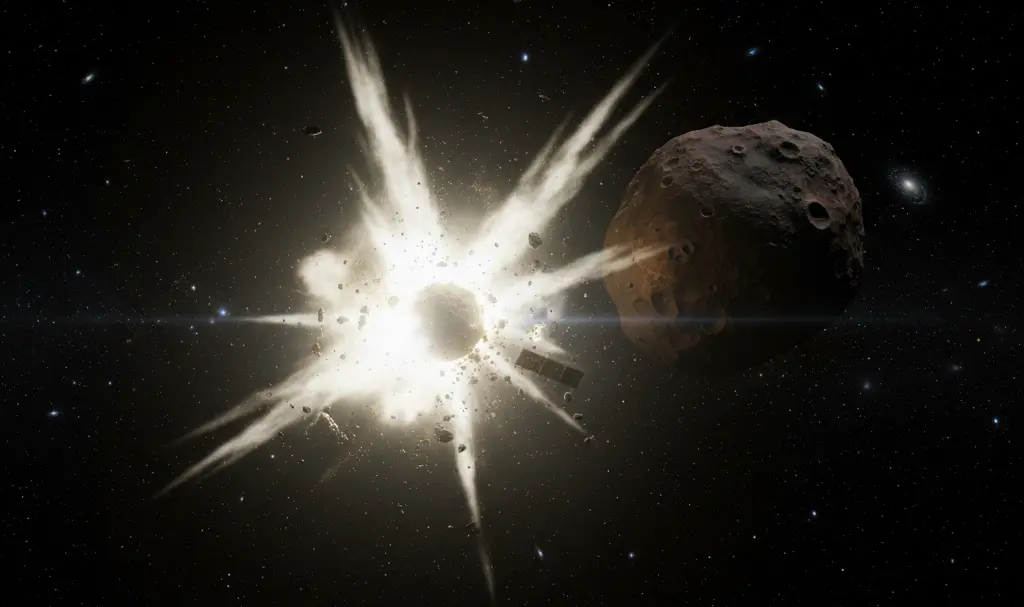
NASA has confirmed the resounding success of its Double Asteroid Redirection Test (DART) mission, a groundbreaking experiment that saw a spacecraft intentionally collide with the asteroid Dimorphos, successfully altering its orbital path. This unprecedented achievement marks a significant milestone in planetary defense, offering a potential method to protect Earth from dangerous celestial objects in the future.
DART Mission: A Historic First in Planetary Defense
The DART mission was the world’s first full-scale demonstration of a “kinetic impactor” — a technique involving deliberately crashing a spacecraft into an asteroid to change its trajectory. Launched in November 2021, the DART probe intercepted Dimorphos in September 2022.
- Dimorphos, approximately 170 meters (558 feet) in diameter, orbits a larger asteroid named Didymos, which measures about 805 meters (2,641 feet) across.
- Neither Dimorphos nor Didymos posed a threat to Earth, making them ideal targets for this crucial technological test.
Unprecedented Orbital Shift Confirmed
Following the impact, astronomers meticulously observed the binary asteroid system, confirming a noticeable change in Dimorphos’s movement:
- The orbital period of Dimorphos around its larger companion, Didymos, shortened by a remarkable 33 minutes, decreasing from approximately 12 hours.
- The entire asteroid system’s orbit around the Sun also experienced a subtle shift of about 0.15 seconds.
Further analysis of the mission revealed that the impact ejected a substantial amount of material from the asteroid’s surface into space. This resulting plume of debris acted as an additional thrust, further contributing to Dimorphos’s altered trajectory. This scenario, once relegated to science fiction films, is now a proven reality.
Small Change, Big Impact: Safeguarding Earth’s Future
While the measured change in the system’s velocity was minute — approximately 11.7 micrometers per second (about 1.7 inches per hour) — experts emphasize its profound significance.
“With a sufficiently early response, such a correction can cause a potentially dangerous object to miss Earth instead of hitting it,” explains Rahil Makadia from the University of Illinois Urbana-Champaign.
The DART mission unequivocally demonstrated that even a small, precisely applied force can significantly alter an asteroid’s path over time, provided the intervention occurs far enough in advance.
NASA’s Ongoing Commitment to Planetary Defense
Building on the success of DART, NASA continues its work on a comprehensive planetary defense system. A key component currently under development is a dedicated space telescope designed to detect asteroids and comets that might pose a threat to our planet.
Early detection is paramount. Identifying a potential threat years or even decades in advance would provide ample time to dispatch a mission similar to DART, allowing engineers to subtly nudge the object off its collision course with Earth before it becomes a real danger.
Frequently Asked Questions (FAQ)
What was the main goal of the DART mission?
The primary goal of the DART mission was to test and demonstrate the “kinetic impactor” technique for planetary defense, proving that a spacecraft collision could successfully alter an asteroid’s trajectory.
Did the DART mission asteroids, Dimorphos and Didymos, pose a threat to Earth?
No, the asteroids Dimorphos and Didymos were carefully chosen because they did not pose any threat to Earth, either before or after the DART experiment. They served as a safe testing ground for this critical technology.
How much did DART change Dimorphos’s orbit?
The DART impact successfully shortened Dimorphos’s orbital period around Didymos by 33 minutes, reducing it from approximately 12 hours.
What is a “kinetic impactor”?
A kinetic impactor is a planetary defense strategy where a spacecraft is intentionally crashed into a potentially hazardous asteroid to change its momentum and alter its orbital path, diverting it away from Earth.
Source: N/A
Opening photo: Gemini
About Post Author
