
Contents
Artemis II Mission Officially Launched: History Unfolds Before Our Eyes
The Artemis II mission, a monumental undertaking that marks the first crewed flight to lunar orbit in over 50 years, is currently targeted to launch in September 2025. This historic journey is planned to not only see the spacecraft visit our natural satellite but also set a new record for the farthest human travel beyond Earth’s boundaries.
Humanity’s Return to Lunar Orbit
Over five decades have passed since December 7, 1972, when humans last journeyed to the Moon as part of the Apollo 17 mission. The upcoming Artemis II mission is poised to break this long hiatus, ushering in a new era of lunar exploration and discovery.
Planned to launch from the iconic Kennedy Space Center in Florida, the powerful Space Launch System (SLS) rocket will propel the Orion spacecraft on an approximate 10-day voyage towards lunar orbit. This mission represents a critical step in NASA’s broader Artemis program, which aims to establish a long-term human presence on the Moon.
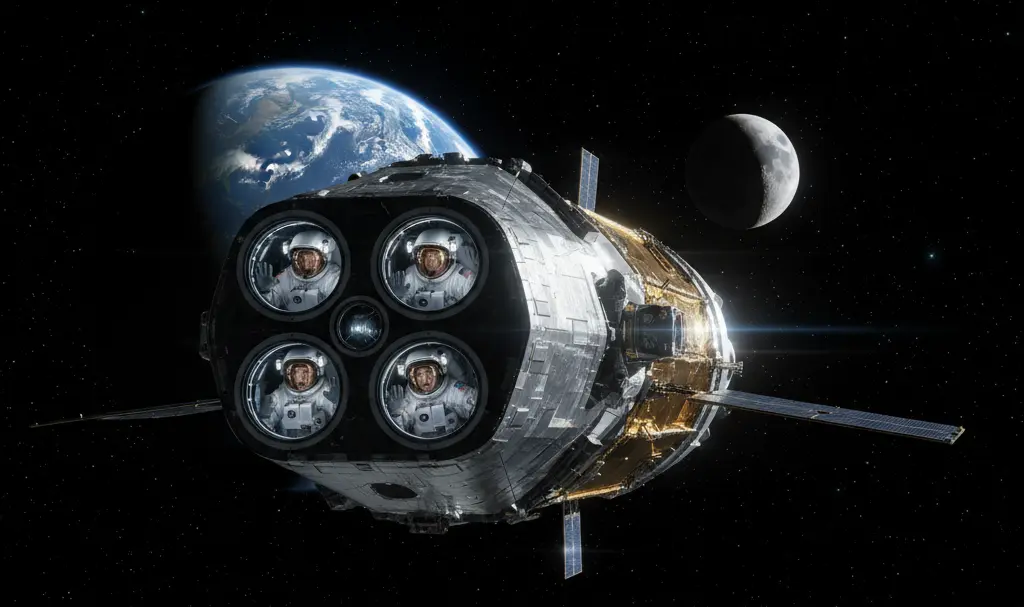
The historic event will involve a crew of four highly accomplished astronauts:
- Commander Reid Wiseman
- Pilot Victor Glover
- Mission Specialist Christina Koch
- Mission Specialist Jeremy Hansen (the first Canadian to venture into deep space)
Breaking the Cosmic Distance Record
Artemis II is not only significant for returning humans to the vicinity of the Moon but also for establishing a new benchmark in space travel. The mission is set to travel approximately 406,841 kilometers (252,799 miles) from Earth, marking the farthest any human has ever journeyed beyond our home planet.
This remarkable distance will surpass the previous record held by Apollo 13, which in 1970 reached roughly 400,000 kilometers (248,548 miles) from Earth. The Artemis II crew will truly go where no human has gone before.
The Critical Objectives of Artemis II
You might be wondering about the primary objectives of the Artemis II mission. Before subsequent missions can land astronauts on the lunar surface, Artemis II will serve as a crucial test flight. The astronauts will meticulously verify the performance of several key systems, including:
- Life support systems
- Maneuvering capabilities
- Manual control features of the Orion spacecraft
These comprehensive tests are fundamental. They will provide invaluable data and experience, forming the bedrock for future Artemis missions that will involve lunar landings and complex docking procedures, ensuring the safety and success of humanity’s return to the Moon.
International Collaboration: Poland’s Contribution to Space Exploration
The Artemis program is a testament to global partnership in space exploration, drawing on expertise and resources from various nations. Notably, two Polish institutions are actively contributing to aspects related to the Artemis II mission and the broader lunar exploration framework:
- The Institute of Nuclear Physics of the Polish Academy of Sciences (IFJ PAN)
- The Polish Space Agency (POLSA)
Their involvement highlights Poland’s growing role in the international space industry, contributing scientific and technological advancements vital for future human endeavors beyond Earth. Learn more about Poland’s significant role in the space industry here.
NASA’s Ambitious Future Plans for the Moon and Beyond
Even as the Artemis II mission prepares for its highly anticipated launch, NASA has already outlined ambitious plans for the near future. Bill Nelson, the Administrator of NASA, has articulated the agency’s commitment to accelerating various space missions. This includes an aim for a full-fledged crewed lunar landing as early as 2028, a strategic move to maintain leadership in space exploration and foster scientific discovery, particularly in the context of increasing global competition in space.
Further Reading
For another fascinating look at cosmic events, read about how astronomers witnessed a planetary collision here.
Frequently Asked Questions (FAQ)
What is the main significance of the Artemis II mission?
Artemis II is significant as it will be the first crewed mission to lunar orbit in over 50 years, following Apollo 17 in 1972. It will also break the record for the farthest human travel beyond Earth, paving the way for future lunar landings.
What key tests will the astronauts perform during Artemis II?
The primary objectives for the Artemis II crew include testing the Orion spacecraft’s vital systems, such as life support, maneuvering capabilities, and manual flight controls. These tests are crucial for ensuring the safety and functionality of the spacecraft for future missions.
How will Artemis II pave the way for future lunar landings?
By rigorously testing Orion’s systems in a deep-space environment, Artemis II will validate the spacecraft’s readiness for carrying astronauts to the lunar surface. The data and experience gained will be essential for developing and executing subsequent missions that involve landing and establishing a sustained human presence on the Moon.
What role does international collaboration play in the Artemis program?
International collaboration is a cornerstone of the Artemis program, with countries like Canada providing astronauts and various nations contributing scientific and technological expertise. Poland, through institutions like IFJ PAN and POLSA, also plays a role in advancing research and development for lunar exploration.
Source: Space.com
Opening photo: Gemini
About Post Author
