
Contents
A Cosmic Cataclysm: Astronomers Witness Planetary Collision in Distant Star System
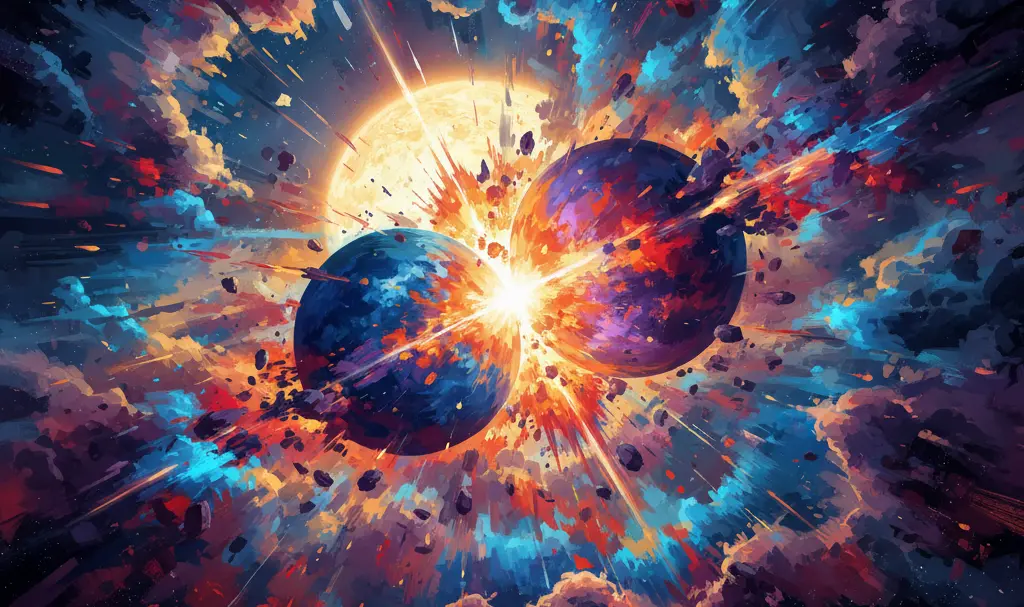
In a groundbreaking discovery, astronomers have observed, for the first time, the real-time collision of two planets in a distant stellar system. This incredibly rare phenomenon, which took place approximately 11,000 light-years from Earth, is expected to significantly enhance scientists’ understanding of planetary formation, including the origins of our own planet.
Unraveling the Mystery of ASASSN-21qj (Formerly Gaia20ehk)
The cosmic drama unfolded around a star initially designated Gaia20ehk, now more formally known as ASASSN-21qj. Located roughly 11,000 light-years away, this star had long been considered an ordinary, Sun-like celestial body with stable, predictable brightness.
However, the situation dramatically changed in 2016 when its light began to dim briefly. These intermittent dips in brightness occurred three times, and a few years later, the star’s luminosity became even more erratic and chaotic.
Detailed analyses suggested that the star itself was not the cause of these fluctuations. Instead, the most probable explanation was that its light was being partially obscured by an enormous cloud of dust and rocky fragments slowly moving across our line of sight. To confirm this hypothesis, scientists employed infrared telescopes, which are capable of observing cosmic phenomena through dust clouds. The infrared observations provided crucial evidence: as the star’s brightness in visible light decreased, its infrared emission dramatically increased. This inverse relationship strongly indicated that hot material was blocking the star’s visible light while radiating its own heat in the infrared spectrum.
The Catastrophic Impact: A Tale of Two Young Worlds
The significant increase in infrared radiation was a powerful indicator that the obscuring material was exceptionally hot, strongly suggesting astronomers were witnessing the aftermath of a colossal collision between two planets. Scientists theorize that the initial, smaller dips in the star’s brightness could have represented partial, grazing encounters between these celestial bodies. The planets likely spiraled closer and closer together with each successive orbit until they eventually culminated in a direct, head-on impact.
The force of this collision was so immense that both objects were ripped apart, disintegrating into a vast, glowing cloud of superheated dust and debris. Remarkably, this cloud of planetary remnants continues to orbit the star at a distance comparable to that between Earth and our Sun. This unique configuration makes the ASASSN-21qj system an invaluable natural laboratory for studying the intricate processes involved in the formation of rocky planets, offering insights into the early, turbulent stages of planetary system development.
Echoes of Our Own Solar System’s Past
This cosmic catastrophe bears a striking resemblance to a scenario believed to have occurred in our own Solar System approximately 4.5 billion years ago. According to prevailing theories, a Mars-sized body is thought to have collided with the young Earth. The ejected debris from this colossal impact coalesced over time to form our Moon.
Therefore, observing the collision in the ASASSN-21qj system provides astronomers with a crucial opportunity to better understand:
- How frequently such cataclysmic events occur throughout the cosmos.
- The specific mechanisms and energy involved in planetary collisions.
- How these impacts influence the formation and evolution of planets and their natural satellites (moons).
Why This Discovery Matters
The direct observation of a planetary collision is a monumental achievement in astronomy. It moves our understanding of planet formation from theoretical models to empirical evidence. By studying the dust cloud’s evolution, composition, and orbital dynamics, scientists can refine their models of protoplanetary disk evolution and the conditions under which rocky planets assemble and survive—or are destroyed—in the dynamic environments of young star systems.
Frequently Asked Questions (FAQ)
What is the significance of observing this planetary collision?
This is the first time astronomers have witnessed a planetary collision in real-time. It provides unprecedented empirical evidence for theories of planet formation and evolution, allowing scientists to study the actual processes involved rather than relying solely on simulations or indirect observations.
Where did this planetary collision occur?
The collision occurred in a distant star system approximately 11,000 light-years from Earth, around a star now formally known as ASASSN-21qj, which was initially observed as Gaia20ehk.
How did astronomers confirm it was a planetary collision?
Astronomers observed unusual dimming of the star’s visible light, which correlated with a dramatic increase in its infrared emission. This indicated that a hot, massive cloud of dust and debris was obscuring the star, consistent with the aftermath of a powerful planetary impact that vaporized the colliding bodies.
How does this event relate to our own Solar System?
The observed collision is thought to be similar to a hypothesized impact that occurred early in our Solar System’s history, where a Mars-sized body collided with the young Earth, eventually leading to the formation of the Moon. Studying this distant event can help scientists understand the frequency and impact of such events on the formation of planets and moons.
Source: ZME Science, Nature Astronomy. Opening photo: Gemini.
About Post Author
