

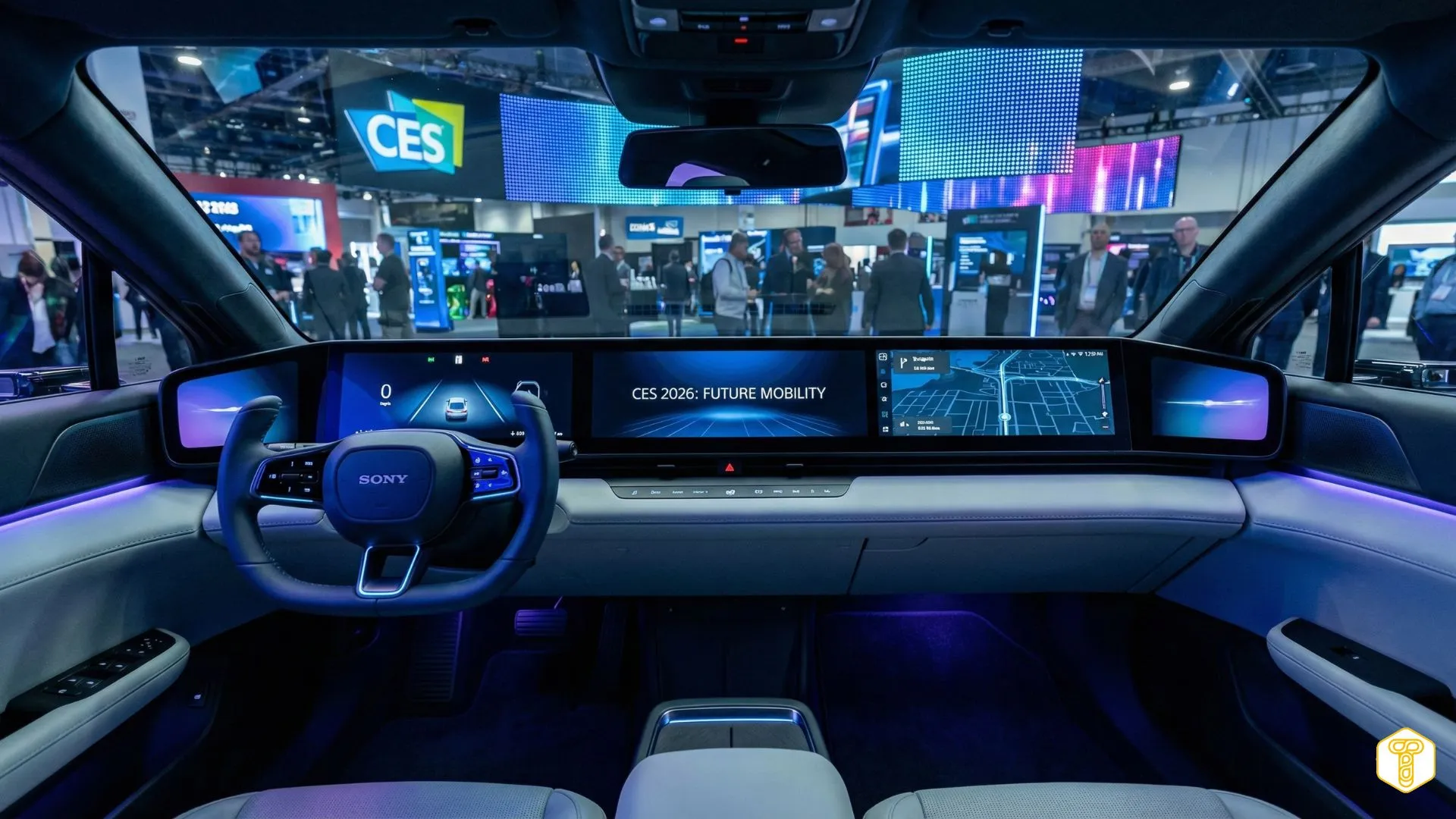
CES 2026 proves the car is now a “mobile living room.” From Sony’s Afeela to Nvidia’s superchips, discover how EVs are shifting focus from horsepower to computing power.
Contents
Key Takeaways (Quick Summary)
- The Shift: As EV motors become standard, automakers are differentiating with software and interior experience.
- The “Third Space”: The car is no longer just for transport; it is a mobile lounge for gaming, working, and relaxing.
- The Tech: Sony Honda Mobility (Afeela) is bringing PS5-level gaming to the dashboard, while Nvidia & Qualcomm are supplying the massive computing power needed for 8K screens and AI.
- The AI: New “AI Co-pilots” don’t just navigate; they manage cabin mood, temperature, and entertainment proactively.
If you walked the floor at CES 2026 this week, you might have forgotten you were at a consumer electronics show. You would be forgiven for thinking you were at an auto show.
As electric vehicle adoption normalizes, the “wow factor” of a fast 0-60 time has faded. Manufacturers are panicking about how to differentiate. Their answer? Turning the car interior into the ultimate “Third Space”—a place distinct from home (First Space) and work (Second Space) where you actually want to spend time.
This massive pivot is a core pillar of our Top 5 CES 2026 Tech Trends, but the automotive sector is evolving so fast it demands its own deep dive.
Here is why 2026 is the year of the Software-Defined Vehicle.
1. Horsepower is Out. Computing Power is In.
The specs that matter in 2026 aren’t “Horsepower” or “Torque.” They are Teraflops and NPU operations.
Chipmakers like Nvidia and Qualcomm are the new engine builders. At CES, they are showcasing “Digital Chassis” platforms capable of powering multiple 8K screens simultaneously while running autonomous driving software in the background.

The “AI Co-Pilot” Evolution
The most exciting development is the shift in voice assistants. We are moving beyond “Navigate to home.” The new generation of in-car assistants are built on the same Agentic AI technology we are seeing in laptops and smart homes.
- What they do: These AI agents manage the entire cabin mood. If the car senses you are stressed (via biometric sensors in the seat), the Agentic AI might automatically dim the lights, switch the playlist to “Calm,” and activate the massage seats—without you saying a word.
2. Sony Honda Mobility (Afeela): The PS5 on Wheels
The poster child for this “Third Space” revolution is Afeela, the joint venture between Sony and Honda. We expect near-final production looks at this vehicle at CES 2026, and it is built entirely around entertainment.

- Epic Games Engine: The car’s interface runs on Unreal Engine 5.3, providing graphics that rival a dedicated gaming console.
- Immersive Entertainment: It’s not just about driving; it’s about parking, charging, and playing. With massive panoramic screens, the car becomes a private movie theater.
Insight: This focus on visual immersion mirrors the trends we are seeing in personal wearables. For passengers who want privacy rather than a shared dashboard screen, the new wave of Spatial Computing AR glasses offers a perfect solution—giving them a 100-inch private screen in the passenger seat.
3. The Living Room Experience (and the Power Problem)
If the car is a living room, it needs to handle our devices like one. A major theme this year is the “War on Wires” extending to the dashboard. We are seeing consoles and gloveboxes equipped with high-wattage wireless charging pads for laptops and tablets.

This technology is parallel to the breakthrough Wireless Power standards (Ki) launching for kitchens this week. Just as you can drop a blender on a counter to power it, 2026 cars aim to let you drop any device on the center console and have it connect and charge instantly—no USB cables required.
The Bottom Line
CES 2026 proves that the “Car” is being redefined. It is no longer a machine that moves you from Point A to Point B.
It is a high-powered computer, a gaming console, and a personal assistant, all wrapped in glass and steel. For the modern commuter, the traffic jam just got a lot more entertaining.
Frequently Asked Questions (FAQ)
Q: What is a “Software-Defined Vehicle”? A Software-Defined Vehicle (SDV) is a car where the features and functions are primarily enabled through software rather than hardware. This allows the car to be updated over the air (OTA), improving performance, battery range, or infotainment features years after purchase.
Q: Can you actually play video games in the Afeela car? Yes. The Sony Honda Mobility (Afeela) prototype is designed to support high-end gaming using the Epic Games Unreal Engine, allowing passengers (and drivers, when parked) to play console-quality games on the dashboard screens.
Q: How does AI change the driving experience in 2026? AI in 2026 moves from passive navigation to active cabin management. Using “Agentic AI,” the car can anticipate needs—adjusting temperature, suggesting stops based on your schedule, and monitoring driver alertness with advanced biometrics.
About Post Author
