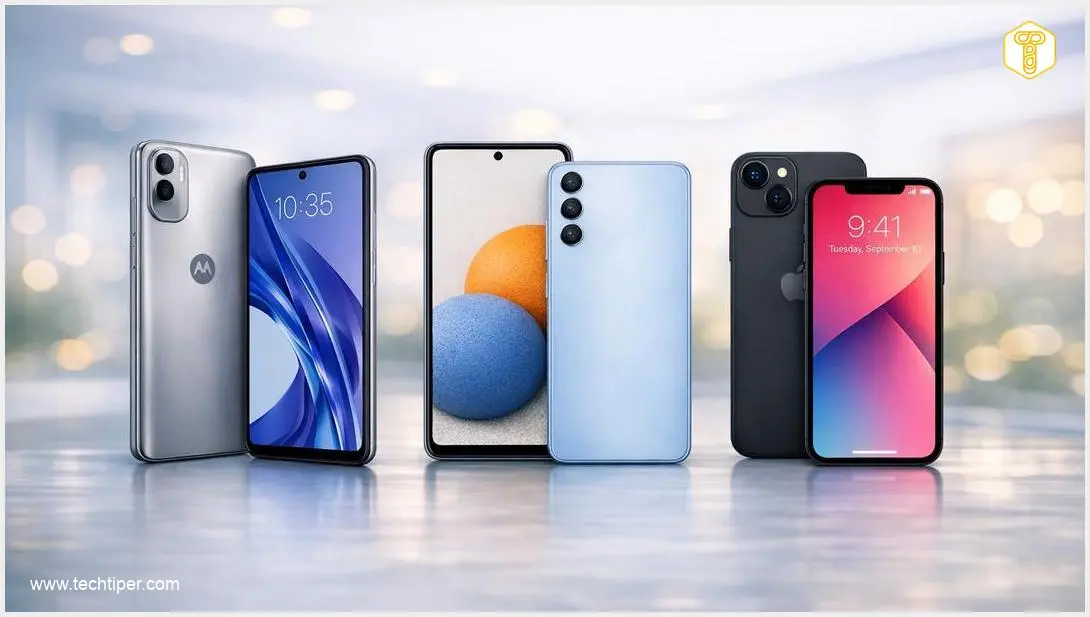
Budget Smartphone Face-Off: Motorola, Samsung, and Apple
-
Overall Performance
-
Display & Design
-
Connectivity Features (5G, eSIM, NFC)
-
Battery Life & Charging
-
Software Longevity
-
Overall Value & Affordability
Navigating the Entry-Level Smartphone Market
While the iPhone 16e leads in specs, its premium price tag removes it from true budget contention. The Samsung Galaxy A17 offers a compelling display and long-term software support, but its overall value is debatable. For pure affordability, the Motorola Moto G05 stands alone, albeit with basic features, making the ‘best’ budget phone highly dependent on individual priorities and wallet size.
Advantages
- Diverse price points, offering options from ultra-budget to entry-level premium.
- Improved display technologies (AMOLED, OLED, 90Hz refresh rates) available even in budget options.
- Enhanced connectivity features like NFC, 5G, and eSIM are present in at least some models.
- Exceptional long-term software support from certain manufacturers (e.g., Samsung’s 6 years).
- Robust performance available at the higher end of the “budget” spectrum (iPhone 16e).
Disadvantages
- Significant price disparity across “budget” options complicates direct comparisons.
- Lower-priced models often lack crucial modern features like 5G, eSIM, and full NFC support.
- Performance in the mid-budget Android range can be “adequate” but prone to slowdowns.
- Value for money can be debatable for some models, with better alternatives suggested for slightly more cost.
- Inconsistent display refresh rates across models, with some flagship-level budget phones still at 60Hz.
Contents
The Quest for the Best Budget Smartphone: Motorola, Samsung, and Apple Face-Off
In today’s fast-paced tech world, finding a smartphone that balances performance with an affordable price tag can be a challenge. We often compare the flagship models from giants like Motorola, Samsung, and Apple, but what about their most accessible offerings? This time, we’ve put the cheapest smartphones from these renowned brands under the microscope to see which one truly delivers. The answer might seem simple, but a crucial factor complicates the outcome.
How We Chose the Most Affordable Smartphones
To ensure our comparison was relevant and helpful, we set clear criteria for device selection. We focused exclusively on models released to market no earlier than early 2025. This approach avoids analyzing outdated devices that are difficult to find in stores and whose prices are heavily influenced by fleeting promotions.
We selected the most affordable smartphones from Motorola, Samsung, and Apple, prioritizing availability and pricing from well-known electronics retailers. For Samsung and Apple, the choice was straightforward. However, for Motorola, two models — the E15 and G05 — were available at similar price points during our research. We opted for the Moto G05 due to its superior memory configuration.
Motorola Moto G05: The Entry-Level Contender
The Motorola Moto G05 positions itself as an ultra-budget-friendly smartphone, often available for under $100. As expected, its specifications are quite basic, designed for essential tasks. It features a MediaTek Helio G81 Extreme processor, paired with 4 GB of RAM and 128 GB of internal storage.
The device boasts a 6.67-inch IPS display with HD+ resolution and a 90 Hz refresh rate, offering a smooth visual experience for its price point. Powering the Moto G05 is a substantial 5200 mAh battery, supporting 18W charging. For photography, it includes a 50 Mpx rear camera (f/1.8) capable of recording video up to Full HD at 30 frames per second.
A distinctive feature of the Moto G05 is its vegan leather finish, adding a touch of premium feel to an otherwise budget device. However, it’s worth noting that the phone does not support 5G connectivity, eSIM, or NFC for contactless payments.
Samsung Galaxy A17: Stepping Up the Budget Game
The Samsung Galaxy A17 represents Samsung’s most affordable smartphone offering. While noticeably pricier than the Motorola Moto G05 (available for under $200 in early April 2026), its enhanced specifications justify the cost difference.
This smartphone features a vibrant 6.7-inch Super AMOLED display with Full HD+ resolution and a 90 Hz refresh rate, providing a significantly better visual experience compared to the Moto G05. Under the hood, the Galaxy A17 is powered by a MediaTek Helio G99 processor, which is an considerably better than the Helio G81 Extreme found in the Moto G05. It also comes with 4 GB of RAM and 128 GB of internal storage.
Our experience with the Galaxy A17, including insights from reviews, indicates that its performance, while adequate for basic tasks, isn’t groundbreaking. Users might notice slowdowns with demanding applications or when multiple tools are running simultaneously. For those considering this model, a deeper dive into mid-range smartphone comparisons, such as our article on Realme 16 Pro vs. 16 Pro: Is it worth paying over $125 more?, might offer broader context on performance expectations.
The Galaxy A17 features a plastic build. It lacks 5G and eSIM support but does include NFC, a crucial feature for contactless payments. Its 5000 mAh battery supports 25W charging. A significant advantage of the Galaxy A17 is Samsung’s commitment to long-term software support, promising up to six years of updates.
Note: A Galaxy A17 5G variant, equipped with an Exynos 1330 processor, is also available. However, its higher price places it outside the scope of this comparison focusing on the absolute cheapest models.
iPhone 16e: Apple’s Entry into Affordability
The most affordable iPhone to hit the market no earlier than 2025 is the iPhone 16e. This device features a 6.1-inch OLED display with a resolution of 2532 × 1170 pixels, though with a modest 60 Hz refresh rate. Powering the iPhone 16e is the formidable Apple A18 processor, complemented by 8 GB of RAM and 128 GB of internal storage in its base configuration. Performance is undoubtedly a strong suit, offering a smooth and responsive user experience.
The iPhone 16e supports 5G connectivity, eSIM, and includes an NFC module, aligning with modern connectivity standards. It features a single 48 Mpx (f/1.6) rear camera lens with optical image stabilization, capable of recording videos in 4K. While it may only have one lens, Apple’s computational photography ensures high-quality results. For more on camera performance, especially how older models stack up, consider reading our Old vs. New Smartphone Camera Comparison: Shocking Results! article.
Key differences from higher-end iPhones include the absence of the “Dynamic Island” and MagSafe accessory compatibility. The battery capacity is approximately 4000 mAh, supporting wired charging at around 25W and wireless charging at 7.5W. As for the price, in April 2026, the iPhone 16e is expected to retail for just under $600.
Comparing the Most Affordable Smartphones: A Summary
If we were to judge solely on specifications, build quality, and overall capabilities, the iPhone 16e would undoubtedly emerge as the winner. It’s the only device among the three to support 5G and eSIM, and it boasts superior performance thanks to its powerful Apple A18 processor and double the RAM compared to the Moto G05 and Galaxy A17.
However, “affordable” in the Apple ecosystem means something entirely different from budget-friendly Android phones. The iPhone 16e costs several times more than the very inexpensive Motorola and Samsung devices. This stark price difference means the target audience for the iPhone with the bitten apple logo operates on a completely different budget.
The Moto G05 and Galaxy A17 cater to users with very modest requirements. The Samsung Galaxy A17 is notably more expensive than the Motorola, but it offers a better processor and display, along with NFC support and Samsung’s commendable long-term software updates.
- For the basics: If you need a phone primarily for calls, messaging apps, and simple applications, prioritize patience, and don’t rely on contactless payments, the Moto G05 might suffice for a period.
- For a little more: If you expect a bit more from your device and are considering the Galaxy A17, we recommend exploring other options. By spending only a little more than the A17, you could find a significantly better-equipped smartphone.
Frequently Asked Questions (FAQ)
Is the iPhone 16e a true budget option compared to Android phones?
While the iPhone 16e is Apple’s most affordable model released after early 2025, its price point is significantly higher than entry-level Android devices like the Motorola Moto G05 or Samsung Galaxy A17. It caters to users with a larger budget who still want an iPhone experience without opting for the flagship models.
What are the key advantages of the Samsung Galaxy A17 over the Motorola Moto G05?
The Samsung Galaxy A17 offers several advantages over the Moto G05, including a superior Super AMOLED Full HD+ display, a better MediaTek Helio G99 processor, NFC support for contactless payments, and a remarkable six years of software update support from Samsung. These features justify its higher price tag for users seeking more capabilities.
Should I consider older flagship phones instead of new budget smartphones?
Potentially, yes. Depending on your budget and priorities, an older flagship phone from a few years ago might offer better performance, camera quality, and build materials than a brand-new budget smartphone. However, consider the battery health and the remaining software update support for older models. Researching specific older flagships and comparing them with current budget options is recommended.
Why is 5G, eSIM, and NFC support important for a modern smartphone?
5G offers significantly faster mobile internet speeds, improving streaming, downloading, and online gaming. eSIM provides flexibility by allowing you to switch carriers digitally without a physical SIM card, ideal for travelers or those with multiple numbers. NFC (Near Field Communication) enables convenient features like contactless payments via services like Apple Pay or Google Pay, easy pairing with accessories, and quick data transfer, making daily interactions much smoother and more secure.
Source: Self-developed. Opening photo: Generated by AI (Gemini)
About Post Author