
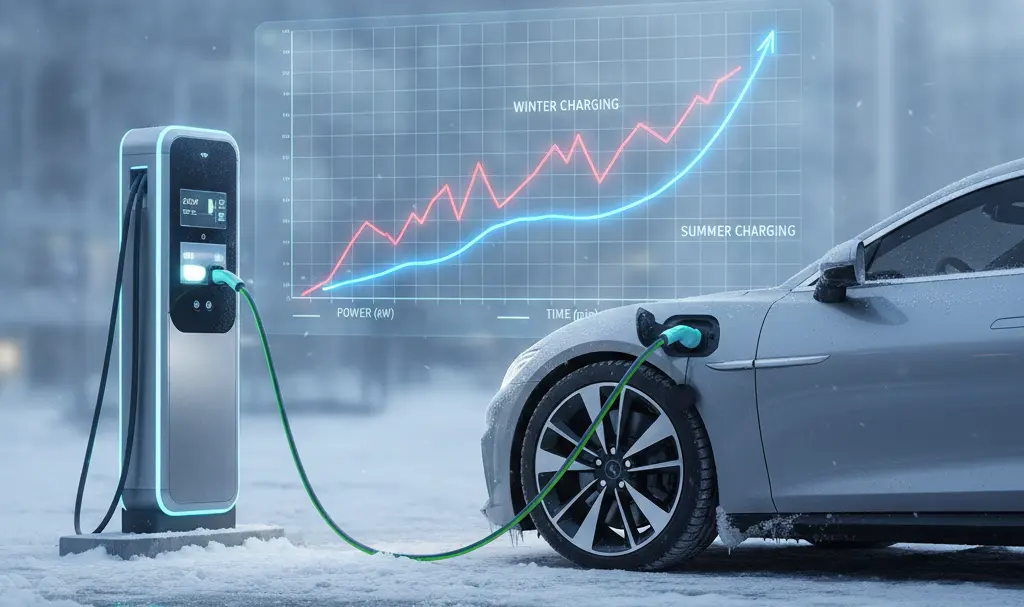
Electric vehicle (EV) charging is a hot topic, often sparking heated debate. Critics frequently point to long charging times and dependence on weather conditions as major drawbacks. Proponents, however, often counter with a nuanced answer: “it depends.” So, what’s the real story behind EV charging? This comprehensive guide aims to cut through the noise and provide a clear, factual understanding.
Contents
Unraveling the EV Charging Debate: Separating Fact from Fiction
Manufacturer Claims vs. Real-World Charging
Many EV manufacturers boast impressive peak charging powers. Take Tesla, for instance, which claims a maximum charging power of 250 kW. Intuitively, one might assume a 75 kWh battery could fully charge at this power in roughly 20 minutes.
However, real-world experience paints a different picture. To charge a Tesla Model 3 Long Range from 0% to 100% on an ‘ultra-fast’ Tesla Supercharger—an ideal, perfectly optimized charger for the vehicle—it would take at least 1 hour and 15 minutes. This significant discrepancy highlights a crucial aspect often overlooked by consumers.
Why Peak Charging Power Isn’t the Whole Story: The Charging Curve
The truth is, the peak charging power advertised by manufacturers can be misleading. Far more important is what’s known as the ‘charging curve’ – a graph illustrating how charging speed changes as the battery’s state of charge increases. Unfortunately, very few manufacturers, especially Tesla, officially publish these crucial graphs.
To better understand this, imagine your car’s battery as a large parking lot, and the electrons flowing in as cars looking for a parking space.
- When the parking lot is empty (battery is low), cars (electrons) can quickly find and occupy spaces. The process is fast and efficient.
- As the parking lot fills up (battery charges), it becomes harder for cars to find empty spaces. They have to circle, taking much longer to park. Similarly, as the battery’s charge level increases, electrons encounter more resistance and take longer to find their place within the battery cells.
Therefore, ‘topping off’ a battery from, say, 80% to 100% takes significantly longer than charging it from a low state. This is why Tesla recommends charging on long trips only between 10% and 80% state of charge. Staying within this range typically results in a charging stop of approximately 25 minutes. Charging beyond 80% becomes extremely inefficient and time-consuming, often taking longer to add the final 20% than it did to charge from 10% to 80%.
Not All EVs Are Created Equal: 400V vs. 800V Architecture
While all electric cars charge slower as their battery level increases, the rate of this slowdown and how long peak power is maintained vary dramatically between models.
- 400-Volt Architecture: Most electric vehicles are built with a 400-volt battery architecture. While capable of high peak charging speeds, this design inherently limits how long those speeds can be sustained, leading to longer charging times to reach 100%.
- 800-Volt Architecture: The future of electromobility lies in 800-volt architectures. These advanced systems allow for maintaining high charging speeds over a much wider range of battery states. Excellent examples include the Kia EV6 and Hyundai IONIQ 5. Although these models might offer slightly less range than a Tesla Model 3, their superior charging curves allow them to charge significantly faster in practice, even at comparable peak power ratings.
Xpeng: Pushing the Boundaries of Fast Charging
When it comes to real-world charging speed, the Chinese brand Xpeng is an undisputed leader. While the much more expensive Porsche Taycan can achieve a maximum charging power of 320 kW, the Xpeng G9 boasts an astonishing peak charging power of up to 525 kW.
While charging infrastructure capable of fully utilizing such immense power may not yet be widespread, Xpeng’s capabilities clearly demonstrate the serious advancements coming from Chinese automotive innovation.
Comparing the charging curve of a Tesla Model Y and an Xpeng G9, the difference is stark. On paper, Xpeng’s peak charging power is more than twice that of Tesla. This holds true when comparing charging speeds at very low battery levels. However, at higher states of charge, this difference isn’t just double; it can be as much as tenfold.
Based on real-world tests:
- A Tesla charging at over 90% battery capacity often charges at an absurdly low rate, typically between 10-15 kW.
- In contrast, an Xpeng G9 charges at 150 kW at 90% and approximately 100 kW at 95%. Even at 99%, the Xpeng maintains over 30 kW, while a Tesla might drop to just 2 kW.
This dramatic difference highlights how 800-volt architecture significantly reduces practical charging times. Even on widely available 350 kW IONITY chargers, the Xpeng benefits. While 350 kW is less than the G9’s maximum potential, its favorable charging curve ensures that this high power is maintained for a longer duration, drastically shortening charging stops. During tests, a 10-minute stop was sufficient to add 155-185 miles (250-300 km) of real-world range.
The Truth About Charging EVs in Winter at -10°C (14°F)
Opponents of electric vehicles frequently use videos to ‘prove’ that EVs are useless in winter, often showing charging speeds ten times slower than advertised. It’s true that in cold temperatures, the charging process can be significantly slower, but crucially, it doesn’t have to be.
- Cold Battery: If you connect an EV that has been parked in freezing temperatures overnight to a fast charger, the battery will indeed charge at a very low power for an extended period. This is because the battery cells are too cold.
- Warm Battery: The situation changes entirely if you pull into a charging station during a long journey. In this scenario, the ambient sub-zero temperature makes little difference because the battery is already warmed up from driving.
What if you’ve just started your journey and need a quick charge?
Many modern EVs offer a solution: simply set the charging station as your destination in the vehicle’s navigation system. The car will then pre-condition its battery by heating it as you drive to the station. This prepares the battery to accept the maximum possible charging speed as soon as you plug in, regardless of the outside temperature. This feature works effectively.
Some cars also allow manual pre-conditioning of the battery for fast charging. If you’re not using navigation to a charger, it’s a good idea to activate this option in the vehicle’s menu. However, it’s worth noting that some older or less advanced EVs do not offer any option to force battery pre-conditioning.
EVs in Winter: Navigating Conflicting Narratives
The online discussion surrounding electric cars in winter is often polarized. Enthusiasts tend to downplay drawbacks, while critics sometimes present an incomplete picture to discourage electromobility.
A negatively biased video might omit crucial context, such as a relatively high battery charge level or the fact that the car has been stationary in freezing conditions for several days. Such decontextualized content can ‘prove’ that an EV is impractical at -10°C (14°F) and that winter charging is incredibly slow. And in a narrow sense, this might be true for that specific, ill-prepared scenario.
Conversely, other materials showcase the latest EVs charging at very high powers, regardless of weather conditions. Here, too, context is often missing; viewers might not know that the battery was optimally discharged and properly pre-conditioned.
The reality is that when it comes to winter EV charging, you can seemingly ‘prove’ almost any claim. There are so many variables involved—battery temperature, state of charge, vehicle pre-conditioning capabilities, and charger power—that it’s easy to manipulate perceptions. The same Tesla could be shown charging at 15 kW in one video and over 200 kW in another, simply due to varying conditions.
Key Takeaways for EV Owners
It’s not true that electric cars become completely impractical in winter. They can still be charged quickly and without major issues. However, it is a fact that refueling a gasoline or diesel car is generally less involved and can be done mindlessly, regardless of conditions.
EV owners, on the other hand, need to understand their vehicle’s characteristics and plan each charging session strategically:
- Charge when the battery is more discharged: Aim for the 10-80% range for optimal speed.
- Pre-condition the battery before fast charging: Utilize navigation to a charging station or manually activate pre-conditioning if available.
So, while it’s inaccurate to say EVs charge ten times slower in winter, it is true that achieving the manufacturer’s declared charging speeds often requires a ‘skillful’ approach and understanding of your vehicle’s systems.
Frequently Asked Questions (FAQ)
Is peak charging power the most important factor for an EV?
No, peak charging power is less important than the “charging curve.” The charging curve illustrates how consistently an EV can maintain high charging speeds as the battery fills up. A high peak power is only useful if it can be sustained for a significant duration.
Why does charging slow down when my EV battery is almost full?
As an EV battery fills, it becomes harder for electrons to find available spaces within the battery cells. This increased resistance causes the charging speed to decrease significantly, especially when charging beyond 80% capacity. This is a protective measure for the battery and helps manage heat.
What is the difference between 400V and 800V EV architectures?
800-volt architectures are a newer technology that allows electric vehicles to maintain higher charging speeds over a wider range of battery states compared to traditional 400-volt systems. This results in faster overall charging times for vehicles like the Kia EV6 and Xpeng G9.
Can I charge my electric car quickly in cold winter weather?
Yes, but it often requires pre-conditioning the battery. If you set a charging station as your destination in your EV’s navigation, the car will warm its battery to an optimal temperature while you drive, allowing for fast charging even in freezing conditions. Charging a cold, un-preconditioned battery will be significantly slower.
What is the optimal charging range for an electric vehicle on a long trip?
For most electric vehicles, it is most efficient to charge from approximately 10% to 80% state of charge during long trips. Charging beyond 80% typically takes much longer and offers diminishing returns in terms of time efficiency.
Source: Original content translated and rewritten.
Opening photo: Generated by Gemini
About Post Author
