Contents
Infinix Note Edge: A Mid-Range Contender with Premium Aspirations
The Infinix Note Edge’s 2026 debut was a pleasant surprise. It combines an attractive design, a sleek build, and a generous battery, all offered at a very competitive price. Notably, it’s the brand’s first smartphone to feature eSIM technology and introduce a “self-healing” battery system. Is this Infinix’s formula for the ideal mid-range device? This review explores the Infinix Note Edge, a smartphone aiming to become a new leader in the affordable smartphone market.
Some phones, simply by their appearance, evoke a sense of premium quality beyond their actual price tag. The Infinix Note Edge is one such device. The moment you unbox it, you’re greeted with a design that feels far more luxurious than its cost suggests. Its slimness and tactile experience create the impression of a high-end product, despite belonging to the lower-to-mid-range segment. This is a testament to thoughtful design, even if certain compromises were necessary to achieve its attractive price point.
The Infinix Note Edge boasts numerous advantages, but it’s important to set expectations: if mobile photography or top-tier gaming performance are your primary concerns, this might not be the device for you. However, if you prioritize an appealing aesthetic, use your camera mainly for occasional snapshots, and seek a budget-friendly price, the Note Edge could be a sensible choice.
Advantages
- Remarkably slim profile
- Generous retail package
- Attractive design with Active Halo notification LED
- Extensive customization options and XOS features (evidently inspired by iOS 26)
- Curved, bright AMOLED display
- Rich feature set: eSIM, NFC, IR Blaster, JBL-tuned speakers
- Stereo speakers with Hi-Res Audio certification, tuned by JBL
- UPS 3.0 technology for improved signal in challenging conditions
- Customizable One Tap button
- Commitment to 3 Android updates and 5 years of security patches
- IP65 ingress protection rating and Gorilla Glass 7i
Disadvantages
- Processor performance
- Lack of an ultrawide camera lens
- Average photo quality (especially at night)
- Battery life could be better
- Significant amount of bloatware in XOS
- No wireless charging
- Relatively high price in some markets
Infinix Note Edge Review: Summary
The Infinix Note Edge delivers excellent design at an accessible price. Visually, it exudes a premium feel, despite its cost suggesting otherwise. Its specifications indicate it’s not ideal for demanding users or photography enthusiasts. However, a significant segment of users will undoubtedly appreciate this model for its unique blend of features and aesthetics.
Packaging and Accessories
Infinix has a reputation for not skimping on its retail packages, and the Note Edge continues this trend. This is a refreshing change from the increasingly stripped-down bundles offered by many well-known brands, which often omit even basic charging cables.
Inside the box, you’ll find a USB-C cable, wired in-ear headphones, and a tempered glass screen protector – a welcome addition, especially for a phone with a curved display. A protective case is also included, though it’s not a highlight. While it offers protection, it unfortunately detracts from the smartphone’s genuinely slim and attractive design.
Beyond the aesthetics of the accessories, such a comprehensive package means you won’t need to spend extra on device protection immediately after purchase, which is a significant advantage.
Design and Build Quality
The Infinix Note Edge’s standout feature is its chassis. Despite measuring approximately 7.2 mm thick and weighing around 190 g, it houses a substantial 6,500 mAh battery. This combination is rare, even among flagship models, making it particularly impressive for a phone that retails for well under $400.
The front is protected by Gorilla Glass 7i, while the back is crafted from high-quality plastic designed to mimic more premium materials, both visually and to the touch. This material also resists fingerprints more effectively. The Infinix Note Edge is notably lightweight, and its casing boasts an IP65 rating for dust and water resistance.
Curved screens are not currently a widespread trend, with most manufacturers opting for flat displays, believing that such curves offer no real-world benefits. However, Infinix has revived this diminishing trend, offering a display that elegantly “spills” over the edges. The manufacturer achieved a desirable aesthetic without sacrificing practicality or ergonomics, carefully balancing the curve to minimize accidental touches.
The bezels around the 6.78-inch screen are narrow, and its proportions make the phone tall yet relatively manageable. The screen’s parameters, brightness, and color reproduction are excellent. However, a minor annoyance is that while the phone supports up to a 120 Hz refresh rate, every new application defaults to 90 Hz. While this can be manually adjusted to 120 Hz, a more consistent default would be preferred.
The front-facing camera for facial recognition and selfies is located at the top, while a fast and accurate in-display fingerprint reader is positioned at the bottom.
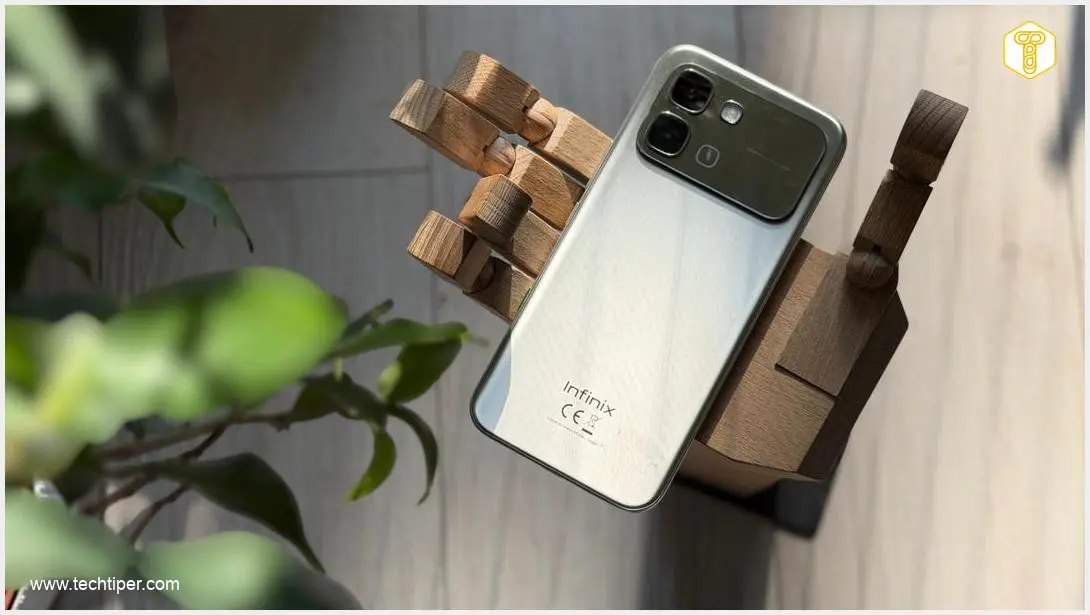
The camera module extends across the entire top section of the device, a design choice popular among several manufacturers recently. A slight drawback is the module’s highly reflective surface (though not mirror-like), which quickly attracts smudges, dust particles, and fingerprints. The lenses, only one of which actively captures images, visibly protrude, meaning the phone won’t lie perfectly flat on a surface. Adjacent to the lenses are the flash LED and an attractive, active “Halo Ring” that illuminates for notifications, adding a touch of elegance.
The Halo Ring is subtle and not overly intrusive, and its simplicity is appealing. It can serve practical purposes beyond aesthetics, such as lighting up for calls and notifications. Users can customize the style and color of the Halo Ring within the smartphone’s settings.
On the shorter edges, the JBL-tuned speakers stand out. They deliver powerful and clear audio, providing a commendable sound experience for streaming services like Netflix or gaming. The phone also includes a USB-C port and a dual nano-SIM card slot.
The left side of the phone is uncluttered, while the right side features standard volume and power buttons, along with a programmable green quick-access button. By default, a long press activates the camera application, but this can be reassigned to various functions via the Note Edge’s software.
Software Experience
The Infinix Note Edge runs on Android 16 with the XOS 16 overlay, and Infinix promises three major Android updates along with five years of security updates. This commitment to long-term support is a significant advantage in the mid-range segment.
The interface, much like many other Android 16-based skins such as ColorOS 16 and OriginOS 6, draws inspiration from more established competitors. The distinctive quick settings panel, large clocks on the lock screen, wallpaper depth effects, and a dynamic bar surrounding the front camera all bear a strong resemblance to iOS 26. As an iPhone user myself, I find this inspiration rather appealing.
Nevertheless, XOS 16 offers a wide array of features designed to enhance user experience and visual customization. These include extensive display settings, a dedicated game panel, power-saving modes, and personalization tools for icons, themes, and Always-on Display effects. The customizable One Tap button and the RGB Halo lighting further add to the unique user experience.
The latest version of XOS also integrates artificial intelligence features, such as an expanded AI Studio for photo editing, including image matte effects, object removal, and photo enlargement.
Cameras
The Infinix Note Edge doesn’t aim to top the charts of camera-centric smartphones. With a single 50 MP (f/1.8) main camera with autofocus and a 13 MP selfie camera, it won’t compete with photography powerhouses.
Photography enthusiasts might be interested in the Live Photo mode, which records images 1.5 seconds before and after the shutter press, combining the best elements to create an ideal shot. In portrait mode, the camera can simulate 24mm, 35mm, and 50mm lens effects, while Pro mode offers full manual control over all settings, from focus to ISO sensitivity.
In daylight, the Note Edge can capture decent photos with respectable detail and natural colors, though the algorithms, primarily for sharpening objects and subtly modifying colors, occasionally overemphasize contrast and saturation. While the camera uses AI to compensate for hardware limitations, the results still lag behind the leading mid-range photography models.
Image processing after pressing the shutter isn’t instantaneous; it takes a noticeable moment, especially in night mode. Night photography also yields less impressive results, with photos often appearing noisy and colors looking murky. Zooming in reveals poor detail and blurry edges.
Is the absence of an ultrawide camera a significant drawback? Users who enjoy landscape photography will likely feel its absence. However, given the quality of the main camera, it’s questionable whether an ultrawide lens would have produced satisfactory results anyway. We also advise against using the 2x digital zoom, as image quality significantly deteriorates.
Video recording is possible at a maximum quality of 2K 30fps, but without a steady hand or a gimbal, the results are often shaky. At 1080p, the quality improves slightly, offering decent results in good lighting conditions. In challenging environments, neither the software nor AI can compensate for the hardware’s shortcomings.
The front camera is adequate for occasional video calls or social media photos but won’t satisfy hardcore selfie enthusiasts.
Overall, considering the device’s price range, the cameras didn’t surprise us. The Infinix Note Edge delivers distinctly average photographic results compared to its competitors. Within the sub-$400 smartphone category, you can easily find much better options for photography.
Connectivity
The Infinix Note Edge supports most essential modules and connectivity methods required in a modern smartphone. It offers 5G network support, Wi-Fi 5, Bluetooth 5.4, and NFC for contactless payments.
The device also supports various GNSS systems, and physical ports include a single USB-C with host function (OTG). Importantly, it features an FM radio, which can be a valuable bonus for many users, though remember it requires headphones to operate.
A notable feature of the Infinix smartphone is its UPS 3.0 technology, designed to improve signal stability in “dead zones.” During the two weeks we spent with the smartphone, we experienced no issues with reception in elevators, tunnels, or underground garages, attesting to its effectiveness.
Additionally, the Note Edge supports eSIM and includes an infrared blaster, allowing the smartphone to function as a universal remote control.
Performance and Storage
At the heart of the Note Edge is the new mid-range MediaTek Dimensity 7100 processor (6nm). This octa-core chip features four Cortex-A78 cores clocked at 2.4 GHz and four Cortex-A55 cores at 2.0 GHz, coupled with Mali-G610 MC2 graphics.
It is paired with 8 GB of LPDDR5X RAM (with the option to virtually extend by another 8 GB, though real-world benefits are moderate) and 256 GB of UFS 2.2 internal storage, regrettably without microSD card expansion.
In terms of performance, this model ranks as merely average, positioning it in the lower half of the mid-range segment. Practically, this means it’s perfectly sufficient for social media, streaming, running multiple applications in the background, and playing most games, albeit likely not at the highest graphic settings.
In most everyday tasks, you won’t encounter any problems, particularly concerning temperature. You can game on it for extended periods without worrying about heat dissipation. Even if the casing temperature rises slightly, it won’t reach uncomfortable levels to hold.
Battery Life and Charging
The 6,150 mAh battery provides good battery life. With normal, mixed usage (social media, camera, 5G connection, some gaming), it realistically offers up to two days of use on a single charge.
How does this translate to specific tasks? Watching a 1.5-hour movie on Prime Video will deplete the battery by approximately 10%. Thirty minutes of navigation will result in about a 5-6% battery drop. The PC Mark application yielded the following results:
- Highest refresh rate (120Hz): [Insert PC Mark result here, as original content implies an image with results]
- Standard refresh rate (60Hz): [Insert PC Mark result here, as original content implies an image with results]
Frankly, we expected more impressive results, given the substantial battery capacity. Charging at 45 W allows the battery to replenish from 0 to 100% in about an hour, and to 50% in just over 25 minutes. For such a large battery, this is a very good result. Significant advantages include reverse wired charging (allowing the phone to charge other devices) and adaptive bypass charging, which bypasses the battery during intensive use while connected to the charger, reducing heat and battery degradation.
However, wireless charging is absent, a feature slowly appearing in some competitors within this segment, which could have been a strong selling point. Nevertheless, the Note Edge offers something unique that may extend battery longevity: Infinix’s industry-first “self-healing” battery technology. This innovative feature automatically repairs micro-damage to the battery cells through dynamic recrystallization after complete discharge, significantly reducing long-term degradation.
Specifications and Pricing
Here’s a detailed look at the specifications of the reviewed model:
| COMPONENT | DETAILS |
|---|---|
| System | Android 16 with XOS 16 |
| Display | 6.78-inch AMOLED, curved, 1208 × 2644 pixels, 120 Hz, Corning Gorilla Glass 7i, typical brightness 700 nits, peak brightness 4500 nits, Widevine L1 |
| Processor | MediaTek Dimensity 7100 (6nm), Mali-G610 graphics |
| RAM | 8 GB LPDDR5X |
| Internal Storage | 256 GB UFS 2.2 |
| Cameras | Main: 50 MP (f/1.8, AF) Front: 13 MP (f/2.2) |
| Connectivity | Dual SIM, 5G, 4G LTE (VoLTE), Bluetooth 5.4, Wi-Fi 802.11 b/g/n/ac (dual-band), NFC, FM radio, USB-C (USB 2.0, OTG), Infrared, eSIM |
| Navigation | GPS, GLONASS, GALILEO, BeiDou |
| Other Features | UPS 3.0 AI Super Signal technology, JBL stereo speakers, IP65 rating, four color options: Lunar Titanium, Shadow Black, Stellar Blue, Silk Green, accelerometer, ambient light sensor, proximity sensor, in-display fingerprint reader |
| Battery | 6150 mAh 45 W wired charging 10 W reverse wired charging |
| Dimensions | 163.1 × 77.4 × 7.2 mm |
| Weight | 185 grams |
The Infinix Note Edge is priced at approximately 1399 Polish Zloty (PLN) in some markets. This places it at a relatively high point within the popular mid-range segment (smartphones under 1500 PLN, or roughly under $400 USD), where devices like the Redmi Note series (e.g., Redmi Note 15), Realme models (e.g., Realme 12 Pro+), and OnePlus devices (e.g., Nord CE5) are popular.
The reviewed model would undoubtedly fare better if its price were lower. Its specifications, features, and performance suggest that a price in the range of 800-1000 PLN (approximately $200-$250 USD) would be far more reasonable. This is closer to its pricing in international markets, making its local price appear somewhat inflated.
Undeniably, the Infinix Note Edge possesses several strengths when pitted against rivals. Its bright, curved AMOLED screen, massive battery, remarkably slim chassis, comprehensive connectivity suite (eSIM, IR, FM radio), and appealing design work in its favor. However, it falls short of the competition in mobile photography capabilities, raw performance, update frequency, and brand recognition.
Infinix Note Edge Review: Conclusion and Our Opinion
The Infinix Note Edge is a smartphone with several solid advantages, but also some compromises and shortcomings that help keep its costs in check. It doesn’t try to be “all things to all people” or satisfy every potential buyer. Instead, the manufacturer has focused on delivering an ergonomic, well-crafted device for users who prioritize aesthetics and durability. However, if mobile photography and extensive long-term software support are your top priorities, competing phones may offer better value.
For users who prioritize the display, battery life, connectivity, and design, the Note Edge can be an attractive option. We recommend waiting for the price to drop to a more rational level, as its current pricing of 1399 PLN (or similar in other currencies) feels notably high for its overall offering.
Frequently Asked Questions (FAQ)
Is the Infinix Note Edge suitable for heavy gaming?
While the Infinix Note Edge can run most games, its MediaTek Dimensity 7100 processor places it in the lower half of the mid-range performance spectrum. For the most demanding games or playing at the highest graphic settings, it may not provide the smoothest experience. It’s more suited for casual gaming and everyday tasks.
How does the Infinix Note Edge’s camera perform in low light?
The Infinix Note Edge’s camera performance in low light is average, with photos often appearing noisy and lacking in detail. Colors can also look murky, and image processing in night mode is noticeably slow. If low-light photography is a priority, you might find better options in this price segment.
What is the “self-healing” battery technology in the Infinix Note Edge?
The Infinix Note Edge features an industry-first “self-healing” battery technology. This innovative system aims to extend the battery’s lifespan by automatically repairing micro-damage to the battery cells through a process called dynamic recrystallization, particularly after a complete discharge. This feature is designed to significantly reduce long-term battery degradation.
Source: Infinix
Opening photo: Jolanta Szczepaniak
About Post Author