
Contents
Record-Breaking Returns Show Growing Impact of Deposit Return Schemes
In a notable incident at a supermarket in a major city, a customer returned an unprecedented 920 packaging units in a single transaction, receiving a refund equivalent to hundreds of units of local currency. This significant event underscores a crucial trend: deposit return systems are no longer a mere curiosity but are becoming an integral part of everyday shopping routines.
A New Record for Packaging Returns
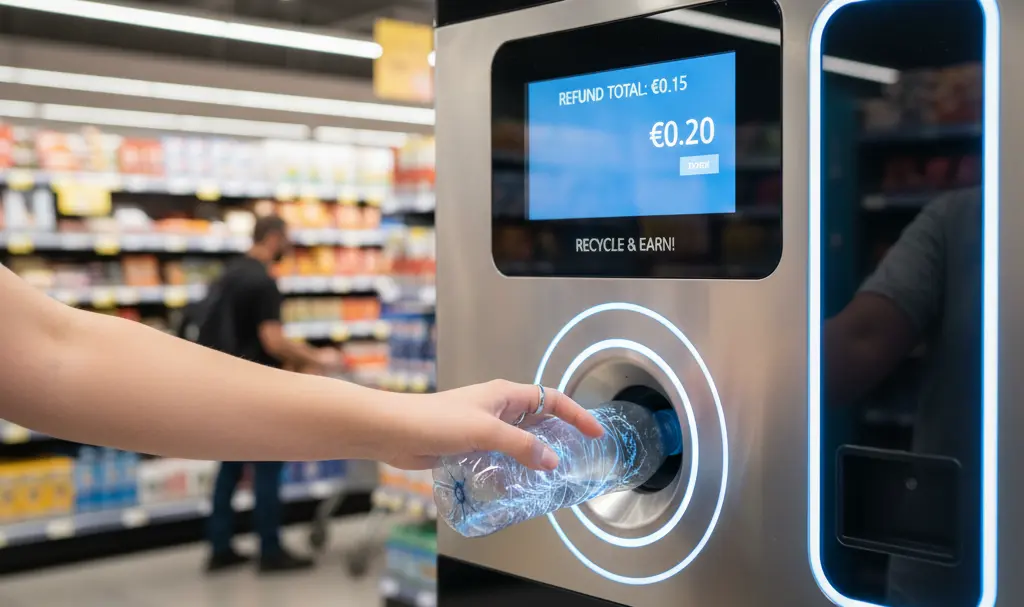
A specific supermarket outlet recently recorded an exceptionally large single return of deposit-eligible packaging. The customer brought 920 bottles and cans to the reverse vending machine, resulting in a substantial refund. While the sheer volume is attention-grabbing, it more importantly illustrates that many consumers are now treating bottle and can returns as a regular activity rather than an occasional task.
For many, this system is primarily a straightforward mechanism to recover money spent when purchasing beverages. While for some it might be a small amount, for others, especially with larger returns, it’s a way to reclaim dozens or even hundreds of units of local currency. It’s understandable that interest is growing, particularly as household budgets remain under careful scrutiny. You can learn more about managing finances in the context of various payment methods by reading our article on Cash vs. Card Payments: Navigating Your Financial Future.
Deposit Systems: From Novelty to Necessity
Major retail chains have reported collecting hundreds of millions of packaging units. For instance, one prominent retailer announced processing over 390 million units, with plastic bottles and cans making up the largest proportion. Currently, consumers primarily experience the simple benefit: they can recover their deposit without significant hassle.
However, from the perspective of retailers and manufacturers, the situation is less convenient. It necessitates adapting logistics, machinery, packaging circulation, and accounting processes. The larger the scale of returns, the more evident it becomes that this is no longer an experiment but a mandatory obligation the market must address. For insights into how retailers are adapting to new regulations and transparency, explore our piece on Retail Discount Transparency Changes.
This evolving landscape is particularly significant as the coming years mark the full implementation of such systems in many regions. There are also plans to expand deposit schemes to cover additional types of packaging. Companies that fail to comply with these regulations face the prospect of incurring additional fees, emphasizing the growing importance of these environmental initiatives.
Frequently Asked Questions (FAQ)
How do deposit return schemes benefit consumers?
Deposit return schemes allow consumers to reclaim a small deposit paid on beverage containers when they return them to designated collection points. This provides a financial incentive to recycle, helping individuals save money while contributing to environmental sustainability.
What are the challenges for retailers and manufacturers in implementing these systems?
Retailers and manufacturers face significant operational challenges, including investing in reverse vending machines, adapting store layouts, managing the logistics of collecting and transporting returned packaging, and updating accounting systems to handle deposits and refunds. These systems require substantial infrastructure and process adjustments.
Are there plans to expand deposit return schemes to include more types of packaging?
Yes, many regions are planning to expand their deposit return schemes to cover a wider array of packaging types beyond just plastic bottles and cans. This expansion aims to further reduce waste and increase recycling rates across various consumer products. Companies not adhering to these expanded regulations may face penalties.
Source: Municipal Portal, BusinessINFO.pl, Internal analysis. Opening photo: FotoDax / Adobe Stock
About Post Author
