
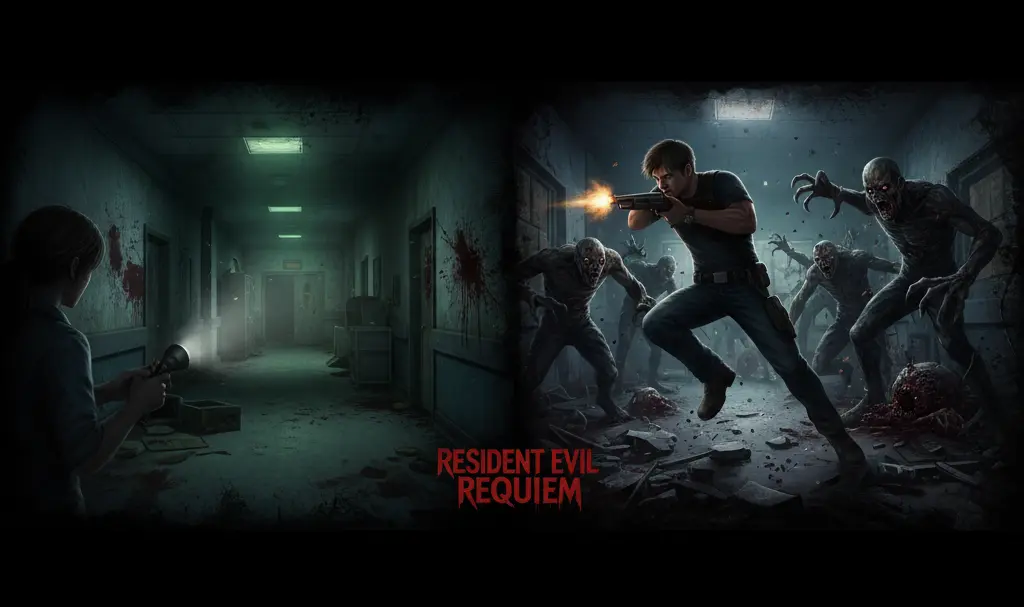
Resident Evil Requiem is the ninth main installment in the legendary saga that began in 1996 on the original PlayStation console. As someone who has historically steered clear of this horror series, I approached Requiem with a simple question: Does it make sense to start my Resident Evil journey with the latest entry? Surprisingly, it turns out I couldn’t have picked a better moment to jump into this thrilling franchise.
Contents
Resident Evil Requiem: A Modern Take on Classic Survival Horror
Resident Evil Requiem masterfully combines two distinct gameplay styles into one cohesive and exhilarating experience. Its exceptional audiovisual presentation is truly worthy of current-generation hardware, immersing players with stunning graphics and atmospheric sound design. The fantastic performances from all voice actors further elevate the narrative, bringing depth to each character.
The story maintains an excellent pace, ensuring that even players unfamiliar with previous games can fully grasp and enjoy the plot without feeling lost. Most importantly, Requiem delivers genuine scares, particularly throughout its gripping first half, keeping players on edge.
Key Strengths:
- Seamless blend of two distinct gameplay styles (survival horror and action).
- Stunning current-generation audiovisuals and sound design.
- Outstanding voice acting performances across the board.
- Well-paced narrative that is accessible to new players.
- Effective and consistent scares, especially in the early game.
Minor Drawbacks:
- Occasional frustrating save points lead to longer re-dos after death.
Story Overview: A Dual Perspective of Terror and Resolve
The narrative of Resident Evil Requiem plunges players into a compelling, dual-perspective story. Grace Ashcroft, an FBI analyst, travels to an abandoned hotel to investigate another body found in a mysterious series of murders. This task is particularly harrowing for Grace, as her mother was murdered there eight years prior, right before her eyes. The corpse at the hotel turns out to be a trap, and Grace is abducted by a deranged scientist, Victor Gideon. It is revealed that Grace is somehow the key to a larger, sinister discovery being pursued by truly evil individuals.
However, Gideon makes a critical mistake by murdering one of the police officers investigating the case. This act alerts Leon S. Kennedy, a veteran agent from the Division of Security Operations (DSO) specializing in combating bioterrorism, to Grace’s abduction. Suddenly, the scientist finds himself with two major problems: Grace, who will overcome her fear with each passing minute, and Leon, who will make the mutants fear him instead.
As a personal aside, while I’ve largely avoided survival horror, I did have a fondness for Dino Crisis (1999) on the PS1—a Capcom game akin to Resident Evil, but featuring dinosaurs instead of zombies and mutants. This background made me particularly excited to experience modern horror from the same studio firsthand.
Grace Ashcroft’s Journey: Tense Survival Horror
The game begins with an extensive, slow-paced, multi-hour section playing as Grace, primarily in the first-person perspective (FPP) as recommended by the developers. Even with the option for unlimited saves (on standard, modern difficulty), I approached every small bit of progress with extreme caution. Capcom masterfully builds dread through expertly delayed jumpscares, fantastically grotesque elite mutant designs, and frequent tactical choices. Do you try to eliminate smaller zombies to clear the path, or conserve precious ammunition for potentially greater threats?

What surprised me most was how little the core mechanics have truly changed since 1999. I quickly settled back into the rhythm of checking every open door, thoroughly reading notes, and planning my next move. This gameplay loop is particularly satisfying when you encounter and solve a puzzle efficiently. Simple item combining, a staple of PS1-era games, is also present, but with a modern twist: I no longer needed to write down codes or remember where I left potentially useful items. Everything is clearly displayed on a very intuitive map, accessible at any point in the game.

This isn’t to say Grace’s journey through the first half of the game was easy. I frequently found myself short on ammunition and healing items at crucial moments. The game also throws curveballs with scripted interactions, giving you mere seconds to figure out what needs to be done. Immersion is significantly enhanced by Grace’s excellent voice actress, whose voice frequently trembles with terror. And then there’s the pervasive darkness. Your flashlight helps, but it also attracts “the girl,” one of the mansion’s primary threats. Thankfully, the hint system after death is helpful, though the lingering shame of failure remains.
Seemingly One Game, But Actually Two: Leon S. Kennedy’s Action-Packed Intervention
Upon launching Resident Evil Requiem, the developers offer a subtle suggestion: play as Grace in first-person and Leon in third-person. While players have complete freedom, keen observers will quickly understand the developers’ intent. Initially, Leon’s sections serve as brief interludes from Grace’s slower, more deliberate gameplay—a 10-minute segment here, a quick shootout there, often ending with a one-liner worthy of Schwarzenegger or Stallone. Such is the nature of Leon S. Kennedy.
Later, however, you control Leon for several solid hours, drastically transforming Resident Evil Requiem into a new, more action-oriented experience. Yet, because the fates of both characters become so deeply intertwined, the second half never feels disconnected from the first.

Simply put, the mutants are in for a bad time. Leon doesn’t hesitate to use an axe, machine gun, shotgun, or even a chainsaw. The game becomes much more generous with ammunition and throws enemies at the player in increased numbers, leaving no doubt that blood will flow—not just as a last resort, as in Grace’s segments. The strength of Resident Evil Requiem’s action portions lies in its skillful balancing of difficulty. Yes, Leon can purchase ammunition, weapons, and upgrades at save points using points earned from killing mutants. (A side note: this mechanic was also present in the more action-focused Dino Crisis 2 (2000)).
As a result, you feel like Leon is a formidable machine, kicking enemies left and right. However, a slight lack of caution can still lead to running out of ammo before the next save point, forcing improvisation. A symbol of this balance is the Requiem revolver, capable of taking down mutants with single shots. Unfortunately, you’ll find perhaps only 20 rounds for this marvel throughout the entire game, so it must be treated as a last resort, regardless of which character you’re playing.
The cherry on top is the segments requiring quick thinking. Perhaps you can shatter glass to make an enemy fall into a chasm, or use a nearby axe to conserve your own resources. There are even arcade-style sequences, like shooting mutated dogs from a speeding motorcycle. When it’s time to go wild, you go wild!

Why I Can’t Focus on This Game’s Flaws
Even after sleeping on it, I genuinely struggle to pinpoint any serious flaws in Resident Evil Requiem. Grace’s slower gameplay serves to uncover the extent of the human experimentation carried out by Victor Gideon and his cronies. Occasionally, an unfortunate save point might force you to repeat a longer, 10-minute segment. However, across 15 hours of gameplay, this only happened to me two or three times, making it more of a minor observation than a significant complaint.
Those 15 hours are crucial. It’s the ideal playtime, ensuring that neither gameplay style ever overstays its welcome or becomes boring. The mystery surrounding Grace’s uniqueness is maintained until the very end, and the personal struggles of both heroes stand out even more against the backdrop of another scandal involving the now-defunct Umbrella Corporation. Despite my initial apprehension, I was eager to discover what would happen next, resulting in a fantastic gaming mixtape spanning two distinct genres.
Moreover, for those who crave more, Capcom offers a classic difficulty mode (with limited saves) or the “Madness” mode, perfect for true maniacs. When you add phenomenal sound design (including the haptic vibrations of the DualSense controller) and current-generation visuals running at a consistent 60 FPS, Resident Evil Requiem solidifies its place as an instant classic of the 9th gaming generation.
The game only makes minor references to previous installments, making it an excellent standalone experience. After finishing Requiem, you could easily jump into titles like Resident Evil 4 Remake (2023), which also features a slightly younger Leon S. Kennedy. If you’ve never played a Resident Evil game before, don’t worry. Requiem is a fantastic moment to begin this adventure.
Frequently Asked Questions (FAQ)
Is Resident Evil Requiem suitable for new players to the series?
Yes, absolutely! The game’s narrative is well-paced and doesn’t require extensive knowledge of previous Resident Evil titles. The reviewer, a newcomer to the series, found it to be an ideal starting point.
How long is Resident Evil Requiem?
Resident Evil Requiem offers approximately 15 hours of gameplay. The reviewer praised this length as ideal, preventing either of the game’s distinct gameplay styles from feeling repetitive or overstaying its welcome.
What are the main gameplay styles in Resident Evil Requiem?
The game cleverly combines two styles: tense, first-person survival horror when playing as Grace Ashcroft, focusing on resource management and dread; and action-packed, third-person combat when playing as Leon S. Kennedy, featuring more aggressive gunplay and melee.
Source: Original Content. Opening photo: Gemini
About Post Author
