
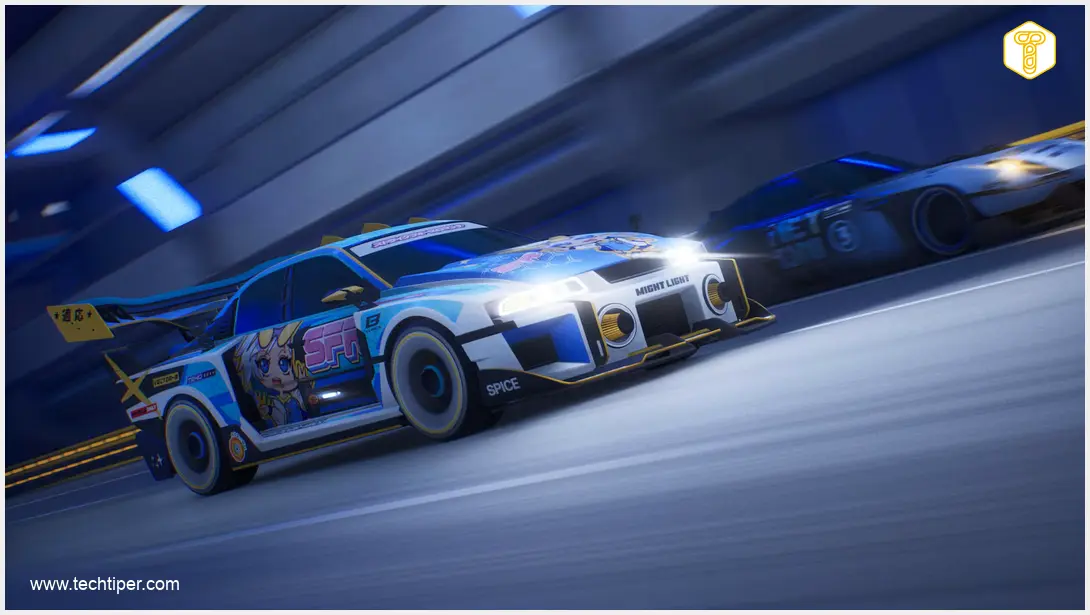
Screamer emerges as a rare breed in the contemporary arcade racing genre, a title from a major publisher that genuinely attempts to carve out its own identity. It’s brimming with fresh ideas, yet glaring signs point to a constrained budget. Despite being priced similarly to more popular racing games, Screamer struggles to compete in the same league, leaving players to wonder about its true potential.
Contents
Screamer Review: A Unique Arcade Racer’s Budget Dilemma
Screamer aims to be an arcade racer wrapped in vibrant anime aesthetics. The core experience revolves around its main tournament mode, which kicks off with an opening sequence reminiscent of popular Japanese animated series. These animated segments, crafted by Polygon Pictures (known for their work on titles like Love, Death & Robots), add a touch of cinematic flair to the game’s presentation.
The Thrill of Dual-Stick Drifting: A Fresh Take on Racing Controls
Inspired by the indie title Inertial Drift (2020), Screamer introduces a distinctive dual-analog stick driving model. The left stick handles steering, while the right stick is dedicated to drifting. This unique control scheme makes drifting not just a mechanic but an essential part of navigating the game’s often winding tracks. Even for seasoned veterans of racing simulations like Gran Turismo 7 or rally titles like EA Sports WRC, the initial hours present a rewarding learning curve as players master the nuances of each character’s drift characteristics.
While gear changes are automatic, Screamer encourages manual upshifts as a way to charge your nitro meter faster. Adding another layer of strategy, chaining two nitro boosts activates the powerful STRIKE ability. This short, aggressive boost allows players to take down opponents if they can get close enough and aim precisely. During races, players monitor two crucial bars above their vehicle: one for nitro and the other for the STRIKE ability status.
Thankfully, the racing itself stands out as Screamer’s strongest suit. On standard consoles, the game maintains a stable 60 frames per second, ensuring a fluid and engaging experience. Even on normal difficulty, AI opponents offer a genuine challenge, pushing players to maximize every nitro opportunity and takedown attack to secure victory. The tournament mode frequently throws in additional challenges, such as requiring a certain number of takedowns, adding a strategic depth beyond just finishing first.
Narrative Ambitions Meet Budgetary Realities
Screamer’s narrative unfolds primarily through static dialogue scenes where characters express their thoughts. While all dialogues are voiced, the sheer volume of text might deter some players. The initial chapter is particularly chaotic, attempting to introduce threads for 12 different characters simultaneously, making it challenging to immerse oneself in the tournament’s storyline. The narrative significantly improves from the second chapter, which organizes its stages into main and side sequences focusing on specific teams, making the plot much easier to follow.
Visually, the character designs are a highlight. The roster features diverse and appealing teams, including a traditional Japanese clan, a corporate team, a space agency crew, and a charming J-pop girl band. A fascinating detail, much like in the Tekken fighting game series, is that characters speak different languages—predominantly Japanese—without any in-game barriers to communication, adding to the game’s global appeal.
However, despite the intriguing characters, the tournament structure itself feels underdeveloped. A lack of a constantly updated scoreboard or a clear sense of progression undermines the stakes of the 100 billion dollar prize. This absence leaves the tournament feeling more like a casual outing than a high-octane competition, with characters often appearing disengaged from their personal objectives, causing the story to stagnate while players simply race.
Visuals and Audio: A Mixed Bag
Screamer features several visually appealing, colorfully designed urban tracks. However, the game’s charm diminishes when races transition to more open environments, which often appear bare and lacking in detail, with colors that feel washed out. The variety of locations is also quite limited; 32 tracks are spread across only four distinct environments.
The electronic music soundtrack, while energetic and dynamic, doesn’t quite leave a lasting impression. More memorable and genre-defining choices, perhaps drawing from eurobeat or K-pop artists, could have significantly elevated the racing experience and cemented the game’s stylistic identity.
Is Screamer Worth the Premium Price Tag?
The most significant hurdle for Screamer is its price point. Positioned at a premium price for consoles, it enters a market where it directly competes with established giants like Forza Horizon 5, which offers a far more expansive and polished experience for the same cost. To justify its price, Screamer would need more animated cutscenes, greater environmental diversity, a bolder visual and musical style, and a more refined narrative.
Despite these criticisms, Screamer undeniably possesses immense potential. The innovative dual-stick driving model is highly successful, offering a genuinely satisfying experience. The character and team designs are strong enough to quickly establish player favorites. Ultimately, what Screamer seems to lack most is a more robust audiovisual presentation that could have elevated it to a contender for the most iconic racing game of the current generation. Perhaps upcoming titles like Star Wars: Galactic Racer will succeed where Screamer fell short.
Frequently Asked Questions (FAQ)
What is the unique control scheme in Screamer?
Screamer features a unique dual-analog stick driving model, where the left stick controls steering and the right stick is dedicated to drifting, making it an essential part of gameplay.
Does Screamer have a strong narrative?
Screamer attempts a story-driven tournament with numerous characters and voiced dialogue scenes. However, the narrative is often diluted by static presentations and a chaotic introduction of characters in the early stages, making it difficult for players to fully engage.
How does Screamer’s price compare to its content and competitors?
Screamer is sold at a premium price, which places it in direct competition with more established and content-rich titles like Forza Horizon 5. While it offers unique gameplay, its limited environmental variety, fewer animated cutscenes, and sometimes stagnant narrative make its value proposition questionable compared to its peers.
What improvements could elevate Screamer to an iconic status in the racing genre?
To achieve iconic status, Screamer would benefit from a more streamlined and engaging narrative, increased diversity in track environments beyond the current four locations, a bolder and more memorable music soundtrack (perhaps drawing from well-known artists in relevant genres), and an overall more polished audiovisual presentation that truly matches its innovative driving mechanics and appealing character designs.
Source: Self-made. Opening photo: Screamer / Press Materials
About Post Author
