
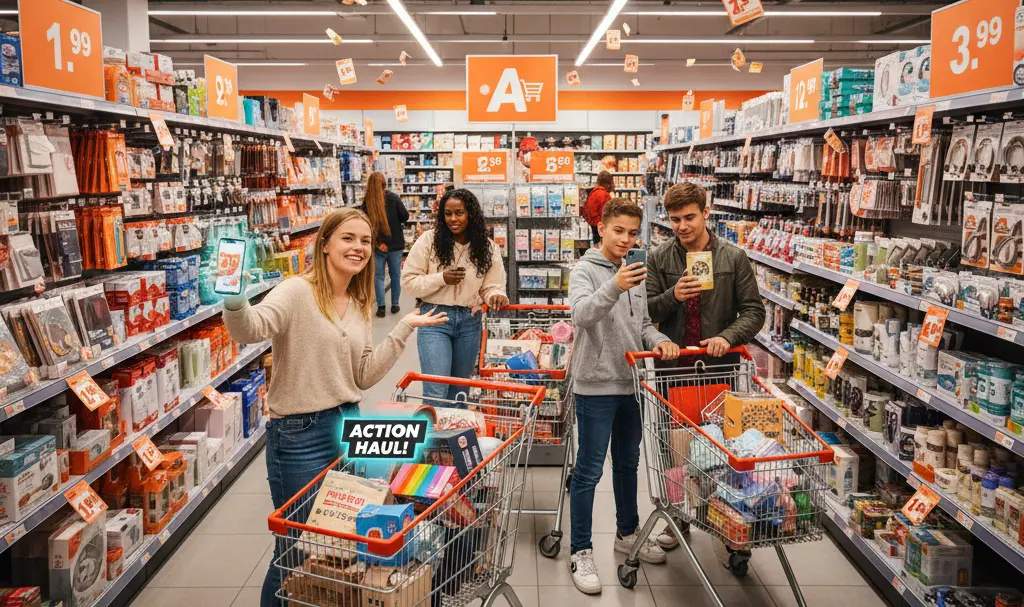
An online post about a carpet cleaner garners nearly 100 likes, while a video showcasing a solar fountain attracts thousands of views. These numbers aren’t surprising when considering that both gadgets are available at Action, a popular discount retailer, for a fraction of the price found elsewhere. Shoppers also actively seek out affordable trackers, RGB LED strips, garden gnomes, and egg timers – among thousands of other items they’ve discovered through social media.
This phenomenon allows consumers to shop frequently and abundantly at Action, underscoring the immense popularity of the Dutch retail chain.
Contents
The Action Phenomenon: How Discount Retail Captivates Millions
The Social Media Powerhouse Behind Action’s Success
The unofficial “Action Polska” Facebook group currently boasts an impressive 1.5 million members. Daily, new posts emerge featuring “recommendations,” where users share their experiences with various products. Someone buys, tests, and then decides to share their honest impressions, helping others determine if an item is worth its modest cost, often just a few dollars or euros.
Action, much like online giants such as AliExpress and Temu, entices customers with the promise of “shopping like a millionaire”—indulging in desires without constantly checking price tags. This holds true even for impulse buys or gadgets that might be forgotten in a few weeks. This accessible approach encourages a cycle of frequent and extensive consumption.
Understanding Consumer Behavior: The Drive to Possess
Marianna Kupść, founder of Kern Institute and a specialist in consumer behavior, sheds light on this trend. She explains that the desire for possession is a direct outcome of a global economic logic where success is often measured by GDP growth.
“It boils down to the belief that the more we produce and consume, the better,” Kupść notes. “Countries with the highest GDP are considered the world’s most developed economies and, by extension, economic powerhouses. High GDP attracts investment and commands respect, signifying substantial economic strength.”
This economic narrative often fosters a subconscious belief that by consuming at the same level as a billionaire, we might somehow become like them. It suggests that the quantity of possessions reflects personal success and, consequently, a source of life satisfaction. To learn more about broader trends in discount retail, read our article: The Price War: Shein and Temu Threaten Retailers Across Europe.
The Magic of TikTok and the Decline of Traditional Advertising
While low prices undoubtedly fuel consumption, social media plays an equally significant role, constantly barraging users with product tests, reviews, and shopping hauls. Products quickly achieve viral status and, just as rapidly, disappear from shelves. This is evident in groups like “Action Polska,” where users frequently request others to purchase and mail them items because they are no longer available in their local stores.
This creates a powerful perception that a particular product is high-quality and worth attention—after all, it’s constantly appearing online for a reason. Social proof remains one of the most potent marketing mechanisms. While fewer people are swayed by traditional advertisements featuring actors with perfect smiles, the opinions of fellow customers can be the decisive factor in whether an item makes it into the shopping cart.
The Psychology of the “Hunt” and Scarcity
Adding to this is the psychology of the “hunt”—a concept as old as commerce itself, now amplified by social media. Facebook groups and images of empty shelves create a sense of urgency. High demand leads to products vanishing from stores at an astonishing pace, triggering another powerful mechanism: the rule of scarcity.
Research from the 1970s already demonstrated that hard-to-find items appear more valuable than those gathering dust on shelves for weeks. The effect is even stronger when a product disappears suddenly. Not only does its attractiveness increase, but so does the feeling that something unique and desirable is slipping away.
Everything now happens much faster. Social media has condensed a product’s lifecycle to mere days, sometimes even hours. A Deloitte study revealed that a remarkable 65% of TikTok users purchased a product they discovered on the platform, and 75% consider a recommendation from an independent creator more credible than a traditional advertisement. For more insights into how social media shapes our online choices, consider reading: The Psychology of Social Media Lurkers: Conscious Choices for Digital Well-being.
Algorithms are relentless. If you pause on one short review video, you’ll soon be presented with ten more. Products begin to repeat, leading to the impression that “everyone has it”—except you. Consequently, we often buy not because we lack something, but due to exposure—what we see and how often we see it. Consumption is no longer a response to a genuine need but a reaction to a constant stream of stimuli.
Action Raises the Bar: 150 New Products Weekly
Paweł Essel, Action’s General Director in Poland, explicitly states that the chain prioritizes continuous product rotation. The goal at Action is for customers to rarely get bored and to shop frequently.
“Action offers 6,000 good-quality products across 14 categories at the lowest prices,” Essel explained in an interview. “Only one-third of our assortment is permanent, and we introduce 150 new products every week. This means our offering is surprising, current, and tailored to customer needs. This is a key element of our success and what differentiates us from other retailers.”
His predecessor, Sławomir Nitek, called this strategy a “unique business idea.” He argued in an interview that “regardless of the situation, customers have the right to live comfortably, spend their free time attractively, and develop their hobbies.”
The narrative of accessibility is convenient and noble, as everyone should have the right to a comfortable life or to own nice things. However, there’s a fine line between accessibility and overproduction. Action, perhaps more than any other retailer, blurs this line—selling not just products, but also fostering the feeling that there can always be more.
Beyond Products: Action Sells a Unique Feeling
Does this imply that Action sells low-quality products disguised by clever marketing? Not at all. Many of their items rival those found in other stores, but at significantly lower prices. And while occasionally one might encounter a faulty item, such instances occur everywhere.
However, the real story isn’t just about product quality or prices. Everything operates according to a well-executed plan: the chain rotates inventory, tempts with new arrivals, and maintains low prices. Customers browse, compare, recommend to each other, and buy. The 1.5 million users in the “Action Polska” group serve as compelling evidence that the Dutch chain’s model works flawlessly—it perfectly meets the desire to acquire more, faster, and cheaper.
Therefore, we often purchase not just a product, but also the sensation of having found a bargain, of having acted quickly, of being one step ahead of others this time.
And that, as full shopping carts and empty shelves attest, remains the most successful selling strategy.
Frequently Asked Questions (FAQ)
How does Action manage to keep its prices so low compared to other retailers?
Action employs a strategy of high-volume purchasing, efficient supply chain management, and a focus on a constantly rotating assortment of products. By sourcing goods in large quantities and frequently introducing new items, they create a dynamic shopping environment that encourages impulse buys and leverages economies of scale, passing the savings on to customers.
What role do social media platforms like TikTok play in Action’s sales strategy?
Social media is crucial for Action’s success. Platforms like TikTok generate viral trends and “haul” videos where influencers and everyday shoppers showcase their purchases. This creates strong social proof, making products quickly desirable and often leading to rapid sell-outs. This organic, peer-driven marketing is highly effective and more trusted by consumers than traditional advertising.
Is Action’s business model sustainable in the long term, given its focus on rapid consumption and low prices?
Action’s model thrives on high sales volume and efficient inventory turnover, which currently makes it very successful. However, the long-term sustainability is subject to ongoing debate within the retail industry. Factors such as supply chain resilience, ethical sourcing practices, environmental impact of rapid consumption, and evolving consumer preferences for sustainability will likely play significant roles in its future trajectory. Retailers in this segment constantly adapt to these pressures.
Source: Original article. Opening photo: Gemini
About Post Author
