Contents
Xiaomi 17 Ultra Review: The Smartphone That Aspires to Be a Camera
It’s often said that the best camera is the one you have with you. While this statement holds some truth, the Xiaomi 17 Ultra review demonstrates just how far mobile photography has advanced. The photos captured with this tested smartphone are genuinely stunning. But what is it like to use Xiaomi’s most advanced smartphone in everyday life?
Table of Contents
- Package Contents
- Design and Build Quality
- Display
- Battery Life
- Cameras
- Photo Quality
- Software and Performance
- Specifications and Pricing
- Conclusion: Our Verdict
Xiaomi 17 Ultra: At a Glance
The Xiaomi 17 Ultra is an undeniably impressive smartphone. Its expansive camera module, known as the “island,” immediately catches the eye, but it’s the exceptional quality of its photographs that truly leaves a lasting impression. Beyond its imaging prowess, this is a true flagship device, designed for the most demanding users who seek uncompromising performance.
Pros
- Striking design and premium build quality
- Top-tier performance and ample storage configurations
- Phenomenal photo quality in all conditions
- Excellent video recording capabilities
- Solid battery life and fast charging
- Large, bright OLED display with slim bezels
- High-quality stereo speakers
Cons
- Heats up quickly under heavy load
- Global version battery capacity is smaller than the Chinese variant
- Lacks a physical camera shutter button, which some users might miss
- Excessive pre-installed applications (bloatware) in HyperOS 3
Package Contents
The Xiaomi 17 Ultra arrives in Xiaomi’s characteristic large white box. While the packaging itself is substantial, the included accessories are fairly standard. This suggests that the era of Chinese manufacturers consistently bundling chargers with their phones has definitively ended.
The box features a two-tier design. The upper tier houses a compartment with accessories, including a relatively long USB-A to USB-C cable, a SIM tray ejector tool, a transparent hard plastic case, and a set of instruction manuals. The lower tier is reserved for the smartphone itself.
Design and Build Quality
The design of the Xiaomi 17 Ultra continues the aesthetic introduced with the 2023 13 Ultra model, which featured a large, circular camera island. Over the past three years, minor details have evolved, but Xiaomi remains committed to this proven design language.
In person, the smartphone makes an excellent impression, especially in the “Starlight Green” version I tested, which boasts shimmering particles. The device is also available in classic black and white, ensuring that fans of traditional aesthetics will not be disappointed.
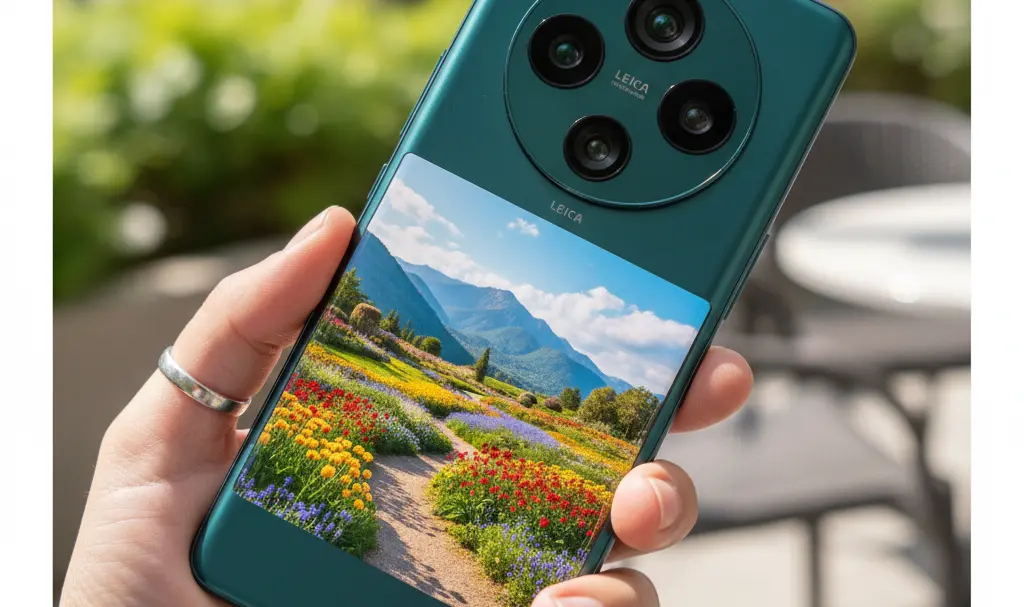
As mentioned, the rear panel is dominated by the enormous, protruding camera island, branded with the Leica logo. Its central placement ensures the smartphone lies flat without wobbling on surfaces. While the limited edition Leica Leitzphone by Xiaomi features a rotating ring, the island on the standard Xiaomi 17 Ultra is fixed, though its edge is adorned with a textured finish.
The “Ultra” logo is discreetly placed in the upper left corner, and the Xiaomi logotype is positioned at the bottom. I appreciate that the model designations and certification marks have been moved to the frame, resulting in a clean and elegant rear panel. The color and finish effectively conceal dirt and fingerprints.
The Xiaomi 17 Ultra utilizes premium materials and boasts uncompromising build quality. Its weight is typical for a flagship device; it is heavier than the hypothetical OnePlus 15 but lighter than the OPPO Find X9 Pro. The construction includes robust sealing, with an IP68 certification guaranteeing the smartphone can withstand accidental submersion in water without damage.
The metal frame is color-matched to the device’s rear. Only antenna bands are visible on the top edge and the left side of the smartphone.
On the opposite side, Xiaomi has placed the power button and separate, circular volume keys. It’s a missed opportunity that Xiaomi didn’t include a physical camera shutter button. The bottom edge houses the speaker grille, a USB-C port, a microphone opening, and a dual SIM card tray.
The Xiaomi 17 Ultra is equipped with dual stereo speakers. While the upper driver is slightly quieter than the lower one, the stereo effect is impressive. The sound is rich and deep, making movie watching, TV series binging, and gaming on the Xiaomi 17 Ultra a truly enjoyable experience. However, the audio quality falls slightly short of the outstanding Google Pixel 10 Pro XL in this regard.
The front panel epitomizes flagship designs expected in 2025 and 2026. It features a flat sheet of Xiaomi Shield Glass 3 and slim bezels. The front-facing camera is located at the top edge, while an ultrasonic fingerprint reader is positioned lower, near the bottom edge. This sensor is both convenient and fast.
Display
The front of the device is dominated by its enormous 6.9-inch HyperRGB OLED screen. This panel boasts a high resolution of 2608 × 1200 pixels and a variable refresh rate ranging from 1 to 120 Hz. Image quality is fantastic; blacks are incredibly deep, and vibrant, saturated colors make content consumption a pure pleasure.
The display achieves a maximum brightness of up to 3500 nits. Throughout my testing, even when photographing in bright sunlight, visibility remained excellent. The minimum brightness also performs exceptionally well, ensuring that checking the time at night is not an issue.
Battery Life
The Chinese version of the Xiaomi 17 Ultra offers a substantial 6800 mAh battery. Unfortunately, the global version has been significantly scaled back, providing users with only 6000 mAh in devices distributed internationally. While this capacity is higher than, for instance, the Galaxy S26 Ultra, Chinese competitors like the OPPO Find X9 Pro feature an even larger 7500 mAh cell.
As a result, the Xiaomi 17 Ultra doesn’t offer the longest battery life on the market, but it’s still quite good. I typically needed to charge the device every 1.5 days, and less demanding users could easily achieve two days of use.
The tested smartphone supports 50-watt wireless charging and 90-watt wired charging. Although I didn’t have a Xiaomi power brick, I used a 90-watt Huawei charger for the charging test. The first 50% charge was reached in just 19 minutes, and a full charge took 62 minutes.
Cameras
Photography is a category where the Xiaomi 17 Ultra is designed to shine, a fact underscored by its massive and comprehensive camera island featuring Leica branding. The ultrawide camera is a 50 MP unit (f/2.0, 14mm). Even more impressive is the 1-inch main sensor (f/1.67, 23mm). The true highlight, however, is the telephoto lens with a variable focal length of 75-100mm, translating to 3.2x to 4.3x optical zoom. Its aperture is also variable, ranging from ƒ/2.39 to ƒ/2.96.
A well-designed camera application greatly aids the photography experience. The interface is intuitively laid out, offering a multitude of modes and options without feeling overwhelming. Crucially, the default photo mode intelligently selects parameters, allowing the user to focus purely on framing the shot. The software operates swiftly and smoothly. While I personally prefer the simplicity of Pixel camera apps, taking photos with the Xiaomi 17 Ultra was equally enjoyable.
Photo Quality
Daylight Performance
It comes as no surprise that daytime photos are phenomenal. The ultrawide lens captures a vast scene, the main camera performs perfectly, and the variable focal length on the telephoto lens proves incredibly useful. While the change between 3.2x and 4.3x isn’t colossal, it provides significant flexibility in framing. The only minor drawback is a slight color shift between the ultrawide and main cameras.
Zoom Capabilities
Encouraged by the detail from the optical lenses, I experimented with even greater zoom levels. The Xiaomi 17 Ultra handles image processing impressively well. While algorithms are undoubtedly at play, photos taken at 8.6x magnification appear remarkably natural.
Nighttime Photography
After dark, the smartphone truly demonstrates its class. The ultrawide camera performs adequately; details can sometimes merge, but noise is not overly intrusive, and a fair amount of detail is visible in shadows. The main camera, however, performs brilliantly. It captures abundant detail, colors are accurate, and streetlights don’t overexpose the images.
The telephoto lens also deserves high praise. Despite its ƒ/2.39-2.96 aperture, it can capture beautiful, noise-free night photos. The Xiaomi 17 Ultra left a huge impression on me with its nighttime capabilities.
Selfie Camera
The selfie camera was somewhat disappointing. Regular photos and daytime portraits are decent. I appreciate that Xiaomi doesn’t automatically blind you with a screen flash, but in low light, the amount of detail captured is poor.
Video Recording
The smartphone records video in 4K at 120 frames per second or 8K at 30 FPS. During the day, the results are captivating. There’s a wealth of detail, colors look natural, and the footage is smooth, aided by excellent stabilization. The smartphone expertly selects parameters and quickly and accurately adjusts focus. Nighttime video is acceptable; 4K recordings are impressive, but 8K footage exhibits noticeable noise.
Software and Performance
Software Experience: HyperOS 3
The smartphone arrived with Android 16, overlaid with Xiaomi’s HyperOS 3 interface. While I personally favor more minimalist operating systems, the Xiaomi 17 Ultra’s interface is quite cohesive. The animated wallpaper looks excellent, and the customization options offer a plethora of possibilities.
The device also includes Xiaomi HyperAI tools such as the “AI Creative Tools Assistant,” “AI Writing,” and “AI Speech Recognition.” During my testing, I used several of these solutions, and they performed well. HyperOS 3 can indeed be appealing, though it does have its drawbacks.
The biggest downside of the software is the sheer number of applications. While the quantity of third-party apps is less than on realme or OPPO smartphones, I found Xiaomi’s own applications, which duplicated other solutions, to be bothersome.
As a result, the device comes with two browsers, two gallery apps, two app stores, and a dedicated QR code scanner. Worse still, some Xiaomi applications display advertisements. While not terrible, HyperOS did not become my favorite custom Android skin.
Performance: Snapdragon 8 Elite Gen 5
The Xiaomi 17 Ultra features flagship-level hardware. Xiaomi has utilized the most powerful mobile chip currently available, the Snapdragon 8 Elite Gen 5. Storage starts at 512GB, and every version comes with 16GB of RAM. Consequently, the smartphone operates like a rocket; all applications load quickly and run smoothly.
The tests were conducted before the global premiere, meaning not all benchmarks were fully functional. The results that were gathered are typical for this class of device, indicating that only other smartphones equipped with the same processor can offer higher performance.
I’ve been using the Xiaomi 17 Ultra for nearly two weeks. In daily use, I didn’t experience issues with case temperatures, as browsing the internet or social media isn’t a challenge for the Snapdragon. Unfortunately, under heavy load, the device does get hot. The tested unit would shut down the AnTuTu Stress Test after approximately 10 minutes, with temperatures reaching 47 degrees Celsius near the camera island.
Specifications and Pricing
The Xiaomi 17 Ultra, in its 512GB configuration, is priced at approximately $1899. This makes the tested device a true flagship in terms of cost. However, it must be acknowledged that Xiaomi has carved out a unique niche for itself. There isn’t another smartphone on the market that combines a flagship Snapdragon processor with such an advanced camera system.
| COMPONENT | DETAILS |
|---|---|
| System | Android 16 with HyperOS 3 |
| Display | 6.9″ LTPO HyperRGB OLED, 1-120 Hz refresh rate, 2608 × 1200 pixels, up to 3500 nits peak brightness, Xiaomi Shield Glass 3 |
| Processor | Snapdragon 8 Elite Gen 5 Mobile Platform |
| RAM | 16 GB |
| Internal Storage | 512 GB / 1 TB |
| Cameras | Rear Cameras: 50 MP main (f/1.67, 23mm), 50 MP ultrawide (f/2.0, 14mm), 200 MP telephoto (75-100mm, ƒ/2.39-2.96) Front Camera: 50 MP (ƒ/2.2, 21mm) |
| Connectivity | 5G + Wi-Fi 7 + Bluetooth 5.4 |
| Other Features | Ultrasonic fingerprint reader, IP68 rating, 4-microphone array |
| Battery | 6000 mAh, 90 W wired charging, 50 W wireless charging |
| Dimensions | 162.9 × 77.6 × 8.29 mm |
| Weight | 219 g |
Conclusion: Our Verdict
Approaching the Xiaomi 17 Ultra tests, I expected a solid smartphone with good cameras. Despite my expectations, the device surprised me. It is arguably the best camera smartphone I have ever tested. Beyond its photographic prowess, it is a very robust device with flagship capabilities across the board. The screen, performance, and even battery life are all on point.
The design does have a few minor imperfections, such as the typically “Chinese” system with numerous pre-installed applications, the smartphone heating up under load, and the battery capacity being inferior to the version sold in its home market. However, these are minor details, and the Xiaomi 17 Ultra ultimately stands as a complete flagship device.
Frequently Asked Questions (FAQ)
Is the Xiaomi 17 Ultra good for photography?
Yes, the Xiaomi 17 Ultra is exceptionally good for photography. It features a advanced camera system with a 1-inch main sensor, a versatile ultrawide lens, and a telephoto lens with variable focal length, delivering phenomenal photo quality in various conditions, including challenging low-light scenarios.
What are the main drawbacks of the Xiaomi 17 Ultra?
While an excellent device, its primary drawbacks include heating under heavy load, a slightly reduced battery capacity in the global version compared to the Chinese model, and the presence of bloatware/duplicate apps in its HyperOS 3 software interface.
What is the price of the Xiaomi 17 Ultra?
The Xiaomi 17 Ultra, in its 512GB configuration, is priced at approximately $1899, positioning it as a premium flagship smartphone in the market.
Source: Gemini. Opening photo: Gemini
About Post Author