

Contents
Nissan Ariya Nismo Review: An Electric SUV with a Sporty Edge, Even if Refined
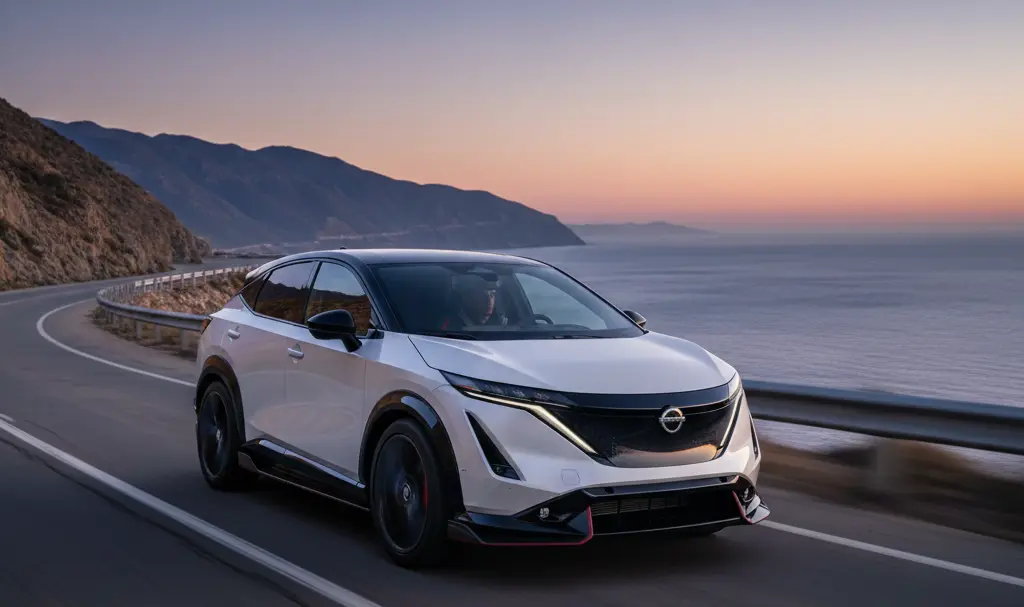
We present a comprehensive review of the Nissan Ariya Nismo, the manufacturer’s flagship electric vehicle and the fastest car in its entire portfolio. The Nismo nameplate typically evokes images of high-performance racing machines, most notably the iconic GT-R. This might create a slight dissonance when applied to an electric SUV. Nevertheless, Nissan has focused on performance, so let’s delve into what this combination delivers.
Table of Contents
- Pricing and Trim Levels
- Insurance Costs
- Nissan Ariya Nismo Technical Specifications
- A Brief History of the Nissan Ariya
- Nissan’s Infotainment System
- Nissan Ariya Nismo Interior
- Driving Impressions of the Nissan Ariya Nismo
- Energy Consumption and Range of the Nissan Ariya Nismo
- Nissan’s Driver Assistance Systems
- Summary and Our Opinion
The vehicle for this test was provided by the manufacturer, who had no influence over the content of this review.
Pros
- Reasonable price for the most powerful variant (and an EV)
- User-friendly and intuitive operating system
- Excellent interior quality and practicality
- Ample power reserves that aren’t overwhelming
- Driving experience is engaging without being exhausting for a “sporty” vehicle
- Accessible and helpful driver assistance systems
Cons
- Wired Android Auto (wireless Apple CarPlay available)
- Lack of certain technologies and solutions available in other trims (e.g., matrix headlights)
- Average performance over uneven road surfaces
- High energy consumption
Nissan Ariya Nismo – A Brief Opinion
Nismo is a prestigious brand, and its combination with the electric Ariya can evoke mixed feelings. However, what we get is Nissan’s most powerful and fastest model on the market, featuring a more aggressive look. Yet, it remains distinct from the raw, unadulterated performance heritage of a GT-R or a Z. This is still an SUV that can be quick, but it remains user-friendly for daily driving, largely thanks to its ergonomic interior and comfortable handling. On the other hand, Nissan has limited the equipment in this top-tier version, and the electric motors demonstrate a considerable appetite for electricity.
Nissan Ariya Nismo Pricing and Trim Levels
The Ariya in Nismo guise is theoretically a separate entry in Nissan’s configurator, emphasizing its unique character. In practice, it represents the most expensive option when comparing individual trim levels, though its value might pleasantly surprise you.
Here’s a breakdown of the Ariya’s pricing across different trims (approximate USD conversion):
- Engage:
- 63 kWh (214 HP): approx. $48,700
- 87 kWh (238 HP): approx. $53,700
- Advance:
- 63 kWh (214 HP): approx. $52,500
- 87 kWh (238 HP): approx. $57,500
- 87 kWh (e-4ORCE, 306 HP): approx. $61,200
- Evolve:
- 63 kWh (214 HP): approx. $57,500
- 87 kWh (238 HP): approx. $62,500
- 87 kWh (e-4ORCE, 306 HP): approx. $66,200
- Evolve + (87 kWh, e-4ORCE, 395 HP): approx. $71,200
- Nismo (87 kWh, e-4ORCE, 435 HP): approx. $72,500
As you can see, the Ariya Nismo isn’t significantly more expensive than the Evolve +. However, the slightly cheaper Evolve + offers better equipment (including a panoramic sunroof and segmented headlights) but without the additional power and unique styling changes of the Nismo.
Nissan offers a 3-year warranty for the entire Ariya, limited to 60,000 miles, which can be extended to 5 years. As an electric model, it also comes with a 5-year drivetrain warranty (60,000 miles) and an 8-year warranty for the traction battery itself (100,000 miles). Standard warranties include 3 years on paint and 12 years against body corrosion.
What Does Nissan Ariya Insurance Cost?
According to market data, liability insurance (OC) for the tested Ariya for a driver with several years of driving experience can be around approx. $145. A full package including comprehensive insurance (AC) might cost around approx. $1,925.
The tested Nissan Ariya Nismo has a starting price of approx. $72,500, with very few additional options available. The primary add-on is a special paint finish (pearl white + black roof) for approx. $1,750. This means the price won’t exceed approx. $75,000, making it a reasonable proposition for Nissan’s most powerful electric vehicle on the market.

Nissan Ariya Nismo Technical Specifications
For the Ariya Nismo to be the fastest, it needs substantial power. This is the key change in this variant, with Nissan ultimately achieving 435 HP (without altering the torque). Compared to the Evolve +, this is an additional 40 HP, improving the 0-60 mph acceleration by 0.1 seconds, achieving it in just 5 seconds. Additionally, the suspension has been re-engineered, and it features sport tires with unique wheels.
Another distinguishing aspect of the Nismo variant is its overall styling, which includes an aerodynamic package comprising unique bumpers, side skirts, and a spoiler. Inside, you’ll find sport seats and more red accents. The available interior space remains the same as other all-wheel-drive variants.
A Brief History of the Nissan Ariya
Nissan was one of the pioneers in electric vehicles with the Leaf, which enjoyed considerable success in a nascent segment. However, increasing competition meant the Japanese manufacturer was somewhat overshadowed. Nissan’s next offensive came in 2020 with the official premiere of the Ariya. However, the car ultimately went on sale two years later due to supply chain issues. The Ariya shares technology with models like the Renault Megane and Scenic E-Tech Electric.
By late 2025, Nissan plans to introduce a facelift for the Ariya. This update will stylistically align the Ariya with other models (including the new Leaf) and introduce a new Android-based operating system. However, the tested model is a pre-facelift variant not yet introduced to the broader market. The Ariya Nismo itself debuted in early 2024 with the changes discussed in the technical specifications section.
The Nissan Ariya is categorized as a D-segment coupe SUV. In its sporty Nismo iteration, competitors include the Kia EV6 GT, Ford Mustang Mach-E GT, Tesla Model Y, and Skoda Enyaq RS Coupe. The Hyundai Ioniq 5 N is a slightly more extreme rival, standing out from this group with its track-focused performance.
Nissan’s Infotainment System: On the Cusp of Greatness
The software in the tested Nissan Ariya distinctly merges two approaches. One embraces modern solutions, where the central screen plays a significant role, directly managing many functions. However, the other approach means that crucial settings—related to specific car modules—are still found within the digital instrument cluster. This requires some getting used to, but the system operates quickly and is generally ergonomic.
So, why is it “on the cusp of greatness”? This refers to the aforementioned facelift, which will update Nissan’s system to an Android-based interface that looks nearly identical but offers significant improvements, particularly in multimedia and Android Auto support. This update is worth waiting for in the Ariya Nismo.
Regardless of the trim level, the Ariya always features two 12.3-inch TFT displays for the central multimedia screen and digital gauges. They offer good image quality, despite a dominant dark theme (especially in navigation). A Head-Up Display (HUD) is standard in top-tier versions (from Evolve onwards), including the Nismo.
Ergonomic Central Screen
Nissan Ariya’s software is dominated by blacks and grays, so don’t expect extravagant animations. The focus is on simplicity and convenience, offering extensive customization options for various menus. It also includes the option to log in to your profile, which connects with NissanConnect mobile services.
The software interface is tab-based, with tabs visible on the left side. The main screen consists of scrollable dashboards with widgets that can be customized. There’s a wide array of variations, allowing you to spend some time arranging everything to your liking. There are no dropdown sections; a shortcut to related settings appears at the top, and climate control information is displayed at the bottom.
The Ariya doesn’t have a built-in owner’s manual, so you’ll need to refer to a physical copy or use your smartphone if needed. There is a voice assistant, but its capabilities are limited. Alexa, which appears in some applications, is not available in all regions. This is another area expected to improve with the facelift, which will introduce a new system with Google Assistant.
The Ariya offers a comprehensive suite of comfort modules, though many settings for lights, wipers, and central locking are found within the digital instrument cluster. The main screen primarily handles climate control, which is also managed daily via a separate, distinctive touch panel.
While the Nissan Ariya awaits its new system, the one in the tested Nismo model is well-equipped with connectivity modules, including Bluetooth, Wi-Fi (with hotspot), and LTE. Additionally, smartphone applications can integrate, though this functionality is increasingly focused on Nissan’s proprietary services.
The audio system in the reviewed car is the top-tier option offered in the Ariya, featuring 10 Bose speakers. Entry-level variants come with only 6 speakers. The Nismo, by definition, should have the best (in theory), and the audio quality is… simply adequate. It’s not a system that stands out with exceptional capabilities, but you shouldn’t encounter issues with frequency distortion.
Navigation Impresses, CarPlay is Good, Android Auto Lacks Wireless
At first glance, Nissan’s navigation system appears simple and stylistically consistent with the overall software, prioritizing readability over elaborate design. However, it offers a wealth of additional functions and customization options. Basic aspects like map data and route planning are well-executed.
Significant enhancements come from its collaboration with Google, which provides not only the search engine but also satellite view and even Street View. Furthermore, numerous screens offer various options for managing how routes are selected and presented. Integration with charging station databases is also present, though I observed some delays in the live availability data.
While the navigation is quite impressive, connecting an Android smartphone leaves something to be desired because… you’ll need a cable. After the facelift, this won’t be necessary, but for now, the Ariya favors iPhone users, as Apple CarPlay works fully wirelessly. Nevertheless, I have no complaints about the performance of either platform.
Digital Gauges are Key for Nissan, HUD is Clear
As mentioned, the digital instrument cluster plays a crucial role in the Nissan Ariya. This screen is where you’ll find settings related to comfort and driver assistance systems. It also features more color, specifically red, to emphasize that you’re driving the Nismo variant. My only minor gripe is that some Polish descriptions don’t fully fit within the display area.
The digital gauges offer two main styles: classic dials with pointers or a more modern numerical display that emphasizes widgets. There are no other themes available, offering a choice between tradition and modernity.
The widgets are identical regardless of the chosen theme, but their size and, consequently, readability change. Functionally, it’s the same customizable set, allowing you to only display what genuinely interests you. The available carousel includes various trip computer displays (e.g., energy consumption, eco tips, tire pressure), a view of driver assistance system operation (with controls), multimedia (with source selection), and various navigation indications (including a map).
Each visualization comes with additional options that allow you to control specific modules, eliminating the need to access the central screen to make adjustments.
Another extensive section is “Settings,” where you’ll find options for central locking, wipers, and lighting operation (including ambient lighting). This is also where you’ll locate additional settings related to traction battery charging, among others. While navigating these menus isn’t as convenient as it would be on the central screen, and detailed descriptions are lacking, the options are understandable, and you won’t need to visit this section frequently.
The head-up display is quite large, bright, and colorful, with customizable information. Some information appears contextually, such as cruise control details, which only become available when the ProPILOT system is activated.
Nissan Ariya Nismo Interior: Sporty Red Accents
Nissan consistently aims to offer something more in its vehicles compared to direct competitors, and often this means superior interior quality. The Ariya Nismo is no exception, with a cabin that features many pleasant, well-fitted materials, an original design, and numerous practical solutions. However, the Nismo variant offers slightly fewer practical features than other trim levels. In return, it boasts sporty distinctions and dominant red accents. Overall, anyone should feel comfortable and quickly adapt to the interior of the tested vehicle.
Before even stepping inside, you’ll appreciate the keyless entry system. This is a complete implementation, meaning the Nissan Ariya unlocks automatically as you approach or grasp one of the front door handles. The same applies to locking: sensors are located within the grooves on the outer part of the handles, or you can simply walk away a few steps. The power-operated tailgate can be opened via various buttons or a foot-swipe gesture under the bumper. You can also force it to close and lock the central locking simultaneously, offering a full suite of solutions expected in this class.
First Row Showcases Nissan Quality
Opening the front doors, you’ll notice that the black and red accents, characteristic of the Nismo version, fully cover the sills, effectively preventing trouser legs from getting dirty when entering. As this is an SUV, taking a seat in the first row is comfortably easy.
The door panels feature soft and pleasant materials, with most plastics yielding to the touch. I can’t even heavily criticize the piano black control panel, which I didn’t observe to get excessively dirty or collect fingerprints. Only the storage compartment is relatively small and lined with hard plastic.
Nismo Seats Stand Out… Almost
They almost stand out, as the Nismo simply features different upholstery (leather-fabric combination) with a hint of the signature red. The contouring itself doesn’t differ from other versions that primarily use leather upholstery. Thus, these aren’t typical sport seats but comfortable ones that also offer adequate lateral support.
Both front seats are electrically adjustable (without memory function), but the driver’s seat additionally offers 2-way lumbar support. Both seats are also heated (3-stage), completing the amenities Nissan has prepared for Ariya Nismo occupants.
The Steering Wheel: Modern Yet Practical
The two-spoke steering wheel features perforated stitching on the side sections. However, the red stripe marking the “0” position is a characteristic element of the Nismo version. The steering wheel rim is heated (1-stage), and the column can be manually adjusted in two planes.
At first glance, the controls on the Ariya’s steering wheel spokes might appear to be touch panels, but physical buttons are hidden beneath the piano black finish. Each button is distinctively shaped, making them easy to differentiate by touch. They are complemented by equally convenient rollers and switches. The left section controls the digital gauges and multimedia, while the right manages cruise control, voice assistant, and phone functions.
Near the steering wheel, or rather the driver’s left knee, in the tested Ariya, a series of buttons allows you to activate assistance systems, the HUD, open and close the trunk, and adjust headlight settings.
Dashboard Blends Modernity and Practicality
At nearly every turn, it’s evident that the Ariya was designed to stand out. Crucially, Nissan executed this very well, resulting in an original, highly practical, and superbly assembled design. Naturally, the Nismo version distinguishes itself with red inserts and appropriate badging.
Before examining the dashboard, you’ll notice the heated windshield with visible heating elements above. Directing your gaze to the soft materials, you’ll find part of the audio system, the head-up display projector, and a central LED. This LED indicates central locking status and the battery’s charge level. Another unexpected addition is a simple brightness switch located on the left side of the screen housing.
Below the central display, you’ll find the ventilation system integrated with physical buttons and a dial. Further down, there’s an interestingly designed panel with haptic-feedback touch buttons for climate control. The Nissan Ariya demonstrates that such an interface can be aesthetically pleasing without relying on piano black. While still not as convenient as classic solutions, it holds its own in the long run. The parking brake switch is discreetly located beneath the physical power button.
Between the front seats, there’s a large, elaborate organizer, which is permanently fixed. In other Ariya variants, it can be electrically slid, a feature not present in the Nismo version. At the front, a small compartment offers a full set of ports: 12 V, USB-C, and USB-A. On top, you’ll find the drive selector and additional touch buttons, integrated into a pleasant material. These control driving modes and e-Pedal activation. The ensemble is completed by two cupholders hidden behind a roller blind; the mechanism itself can be removed to create a larger storage compartment.
Moving to the armrest, it’s non-adjustable but quite wide and comfortable. Lifting it reveals a wireless charging pad and space for small items. If you’re using an Android smartphone, you’ll need to route a cable forward. Fortunately, Nissan anticipated this, so nothing gets pinched.
Larger storage compartments are located in front of the passenger and in the central part of the dashboard. Again, there’s no electrically sliding drawer as in other Ariya versions. Nevertheless, the divided compartments are softly lined and together provide acceptable space for storing items.
At the headliner, a panel with touch-controlled lighting allows you to adjust its intensity. There’s also a sunglasses compartment. Further back, some might be surprised by the rectangular auto-dimming rearview mirror, which is intelligent – more on that when discussing assistance systems.
Second Row Offers Many Amenities
Opening the rear doors of the Nissan Ariya, you’ll first appreciate the wide opening. The doors lock in an almost 90-degree position, which parents with small children will particularly value. The rest of the rear cabin maintains a similar level of quality as the front, though ambient lighting is absent.
Tall individuals (around 6’4″) will comfortably fit in the rear seats of the Ariya. Interestingly, the low roofline might be the first constraint, as legroom is abundant. You can also adjust the recline of the backrests, albeit to a very limited extent. Furthermore, there’s no central tunnel (the floor is raised), making it slightly more comfortable for a middle passenger if needed.
Amenities include a central air vent (without a third zone or heated seats), two USB-C ports below the vents, and seat-back pockets. Hooks and an armrest with two always-open cupholders are also present. The setup is completed by Isofix child seat anchors, conveniently hidden behind sliders.
Lighting Matters, but Only Inside
Regarding lighting, most of the action happens inside. Externally, the Ariya doesn’t offer additional light points that would improve visibility around the doors, even when open. However, a powerful additional LED is present near the charging port.
Inside, there’s relatively strong basic lighting based on cool-toned LEDs, with adjustable brightness. Similarly, other lighting components (e.g., buttons) can be set to a very high intensity, though a greater difference between the highest setting and one step down would be beneficial. Ambient lighting is also present, divided into two zones but focusing exclusively on the dashboard and front door panels. The first zone is a white strip running almost along the windows, while the second is red, distinguishing the Nismo model. In both cases, adjustment is limited to brightness.
Note: A panoramic sunroof is available in other Ariya trims but not in the Nismo variant.
Trunk: Practical, Though Capacity Reduced
The Ariya offers only one trunk; Nissan did not manage to create additional space under the hood (frunk). Therefore, we proceed directly to the rear of the vehicle. A power-operated tailgate awaits, featuring an additional button to close it along with the central locking. When opened, it reveals a large loading aperture with a sill positioned classically for SUVs.
The basic trunk capacity of the tested Nissan Ariya Nismo aligns with other e-4ORCE all-wheel-drive variants, offering 415 liters (compared to 468 liters without a rear motor). Nevertheless, the initial impression is that there’s ample space, with the difference stemming from reduced under-floor storage, where a Bose subwoofer is also located. Larger, uniform items can be accommodated by adjusting the recline of the rear seatbacks. Folding them down (60:40 split, without a ski pass-through) yields approximately 1300 liters. Of course, you must account for the steeply sloping roof when loading luggage to the ceiling.
Some of the aforementioned space is distributed under the floor, which is divided into two sections, facilitating the organization of charging cables, among other things. Additionally, two large compartments are present near the wheel arches, with an extra strap in one to secure items. Other conveniences include two hooks and net anchor points. Surprisingly, Nissan has not provided any form of power outlet in the trunk, not even a 12V socket.
Driving Impressions of the Nissan Ariya Nismo: Filtering Expectations
On paper, the Nismo designation implies that the Ariya is a sporty variant. This translates to a sport-tuned suspension, more precise steering, and increased power. While this is true, the differences aren’t colossal compared to other Ariya drivetrains. Overall, the Ariya drives well but retains comfortable aspects. It’s not a hardcore sports car.
The steering system provides a very pleasant feel, especially when set to sport mode, as you can fine-tune this parameter independently of other driving modes. It strikes an ideal balance between precision and ease of maneuvering. The turning circle (just over 36 feet) is perfectly acceptable, and stability is ensured at higher speeds.
The suspension system partly conveys the feeling of a car designed for more emotional driving. The damping is relatively stiff, so all road imperfections are noticeable inside the cabin. This is also influenced by the low-profile tires on 20-inch wheels and the vehicle’s curb weight (over 2.2 tons).
On the other hand, this stiffness provides greater body stability in dynamically taken corners, although the differences from base models are truly minimal. For ultimate satisfaction, adjustable dampers would have been ideal to avoid a bouncy feel on less even roads.
Driving Dynamics: Nismo Means Speed
The tested Nissan Ariya Nismo is essentially a powered-up Evolve + model, featuring e-4ORCE all-wheel drive, based on two electric motors (each providing 300 Nm of torque). The total system output is 435 HP, a record for Nissan’s configurator, but not particularly outstanding in the context of the electric vehicle market, especially when considering the “sporty” adjective.
Nevertheless, the performance is good, though again, it depends on your perspective. Accelerating from 0-60 mph in 5 seconds is a respectable time, but many electric cars without sporty aspirations offer better results. During my tests, due to lack of dry pavement and winter tires, my best measurement was 5.3 seconds. This is still a good result, suggesting that under optimal conditions, it’s possible to achieve under 5 seconds.
Nissan has provided four driving modes: Snow, Eco, Standard, and NISMO. These are generally classic offerings, with only the extreme modes attempting to distinguish themselves. Essentially, they alter the Ariya’s responsiveness to driver input. Snow mode is characteristic of all Nissan Ariya models with e-4ORCE drive and changes the power delivery characteristics of individual motors. The NISMO mode replaces the Sport mode found in other trim levels. The manufacturer states it was specifically developed for the tested car, but in practice, it primarily alters throttle response and makes more pronounced use of all-wheel drive. And yes, there’s an artificial sound from the speakers.
If I hadn’t seen the various Nismo badges inside the Ariya, it would be difficult to tell from everyday driving that I was in a strengthened, sporty car. Of course, pushing the accelerator with a kickdown immediately reveals the immense power reserves, which is a key advantage of this car. Regardless of speed, it eagerly accelerates, doing so very smoothly and confidently.
Despite appearances, the relatively calm character of the tested car, which can quickly transform its demeanor, has its charm. On a daily basis, the Ariya Nismo can turn heads with its exterior embellishments, but it’s not at all tiring to drive. While the suspension could handle uneven surfaces better, it’s something one can adapt to, and it’s somewhat expected when purchasing the most powerful variant.
Naturally, the Nissan Ariya Nismo incorporates recuperation, as befits a full-fledged electric vehicle in this segment. Nissan, in part, popularized this solution as a useful driver aid. Hence, the e-Pedal button activates a nearly full one-pedal driving mode, relying almost entirely on the accelerator.
It’s “almost full” because the tested Ariya doesn’t come to a complete stop but slows down to around 6 mph. The final braking remains the driver’s responsibility. This aspect is not addressed by the “B” mode on the drive selector, which effectively offers a milder version of the e-Pedal mode. There are no other recuperation settings that could, for instance, intelligently adjust the energy recovery force.
Energy Consumption and Range of the Nissan Ariya: Nismo’s Impact
The Nismo variant is exclusively offered with the largest battery available for the Ariya, meaning Nissan includes an 87 kWh (net, 91 kWh gross) battery pack. In this regard, the most powerful model doesn’t differ from the rest of the lineup. Similarly, a heat pump is standard. The following measurements were recorded as winter receded, with outdoor temperatures ranging from 32 to 41 degrees Fahrenheit (0 to 5 degrees Celsius).
Initial city drives revealed that… I might have forgotten how to drive electric cars. However, it soon became clear that the Ariya simply requires a lot of power to get moving. Frequent starts from a standstill (traffic jams, red lights) mean you can expect energy consumption around 22 kWh/100 km (approx. 2.8 mi/kWh), resulting in a range of around 240 miles. If you add more dynamic driving and limit recuperation, consumption can easily reach up to 30 kWh/100 km (approx. 2.0 mi/kWh). On the other hand, a result of 16 kWh/100 km (approx. 3.9 mi/kWh) is achievable when driving smoothly without frequent full stops.
The Ariya Nismo performs best in suburban driving (around 50 mph), where the trip computer shows a stable 18 kWh/100 km (approx. 3.5 mi/kWh), yielding a range of around 300 miles. On highways, expect the following results:
- 60 mph: 22 kWh/100 km (approx. 240 miles range)
- 75 mph: 25.5 kWh/100 km (approx. 210 miles range)
- 80 mph: 28.5 kWh/100 km (approx. 190 miles range)
- 87 mph: 32 kWh/100 km (approx. 170 miles range)
I must admit, I didn’t anticipate such high energy consumption figures. Of course, the power plays a role, but many more powerful and heavier electric vehicles on the market manage power demands more reasonably. Perhaps the facelift has improved this aspect, but we will likely find out when the updated Ariya becomes available.
Regarding charging, the Nissan Ariya Nismo, based on a 400V architecture, doesn’t stand out. It features an onboard charger (Type 2, AC, 22 kW), meaning that in home conditions—with an appropriate wallbox—you can achieve 100% charge in about 5 hours. This is still a very sensible result.
At fast-charging stations (CCS, DC, 130 kW), charging is limited to 130 kW. Therefore, charging from 20% to 80% takes approximately 45 minutes, which is considered slightly below average. The Ariya Nismo does not support any forms of external power delivery (e.g., V2L).
Nissan’s Driver Assistance Systems Impress
As you already know, Nissan has centralized all car-operation-related settings on the digital instrument cluster. This is where you’ll find options for driver assistance systems, which are quite well-organized, though detailed descriptions are absent. It’s worth taking a moment to configure the customizable mode, allowing you to quickly activate personalized settings.
Within this mode, you can, for example, deactivate the speed limit warning system, which reads signs. However, I suspect an internal database is also involved, as the displayed information can sometimes be surprising. While the auditory warning for alleged speeding isn’t irritating, it’s accompanied by an additional notification on the digital gauges.
The Nissan’s side mirrors are large and provide good visibility. The Ariya is, of course, equipped with a blind-spot monitoring system (and rear cross-traffic alert when reversing), so all essential features are present.
Given that the Ariya is an SUV with a coupe design, Nissan opted to include an “intelligent mirror,” commonly known as a digital rearview mirror. This technology is employed by many Korean and Japanese brands.
In the tested car, you get a rectangular mirror that, with a single switch, can transform from a standard auto-dimming mirror into a screen displaying an image from an additional camera. The overall quality is decent, although the lens could offer a wider view. You can adjust selected parameters within the available settings, though surprisingly, a specific language option might be missing in some regions.
ProPILOT, Nissan’s advanced adaptive cruise control solution, functions flawlessly once properly configured. Of course, you first need to go through the individual settings, for example, to deactivate the automatic adjustment of speed settings to detected limits. Afterward, you’re greeted with a responsive system that efficiently recognizes other cars on the road and adapts to them. It also includes lane-keeping assist, where the Ariya maintains its position within road curves based on marked lanes. While at lower speeds (around 45 mph), the software prefers to give full control back to the driver, I have no complaints at highway speeds.
Regarding headlights, the Nissan Ariya Nismo does not feature the maximum capabilities it could, but more on that in a moment. Initially, I can commend the basic light beam, which is perfectly filled, reaches adequately far, and is very wide. In this respect, it’s truly hard to complain. The main headlights also feature an automatic high beam function, which works quite well. The only minor drawback is that in this class, one might expect segmented lights, which are surprisingly found in the Evolve variants. On the other hand, fog lights are present, but without a cornering light function.
Nissan has generally been a pioneer in promoting the utility of 360-degree cameras in cars. Of course, over the last ~20 years, other companies have caught up. Thus, the quality of the cameras used in the tested Ariya Nismo is perfectly adequate. Primarily, you get a sufficiently bright image with acceptable resolution. On the plus side, there are additional options allowing you to correct selected parameters. On the minus side, more options for adjusting the viewing angle of the car would be beneficial. It’s possible that the facelift will address this inconvenience, considering the capabilities I’ve seen in other Nissan models like the Qashqai.
Nissan Ariya Nismo Review: Summary and Our Opinion
We conclude our review of the Nissan Ariya Nismo, the most powerful, sporty electric vehicle from the Japanese manufacturer. It’s a car that’s quite pleasant to drive, imposing no limitations in daily use, yet capable of showcasing its power when needed. Its distinctive design with added accents is appealing and still stands out on the road. Furthermore, its spacious, practical, and well-crafted interior is commendable.
On the other hand, some might expect more excitement from a Nismo variant, which can partly be seen as a styling package on top of the Evolve + version. The fact that the top-tier model doesn’t allow for the inclusion of all the best technologies available for the Ariya (such as matrix headlights) is somewhat puzzling. Regardless, Nissan should still work on the drivetrain’s efficiency concerning energy consumption. Thus, we eagerly await to see if the already announced facelift improves these aspects.
Frequently Asked Questions (FAQ)
What makes the Nissan Ariya Nismo different from other Ariya models?
The Nissan Ariya Nismo stands out with its increased power output (435 HP), sport-tuned suspension, unique aerodynamic body kit (bumpers, side skirts, spoiler), sport seats, and distinctive red interior accents. It is also the fastest variant in Nissan’s lineup, offering improved acceleration compared to other Ariya trims.
What is the approximate range and charging time for the Nissan Ariya Nismo?
The Ariya Nismo comes with an 87 kWh (net) battery. Its range can vary significantly based on driving conditions and speed, from an estimated 240 miles in city driving with frequent stops to around 170 miles at highway speeds of 87 mph. For charging, it features a 22 kW AC onboard charger, allowing a full charge in about 5 hours with a suitable wallbox. DC fast charging at 130 kW can charge the battery from 20% to 80% in approximately 45 minutes.
Does the Nissan Ariya Nismo offer wireless Android Auto?
No, the tested pre-facelift Nissan Ariya Nismo requires a wired connection for Android Auto. However, Apple CarPlay works wirelessly. Nissan has announced a facelift for the Ariya, which is expected to introduce an updated Android-based infotainment system that will likely include wireless Android Auto functionality.
Source: Self-developed. Opening photo: Generated by Gemini.
About Post Author
