

Contents
China’s Ambitious “Great Green Wall” Transforms Desert into a Global Carbon Sink
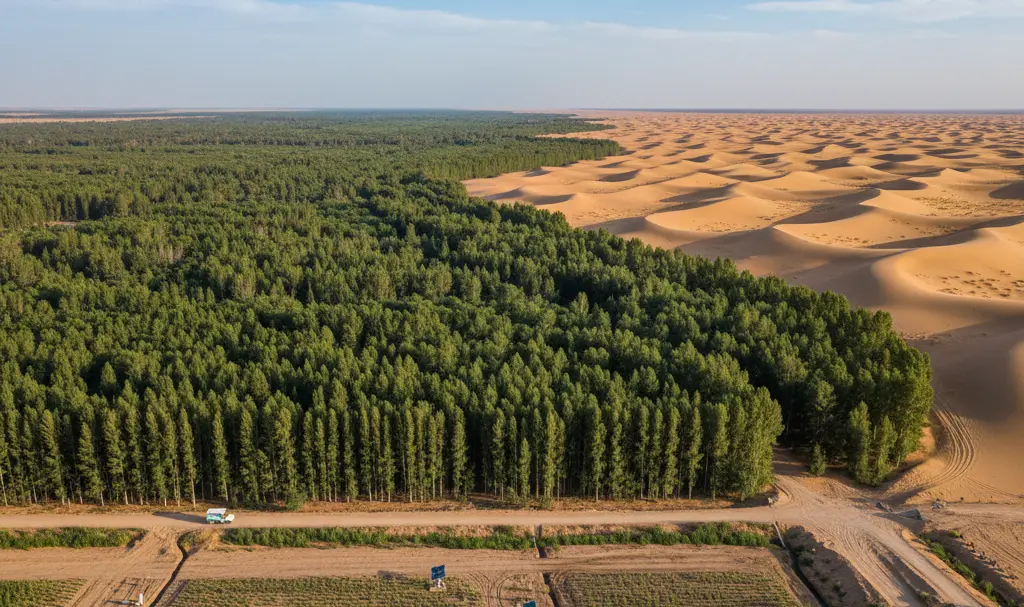
China has embarked on one of humanity’s most ambitious ecological undertakings: planting billions of trees to combat desertification. What began as a monumental effort to halt the relentless advance of the Taklamakan Desert has, according to new research, evolved into something even more profound – transforming the edge of one of the world’s driest deserts into a significant absorber of atmospheric carbon dioxide. This “Great Green Wall” project, once a “biological void,” is now playing a surprising role in protecting our planet from greenhouse gas emissions.
The Vision Behind China’s Great Green Wall
For decades, China has been implementing a colossal environmental project, widely known as the Great Green Wall. Initiated in 1978, this ambitious afforestation program aimed to encircle the Taklamakan Desert. Its primary objectives were clear: to stop the desert’s expansion, shield vital cities, agricultural lands, and infrastructure from devastating sandstorms, and mitigate widespread soil erosion.
Over the years, more than 66 billion drought-resistant trees, including species like desert poplar and willows, have been planted, forging a green barrier thousands of kilometers long around the Taklamakan. This systematic effort, spanning nearly half a century, has created an effective defense, binding shifting sands and diminishing the destructive force of dust-laden winds. Consequently, vast areas once regularly engulfed by the desert are now reclaiming their productivity, bolstering local agriculture and stabilizing the livelihoods of millions of inhabitants.
Transforming Arid Lands into Carbon Sinks
The ecological and climatic impacts of China’s “Great Green Wall” are becoming increasingly evident. The afforestation along the Taklamakan’s periphery has been instrumental in curtailing the reach of sandstorms, enhancing soil quality, and safeguarding nearby settlements and transportation routes.
Recent analyses, combining satellite imagery, on-the-ground measurements, and carbon flow models spanning approximately the last 25 years, reveal a remarkable discovery: these artificially restored ecosystems are now absorbing more carbon dioxide than they emit. This means the verdant ring around the Taklamakan is actively functioning as a significant carbon sink.
- Slowing Desertification: Increased vegetation cover has effectively slowed the desertification process, anchoring sand and dust that previously inundated farms, cities, and crucial communication networks.
- Boosting Biodiversity: Concurrently, the newly established trees and shrubs are fostering new habitats, inviting back a variety of insects, birds, and other organisms to a landscape that was once largely barren.
Further research conducted between 1985 and 2024 confirms a notable increase in vegetation cover and a reduction in soil erosion risk. These findings underscore positive shifts in ecosystem functionality and a decrease in ecological stress across the region.
The program’s significance extends beyond its immediate local environmental benefits. According to studies by Chinese scientists, the “Great Green Wall” expanded the forested area within the project region from approximately 221,000 square kilometers to 379,000 square kilometers between 1978 and 2017. This expansion has generated an average annual carbon sink of over 47 million metric tons of carbon dioxide.
Recent data indicates that the Taklamakan project has the potential to remove up to 60 million metric tons of carbon dioxide from the atmosphere annually. While this contribution is modest compared to global emissions of approximately 40 billion metric tons per year, its impact is far from insignificant, demonstrating a tangible positive step in climate mitigation.
Global Implications and Lessons Learned
The success of the Great Green Wall offers a crucial blueprint for other nations grappling with the escalating challenge of desertification. It stands as compelling evidence that, with appropriate scale of action and sustained long-term funding, it is indeed possible to reverse detrimental climatic trends, even within the planet’s most inhospitable regions.

However, this success story also comes with a vital caution: not every large-scale tree-planting initiative in every location will automatically yield climate and environmental benefits. Experts emphasize that the selection of unsuitable species and ill-conceived planting locations can lead to excessive water consumption, competition with native vegetation, and even the degradation of existing fragile ecosystems. Careful planning, scientific assessment, and consideration of local ecological conditions are paramount for such projects to be truly sustainable and effective.
Frequently Asked Questions (FAQ)
What is China’s Great Green Wall project?
China’s Great Green Wall is an ambitious, long-term afforestation program initiated in 1978. Its primary goal is to plant billions of trees around the Taklamakan Desert to combat desert expansion, prevent sandstorms, reduce soil erosion, and protect agricultural land and infrastructure.
How has the Great Green Wall impacted climate change?
Recent research indicates that the afforested areas around the Taklamakan Desert now absorb more carbon dioxide than they emit, effectively acting as a significant carbon sink. The project has expanded forested land and is estimated to remove up to 60 million metric tons of CO2 annually, contributing to global climate mitigation efforts.
What are the key environmental benefits beyond carbon absorption?
Beyond acting as a carbon sink, the Great Green Wall has significantly reduced the frequency and intensity of sandstorms, improved soil quality, slowed desertification, and provided new habitats for biodiversity, leading to the return of various insect, bird, and animal species to previously barren landscapes.
Are there any ecological concerns or considerations for similar large-scale afforestation projects?
Yes, while the Great Green Wall demonstrates the potential of large-scale afforestation, experts caution that careful planning is crucial for similar projects. Poorly selected tree species or inappropriate planting locations can lead to excessive water consumption, hinder native plant growth, or even degrade existing ecosystems. Sustainable projects require thorough scientific assessment and consideration of local ecological conditions.
Source: UC Riverside News, Greenmatters, Chinese Academy of Sciences, Reuters, Nature.
Opening photo: Zhu Yujia, Feng Xianzhe / Sun Yat-Sen University News.
About Post Author
