

Contents
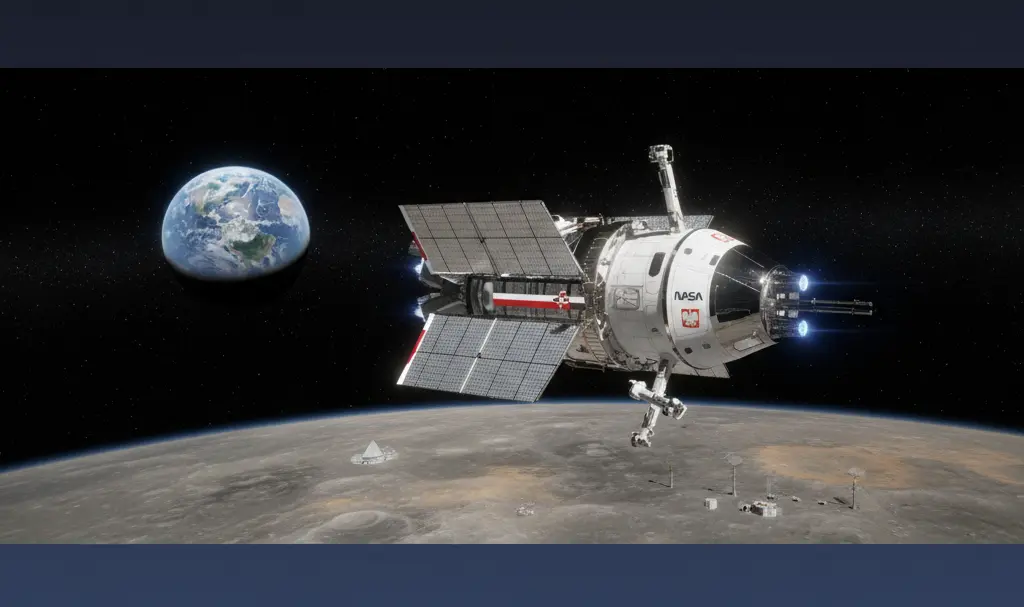
Poland’s Significant Role in the Artemis II Mission
On April 1, the Artemis II mission officially commenced, and Poland is making substantial contributions to this groundbreaking endeavor. For years, the internet playfully mocked the phrase “Poland cannot into space,” but today, the nation’s burgeoning space industry is competing for the highest stakes. Polish companies and institutions are providing crucial solutions for the lunar missions, without which humanity’s return to the Moon might not be possible. So, what exactly is Poland’s role in this transformative space program?
“Poland CAN Into Space”: A Global Comeback
Do you remember the viral meme “Poland cannot into space” from many years ago? It turns out that decades of development and proving its worth on the global new technology stage mean that Poland absolutely can go into space – and with significant impact!
While another Polish astronaut might not repeat the feat of Sławosz Uznański-Wiśniewski anytime soon, Polish technological innovation extends much further. After all, what good are astronauts if we don’t have the means to send them into space?
This is precisely where Poland steps in, contributing a significant piece to the Artemis II mission – arguably the most important project since the Cold War-era Apollo program. But what does Poland’s contribution to this ambitious undertaking entail?
Understanding Artemis II: A New Era of Lunar Exploration
First, let’s clarify a few things. We need to answer the fundamental question: What is Artemis II?
The Artemis II mission is best understood as the modern equivalent of the legendary Apollo 8 flight in 1968. Back then, Frank Borman’s crew was the first in history to leave low Earth orbit and view Earth from beyond the lunar horizon.
Today, Artemis II aims to break over half a century of stagnation in crewed deep space exploration. However, it is not yet a landing mission. Instead, it serves as a “dress rehearsal” for the Artemis III mission, which intends to place human feet on the surface of the Moon for the first time since 1972.
The entire endeavor is planned as a ten-day journey, with a free-return trajectory playing a key role. This means that after an initial “push” towards the Moon, the gravity of our natural satellite will naturally curve the spacecraft’s flight path, directing it back to Earth without needing to fire its main engines to enter orbit.
During this flyby, the Orion capsule will approach the Moon’s surface to a distance of approximately 7,500-8,900 kilometers, offering the crew views unseen by human eyes since the Apollo program.

Technically, the mission relies on two powerful pillars: the Space Launch System (SLS) rocket and the Orion spacecraft. The SLS is currently the most powerful operational rocket in the world, generating 15% more thrust than the legendary Saturn V.
The Orion capsule, in turn, has been integrated with a European Service Module (ESM) and offers half again as much living space as the Apollo command modules.
However, the main goal of Artemis II is not to break distance records. The mission’s priority is the rigorous testing of the Environmental Control and Life Support Systems (ECLSS). Unlike the uncrewed Artemis I mission in 2022, this time, computer systems will have to manage oxygen, remove carbon dioxide, and regulate temperature in real-time for living organisms under conditions of extreme cosmic radiation.
These critical tests will provide NASA and its partners with the confidence that the technology is ready for the most challenging phase: landing humans on the lunar surface in two years.
It’s worth noting that during this mission, the Orion spacecraft could break another record: the furthest distance from Earth achieved by a crewed spacecraft. The planned route involves moving further away from our planet than the ill-fated Apollo 13 mission.
Artemis II is therefore not just a “show flight,” but a real test of whether, after five decades, humanity still possesses the technological and operational courage to reach further than ever before.
Polish Contributions to the Artemis Program
Poland’s presence in the Artemis program is not a marketing gimmick or a “flag added” to a major NASA project. It represents real, hard-earned competencies developed over years of collaboration with the European Space Agency (ESA), which Poland joined in 2012. It is thanks to this membership that Polish companies and institutions were able to enter the supply chain for the Orion spacecraft’s European Service Module (ESM).
Why is Poland’s presence in the Artemis II program (and ESA) so important? Primarily because, in projects of this scale, reliability and experience are paramount. Polish companies are not responsible for “space toys” or performing menial tasks. Our compatriots are entrusted with specific and highly responsible assignments.
Equipment and solutions produced in Poland undergo rigorous ESA and NASA qualification, meeting the quality standards required for crewed flights. This represents the highest league of engineering, and when Orion flies near the Moon, a piece of Poland will be on board.
Clarifying Institutional Involvement
Space Research Centre of the Polish Academy of Sciences (SRC PAS)
It’s easy to find simplified information online suggesting that the Space Research Centre of the Polish Academy of Sciences (SRC PAS) is participating in the Artemis II mission. This is incorrect, likely stemming from the fact that SRC PAS is a scientific institute with vast experience and a long history.
It is therefore NOT surprising that some “Polish space activities” are automatically associated with this institution.
“SRC PAS is not involved in the Artemis II mission at any level. We have also not worked on the Orion capsule. We are engaged in the broader ESA lunar program, but not directly in Artemis.” – Space Research Centre of the Polish Academy of Sciences
For more on cutting-edge space technology, consider developments like Elon Musk’s Terafab Semiconductor Factory in Texas: AI, Space, and Robotics.
Institute of Nuclear Physics of the Polish Academy of Sciences (IFJ PAN)
The Henryk Niewodniczański Institute of Nuclear Physics of the Polish Academy of Sciences (IFJ PAN) confirms its specific involvement in the Artemis program. This involved supplying ionizing radiation detectors during the Artemis I mission, which initiated the entire program. While IFJ PAN is not participating in the Artemis II mission, it is worth recalling their contribution from a few years ago.
“We participated in the MARE experiment as part of the Artemis I mission, but we are not participating in the Artemis II mission. The MARE experiment involved placing two human body models (known as phantoms), equipped with a large number of various ionizing radiation detectors, in the crew compartment. One of the phantoms was additionally equipped with a vest designed to protect against the low-energy component of cosmic radiation (solar flares). This was a collaboration between many research institutions from various countries. Our contribution primarily involved thermoluminescent detectors developed at IFJ, as well as nuclear particle track detectors. The overall goal of the experiment was to determine the potential radiation exposure of astronauts during such a flight, or rather to confirm whether existing models of this exposure are correct. Additionally, the experiment aimed to test the effectiveness of the aforementioned protective vest. Our analyses have already been completed, and the results have been submitted to the scientific leader of the project – the German Aerospace Center (DLR). The comprehensive report has unfortunately not yet been published, likely because some participants are still delayed in submitting their results.” – Henryk Niewodniczański Institute of Nuclear Physics of the Polish Academy of Sciences
So, which companies, institutions, and facilities should we focus on regarding the Artemis II program? VIGO Photonics comes to the forefront. This company, based in Ożarów Mazowiecki, supplied infrared detectors for the Laser Air Monitoring System (LAMS).
Sounds complicated, right? In short, such a system is responsible for monitoring the atmosphere quality inside the Orion capsule (concentrations of oxygen, carbon dioxide, and water).
Polish Space Agency (POLSA) and Artemis Accords
Of course, the contribution of the Polish Space Agency (POLSA) is also significant here. The agency coordinates Polish participation in the program, and in 2021, it signed the Artemis Accords. This made Poland an official partner of NASA in the program.
It was then that Polish companies received the green light for direct contracts with the American agency. We had the opportunity to discuss this contribution directly with the Ministry of Development and Technology.
How does the Ministry assess the return on investment from Poland’s financial commitment so far to ESA’s lunar missions and the Artemis program?
“ESA’s lunar missions and the Artemis program should be evaluated separately. Currently, Poland does not make a financial contribution to the Artemis program. However, as Polish companies are present in the Artemis program (e.g., Polish startup SigmaLabs has joined the work on dosimeters for the Artemis lunar program), we positively assess Poland’s accession to the Artemis Accords in 2021. In the uncrewed Artemis I mission, which took place in 2022, infrared detectors developed by VIGO Photonics were successfully used in the Orion capsule.” – Ministry of Development and Technology
Are new bilateral agreements with the United States planned in light of the Artemis II mission to facilitate Polish space startups’ access to the American government procurement market?
“Poland’s accession to the ARTEMIS Accords opens the way for Polish companies and institutes to secure contracts for the development of robotics, power systems, and space mining technologies (the search for and processing of lunar resources). It is also an opportunity for domestic enterprises to develop and commercialize technologies that will be used in future lunar bases. Regarding potential new bilateral agreements between Poland and the United States in the context of the Artemis II mission, we inform that the Ministry of Development and Technology is not working on such agreements.” – Ministry of Development and Technology
Incidentally, during this conversation, the ministry also noted its strong engagement in ESA’s lunar mission. At the Ministerial Council in November 2205 in Bremen, Poland declared a support amount of 30 million Euros. At the previous ESA Ministerial Council in 2022, this was 10 million Euros, which was increased by an additional 45 million Euros in 2023 (25 million Euros for the Lunar Robotic Exploration component and 20 million Euros for Humans beyond LEO).
A Brief History of Poland in Space
Nevertheless, the path to Poland’s presence in the Artemis program was long and challenging. Of course, the first major milestone was the flight of Mirosław Hermaszewski in 1978 as part of the Interkosmos program. He became the first Pole to fly into space. The Soyuz 30 mission and his stay on the Salyut 6 station symbolized an era, but also proved that Poland could participate in advanced space projects.
In the interim, the Space Research Centre of the Polish Academy of Sciences (SRC PAS) was actively developing scientific instruments sent on interplanetary probes and satellites. Polish experiments were included in missions carried out in cooperation with the Soviet Union and later with Western partners.
A new chapter opened in 2012 when Poland became a full member of the European Space Agency. This was essentially a turning point – from then on, Polish companies and institutes began regularly participating in ESA tenders, building competencies in satellite technology, space electronics, robotics, and Earth observation systems.
Last year, there was significant media attention surrounding the mission to the International Space Station (ISS) involving Sławosz Uznański-Wiśniewski – the second Pole in space. Such moments demonstrate that Poland is returning to crewed spaceflight not only as a technology subcontractor but also as a provider of human expertise. Advancements in connectivity, such as those discussed in Samsung Galaxy Watch Ultra 2 5G Satellite Connectivity, highlight how technology developed for space can influence everyday devices.
Why Space Exploration Matters for the Economy
Flying into space sounds noble, but it’s important to keep our feet on the ground, as concrete benefits are crucial for the economy. And these benefits are very tangible:
- Technology Transfer: Projects undertaken within ESA and the Artemis program require meeting extreme quality standards. Technologies developed for space applications, such as radiation-hardened electronics or advanced control systems, later find their way into the civilian sector. This includes fields like energy, medicine, telecommunications, and defense.
- Competencies and Job Creation: Participation in the supply chain for ESA and partners like NASA means stable, highly specialized employment opportunities in Poland. Engineers, programmers, composite materials specialists – these are not assembly line positions but high-value-added jobs.
- Multiplier Effect: According to ESA analyses, public investments in the space sector generate a return in the form of new contracts, innovations, and increased competitiveness for companies in international markets. In other words, money invested in space returns to the economy as know-how and export revenue.
- International Standing: Participation in a program as prestigious as Artemis is crucial for building Poland’s image as a country of advanced technologies. And in a world where reputation often determines contracts, this is an invaluable asset.
Beyond the Memes: Poland’s Future in Space
Just a decade ago, the phrase “Poland cannot into space” elicited a smile. Today (fortunately), it sounds like an archived internet joke that few remember.
Poland can not only “go into space” but is doing so in the most demanding crewed project of the 21st century. We are participating in the construction of Orion’s European Service Module, supplying certified electronics, and undergoing the same rigorous procedures as the largest players in the global space sector.
Artemis II is a test for systems, people, and the entire infrastructure for humanity’s return to the vicinity of the Moon. And somewhere within this complex puzzle lies Polish technical ingenuity. All of this sounds truly promising, and it’s no longer just a story of ambition. It’s a history of competence. And if everything goes according to plan, Poland will be part of the next crewed journey to the Moon.
Frequently Asked Questions (FAQ)
What specific technologies is Poland contributing to the Artemis II mission?
For the Artemis II mission, Poland’s VIGO Photonics is providing crucial infrared detectors for the Laser Air Monitoring System (LAMS) within the Orion capsule. This system is essential for monitoring the quality of the atmosphere inside the spacecraft, including oxygen, carbon dioxide, and water vapor concentrations, ensuring astronaut safety.
How does Poland’s involvement in Artemis II benefit its economy and technological sector?
Poland’s participation offers several economic benefits, including technology transfer from space applications to civil sectors (energy, medicine, telecom, defense), creation of high-skilled jobs for engineers and specialists, and a multiplier effect where public investments in space generate new contracts and innovation. It also enhances Poland’s international reputation as a technologically advanced nation.
What are the future prospects for Polish companies in international space programs beyond Artemis II?
By signing the Artemis Accords, Poland has opened doors for its companies and institutes to secure direct contracts with NASA for robotics, power systems, and space mining technologies. This also creates opportunities for developing and commercializing technologies for future lunar bases, indicating significant potential for continued growth and involvement in advanced space projects.
How does Poland’s financial commitment to ESA’s lunar missions relate to its involvement in Artemis?
While Poland currently does not make direct financial contributions to the Artemis program, its increased financial commitment to ESA’s lunar missions (e.g., 30 million Euros declared for 2025, and significant increases in 2023) is crucial. Membership in ESA, which contributes to the European Service Module for Orion, has allowed Polish companies to integrate into the supply chain for Artemis-related projects, demonstrating an indirect but vital connection.
Source: Original article content
Opening photo: Gemini
About Post Author
