

Contents
Unprecedented Discovery: Astronomers Detect Record-Breaking Megamaser Signal from Distant Merging Galaxies
Astronomers have registered an exceptionally powerful microwave signal originating from an object approximately 8 billion light-years away. This remarkable detection is set to significantly enhance our understanding of how galaxies evolve, collide, and change over billions of years. Such breakthroughs underscore the diverse applications of astronomy, ranging from deciphering the universe’s grandest events to understanding more Earth-bound phenomena, like how astronomy is used to determine the date of Easter.
Astronomers Detect Unique Signal from Deep Space
An international team of researchers, led by the University of Pretoria in South Africa, has announced the detection of an extremely strong microwave signal that has traveled an immense distance to reach Earth. The observations were made using the MeerKAT radio telescope, and the signal itself might represent one of the most energetic phenomena of its kind ever observed.
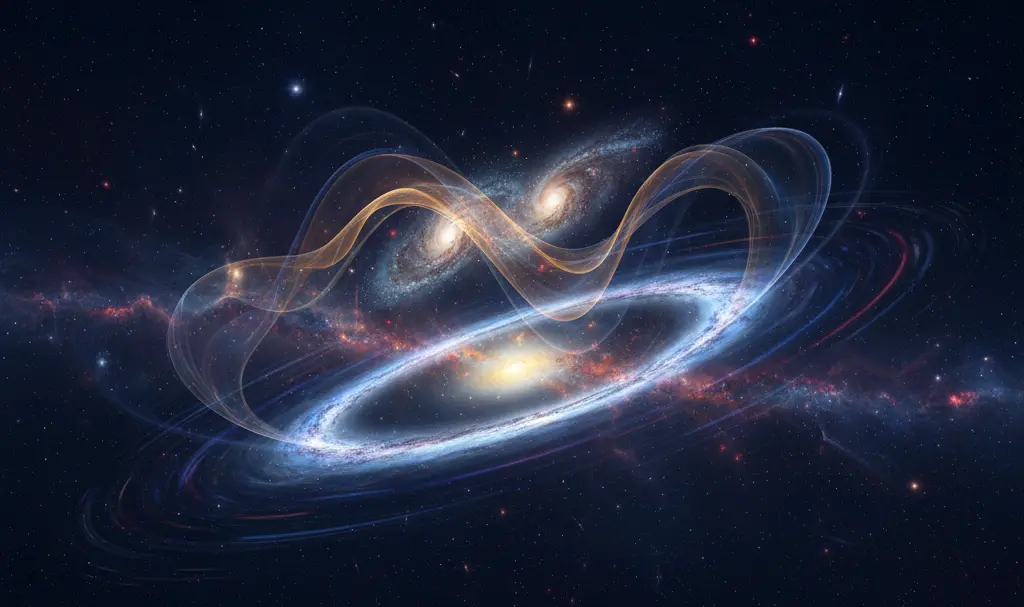
The source of this emission is identified as a galaxy system designated HATLAS J142935.3–002836, currently undergoing a merging phase. In such colossal cosmic collisions, massive clouds of gas are violently compressed, triggering intense physical processes that lead to the emission of exceptionally powerful microwaves.
Understanding Hydroxyl Megamasers and Gigamasers
Scientists classify this phenomenon as a hydroxyl megamaser, which is a natural radio-wave counterpart to a laser. Just as a laser emits a concentrated beam of light, a maser (Microwave Amplification by Stimulated Emission of Radiation) produces an amplified beam of microwaves. Hydroxyl megamasers specifically refer to these powerful natural radio emissions generated by hydroxyl molecules (OH) in regions of intense star formation or galactic mergers.
What is particularly intriguing about this discovery is the registered signal’s intensity. It is so significant that the object could potentially be classified into an even rarer and more extreme category known as a gigamaser. Gigamasers are megamasers that are exceptionally luminous, making them far less common and even more crucial for studying extreme cosmic environments.
Cosmic Lens Reveals the Galactic Past
A crucial factor in this groundbreaking discovery was the phenomenon of gravitational lensing, first predicted by Albert Einstein. This occurs when a massive object situated between Earth and a more distant source bends spacetime, effectively magnifying and amplifying the radiation reaching us from the far-off source.
In practical terms, an intervening galaxy acted as a natural cosmic magnifying glass, making the signal from the extremely distant galaxy system significantly stronger and easier for Earth-based instruments to detect. Without this gravitational lensing effect, registering the signal might have been considerably more challenging, or even impossible.
Implications for Galactic Evolution
Observations like these are vital for a deeper understanding of the fate of our own galaxy. The Milky Way is also on a collision course with the Andromeda galaxy, an event projected to occur in approximately 5 billion years. While such a collision might not spell immediate catastrophe for individual stars and planetary systems, in the very distant future, Earth will likely no longer be habitable, primarily due to changes occurring within our Sun as it evolves into a red giant.
Understanding these cosmic collisions is crucial, and builds upon observations of other dynamic events, such as when astronomers recently witnessed a planetary collision, providing invaluable data on the universe’s violent processes.

Frequently Asked Questions (FAQ)
What is a hydroxyl megamaser, and why is this detection significant?
A hydroxyl megamaser is a natural, extremely powerful source of microwave radiation, akin to a laser, generated by hydroxyl molecules in the universe. This particular detection is significant because it’s the most distant hydroxyl megamaser ever observed, located 8 billion light-years away. Its immense power could even classify it as a gigamaser, offering unprecedented insights into how galaxies merge and evolve in the early universe, where such energetic processes were more common.
How did astronomers manage to detect a signal from so far away?
The detection was primarily aided by a phenomenon called gravitational lensing. A massive galaxy located between Earth and the distant megamaser acted as a cosmic magnifying glass, bending spacetime and amplifying the microwave signal. This made the otherwise faint signal strong enough for the MeerKAT radio telescope to detect and study, allowing astronomers to effectively “look back in time” and observe processes from 8 billion years ago.
What can this discovery tell us about the future of our own galaxy?
This discovery provides valuable insights into galactic mergers, a process our own Milky Way galaxy will undergo when it collides with the Andromeda galaxy in about 5 billion years. By studying these ancient, distant mergers, astronomers can better model and understand the physical processes, gas compression, and star formation that occur during such colossal cosmic events, helping to predict the long-term evolution and fate of our galactic neighborhood.
Source: Focus.de, own elaboration.
Opening photo: Gemini
About Post Author
