

Contents
Unveiling Earth’s Ancient Climate: Scientists Bore Through Antarctic Ice to Reach 23-Million-Year-Old Geological Records
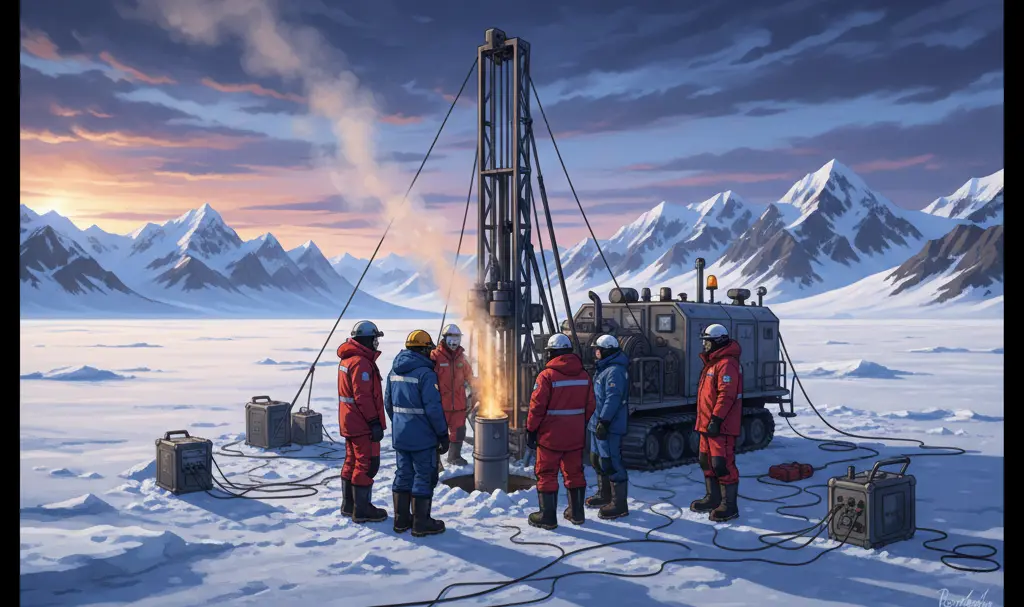
In one of the most remarkable scientific expeditions of recent years, researchers utilized hot water to melt through more than 500 meters (over 1,640 feet) of ice in Antarctica. This innovative approach allowed them to access previously hidden sediments and bedrock, from which they successfully extracted a 228-meter (approximately 748 feet) geological core. This extraordinary core is believed to contain a detailed record of Earth’s climate changes, potentially stretching back an astonishing 23 million years.
Scientists Melt Antarctic Ice, Uncovering a Vital “Geological Record”
The research took place in the remote Crary Ice Rise region of Antarctica, located over 700 kilometers (approximately 435 miles) from the nearest research station. Instead of conventional drilling methods, the team employed a unique hot water drilling technique to penetrate the massive ice sheet. This allowed them to collect invaluable samples of rocks and sediments from the deep subsurface. The extracted material revealed a distinct layered structure, commonly referred to as a “geological record.” Each layer within this core corresponds to a different period in Earth’s history, offering scientists an unprecedented opportunity to reconstruct climate changes over millions of years.
Initial Findings Suggest Past Warming Periods
Preliminary analyses of the core samples are already yielding fascinating insights. Some sections contain evidence of both ice and marine environments. Researchers discovered thick gravel and rock fragments in certain layers, while others revealed fine sediments, shell fragments, and traces of marine organisms. This compelling evidence suggests that the investigated area was not always covered by ice. It points to past periods of warmer climates when open bodies of water existed in what is now a frozen continent. Understanding these past warm periods is crucial for predicting future climate scenarios, particularly concerning global sea levels. For more on the challenges of predicting sea-level changes, see our article on Sea Level Rise Studies: Errors and Coastal Threat Maps.
Ongoing Research to Forecast Future Climate Change
This ongoing research is expected to significantly improve the accuracy of sea-level rise predictions. The West Antarctic Ice Sheet alone holds enough ice to raise global ocean levels by 4-5 meters (approximately 13-16 feet) if it were to melt completely. By analyzing the new core, scientists aim to determine the rate and extent of past climate changes, which will enable the creation of more precise forecasts for the future.
Previously, most information regarding Antarctica’s climate history came from coastal areas and ocean floors, leaving the interior of the continent less explored. This new core provides an unprecedented window into the deep past of an understudied region. Scientific teams from several countries will collaborate on the analysis of these precious samples. The collective findings are anticipated to greatly enhance our understanding of the complex processes occurring in Antarctica and their profound impact on future global climate change.
Frequently Asked Questions (FAQ)
Why is understanding Antarctica’s past climate crucial for future predictions?
The West Antarctic Ice Sheet contains enough ice to raise global sea levels by several meters if it melts. By studying past climate fluctuations in Antarctica, scientists can create more accurate models for future ice melt rates and their impact on global sea levels, helping coastal communities prepare.
What makes the hot water drilling technique particularly suitable for this research?

Hot water drilling offers several advantages over traditional mechanical drills for deep ice penetration. It minimizes disturbance to the ice and underlying geological layers, ensuring the integrity of the collected samples. It can also be more efficient for melting through vast depths of ice, reaching ancient records that would otherwise be inaccessible.
How can a geological core reveal climate history over millions of years?
A geological core acts like a natural timeline. Each layer of sediment and rock within the core was deposited at a different point in time. By analyzing the composition of these layers—such as the presence of specific minerals, fossilized organisms (like marine shells), pollen, or even distinct types of gravel—scientists can infer environmental conditions, temperatures, and ice coverage that existed at the time of deposition, going back millions of years.
Source: Scientific research reports
Opening photo: Gemini
About Post Author
