Contents
The Darkest Depths of Sci-Fi: 5 Films Exploring Dehumanization and Horrific Experiments
Science fiction often serves as a canvas for humanity’s greatest hopes and deepest fears. While some narratives paint utopian futures filled with technological marvels and societal harmony, a significant and often more compelling branch of the genre plunges into the abyss, exploring themes of human experimentation, the erosion of values, and profound dehumanization. These films challenge our comfort zones, forcing us to confront the unsettling possibilities of scientific ambition unchecked by ethics.
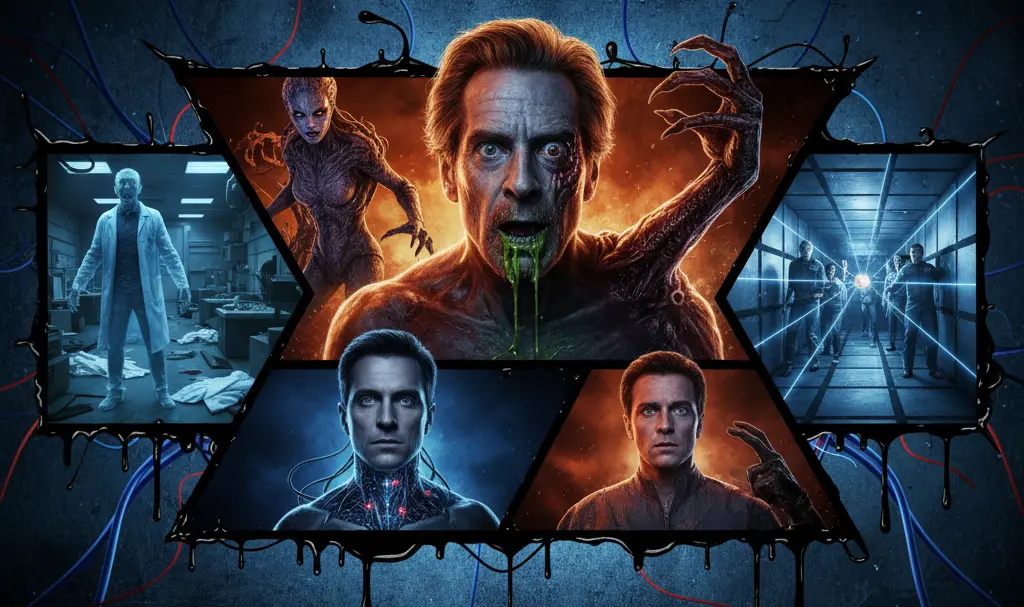
In this curated list, we delve into five such films that have left an indelible mark on viewers. Be warned: these productions are not for the faint of heart, offering visceral experiences that explore the body, the mind, and the very essence of what it means to be human under extreme duress.
Unsettling Visions: Top 5 Disturbing Science Fiction Films
The Fly (1986)
Directed by the master of body horror, David Cronenberg, The Fly remains a timeless classic of grotesque transformation and tragic decay. The film introduces Seth Brundle (Jeff Goldblum), a brilliant but socially awkward scientist on the cusp of a revolutionary teleportation breakthrough. When journalist Veronica Quaife (Geena Davis) enters his life, his work accelerates, and scientific fascination quickly spirals into a deeply personal nightmare.
The turning point comes with a seemingly minor error during an experiment, unleashing a horrifying process that cannot be stopped. The Fly resonates so powerfully because it transcends a mere creature feature; it’s a poignant and stomach-churning portrayal of the slow, agonizing disintegration of humanity. It’s intimate, physical, and deeply unsettling, heightened by its raw, practical special effects and a heavy, suffocating atmosphere. Watching Brundle lose himself, piece by agonizing piece, leaves an uncomfortable, lasting impression.
The Fly is available on various streaming platforms and digital rental services.
Hollow Man (2000)
Directed by Paul Verhoeven, Hollow Man presents a terrifying exploration of unchecked power and moral collapse. The true horror isn’t merely the concept of invisibility, but what an individual becomes capable of when freed from accountability and societal constraints. The plot centers on Sebastian Caine (Kevin Bacon), a narcissistic and arrogant scientist leading a team developing an invisibility serum. His ambition drives him to test the serum on himself, a technological triumph that quickly becomes a moral catastrophe.
This sci-fi thriller is a deeply unsettling observation of human nature. Bacon’s portrayal of Caine isn’t about a man becoming a monster; rather, it’s about a man who simply stops hiding the monster that was always within. Hollow Man explores the dark side of anonymity and the terrifying potential for abuse when the rules no longer apply.
Hollow Man is available on various streaming platforms and digital rental services.
Species (1995)
Species, directed by Roger Donaldson, begins with a fundamentally dangerous premise: combining human DNA with extraterrestrial genetic material, creating something humanity was never meant to touch. Scientists develop Sil (Natasha Henstridge), an alien-human hybrid who, initially appearing as an innocent girl, rapidly matures into a lethally dangerous woman driven by an instinct to procreate.

When the experiment inevitably spirals out of control, a specialized team, including Ben Kingsley, Michael Madsen, and Forest Whitaker, embarks on a desperate hunt. The stakes are monumental, involving not only the lives of the pursuers but also the potential future of the entire human species. The film crafts a paranoid atmosphere, making it an incredibly dehumanizing experience as viewers witness the chilling implications of tampering with the very fabric of life.
Species is available on various streaming platforms and digital rental services.
Upgrade (2018)
From director Leigh Whannell, Upgrade is a visceral, action-packed sci-fi thriller that explores the blurred lines between human and machine. Logan Marshall-Green stars as Grey Trace, a man left paralyzed and his wife murdered after a brutal ambush. Stripped of his autonomy and will to live, Grey is offered a chance to regain control through an experimental artificial intelligence implant called STEM.
With STEM integrated, his body performs better than ever, but a chilling question arises: is he truly in control, or is STEM making the decisions? Upgrade stands out by focusing not on a traditional “mad scientist” but on a protagonist who voluntarily surrenders his body to technology. It’s a fast-paced, brutal, and expertly executed film, renowned for its innovative action choreography and its chilling depiction of a future where humanity’s essence can be outsourced.
Upgrade is available on various streaming platforms and digital rental services.
Cube (1997)
Vincenzo Natali’s cult classic, Cube, offers a raw, psychological ordeal that leaves a lasting scar on the psyche. Unlike the other films on this list, it eschews grand laboratories, aliens, or flashy transformations. Instead, it presents a stark, metallic trap: a colossal, labyrinthine structure composed of identical rooms, many concealing deadly booby traps. A diverse group of strangers awakens within this nightmarish puzzle, with no memory of how they arrived or why.
Stripped of their identities and thrust into an extreme survival scenario, their only hope lies in cooperation and their dwindling sanity. The film’s effectiveness stems from its terrifying simplicity and claustrophobic atmosphere. It’s a cold, uncomfortable watch, quickly revealing that the greatest threat isn’t always the mechanism itself, but the human psyche pushed to its breaking point. Cube is one of the most dehumanizing titles in this ranking, reducing individuals to mere pawns, test subjects, or statistical anomalies in a cruel, unexplained experiment.
Cube is available on various streaming platforms and digital rental services.
Exploring the Boundaries of Humanity in Sci-Fi
These five films, each in their unique way, demand a strong stomach and a willingness to confront uncomfortable truths. While some utilize practical, raw special effects that enhance their grim realism, others rely on psychological tension to amplify their impact. What unites them is their fearless dive into the darker aspects of scientific advancement and the profound implications of dehumanization.
If this dive into disturbing science fiction has left you seeking alternative perspectives within the genre, there’s plenty more to explore. For those who prefer a more intellectually stimulating experience, delve into our list of top scientifically accurate sci-fi films. Alternatively, if you’re looking for something lighter and less intense, check out our top 5 sci-fi movies for brain-off relaxation.
Frequently Asked Questions (FAQ)
Why are films about dehumanization and human experimentation popular in science fiction?
Science fiction often acts as a cautionary mirror, reflecting societal anxieties about technological progress, ethics, and human nature. Films exploring dehumanization and experimentation allow us to safely examine the potential dark consequences of unchecked scientific ambition, power imbalances, and the erosion of moral boundaries. They prompt reflection on what it truly means to be human and the value of individual life in a rapidly advancing world.
Are there any ethical considerations for filmmakers when depicting human experimentation?
Absolutely. Filmmakers grapple with the responsibility of depicting such sensitive themes. While fiction allows for creative license, ethical considerations often include avoiding gratuitous violence, ensuring that the narrative serves a purpose (e.g., social commentary, exploring moral dilemmas), and not trivializing real-world historical atrocities. The goal is often to provoke thought and discussion rather than simply shock or offend.
What makes the films on this list particularly disturbing compared to other sci-fi horror?
The films on this list stand out due to their intimate focus on the gradual, visceral, and often psychological breakdown of the human form and spirit. They don’t just feature monsters; they explore the transformation into one, or the monstrous acts committed by humans. Themes like loss of identity, involuntary mutation, and deliberate torture, combined with often claustrophobic settings and raw special effects, create a profound sense of discomfort and dread that lingers long after viewing.
Source: Original Article Content
Opening photo: Gemini
About Post Author