

Contents
Tesla Cybercab Production Begins: Navigating Regulations Amid Software Challenges
Tesla has officially kicked off production of its highly anticipated Cybercab, a vehicle poised to become the cornerstone of the company’s autonomous transportation future. While Elon Musk’s enterprise has successfully navigated restrictive regulatory bottlenecks, the core Full Self-Driving technology powering the vehicle remains a significant work in progress.
Bypassing Regulatory Roadblocks in Texas
During a Q1 2026 financial earnings presentation, Elon Musk confirmed that the Tesla Cybercab is now rolling off the assembly lines at the company’s Texas manufacturing facility. One of the most fascinating aspects of this launch is how Tesla handled the strict limitations typically imposed by the National Highway Traffic Safety Administration (NHTSA).
Traditionally, manufacturers producing autonomous vehicles that lack conventional controls must apply for special federal exemptions. These exemptions are usually capped at a restrictive 2,500 units per year. Tesla, however, opted for a fundamentally different strategy to ensure rapid growth:
- Self-Certification: The Cybercab was meticulously engineered to comply with all existing motor vehicle safety standards without needing special exemptions.
- Unlimited Scaling: By meeting these standard requirements, Tesla can scale its production without facing formal regulatory volume limits, treating the Cybercab just like its traditional consumer cars.
- Visible Compliance: Recent sightings confirm the production vehicles already carry standard compliance markings, proving they meet federal requirements.
This strategic move means that ongoing legislative debates over autonomous vehicle laws in the US might not hinder Tesla’s immediate manufacturing goals. If this self-certification strategy holds up, Tesla could gain a massive competitive advantage globally, paving the way for a rapid expansion when commercial robotaxis arrive in Europe and other international markets.
Design Updates: Glossy vs. Matte
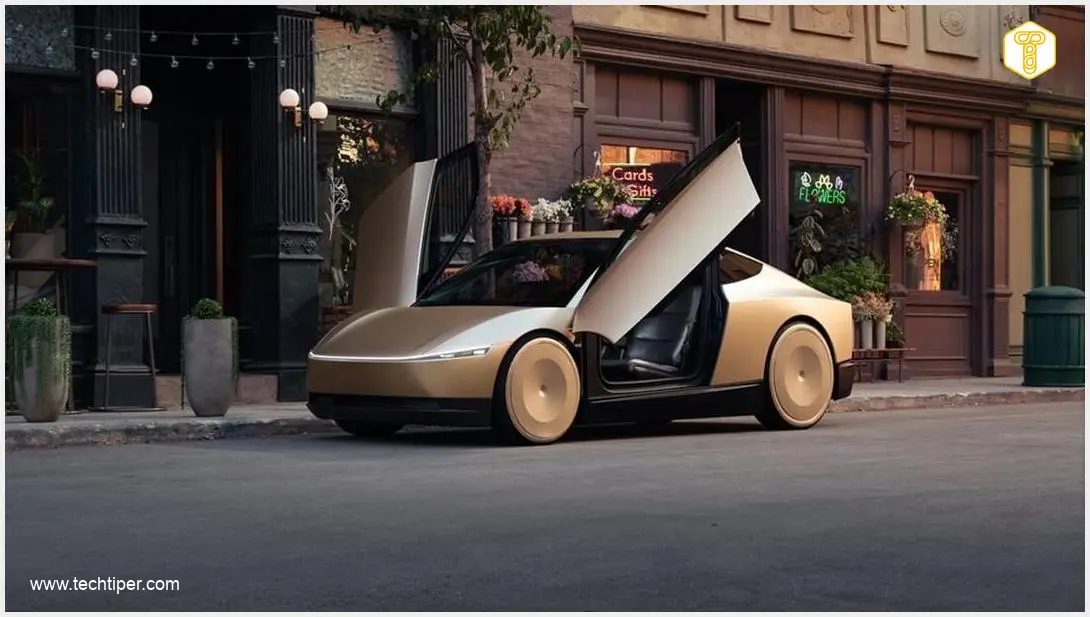
Recent observations of the production-ready Cybercabs reveal notable design tweaks compared to earlier prototypes. The production model features a striking glossy exterior finish instead of the previous matte look, alongside a richer, deeper gold color palette that has drawn praise from industry observers.
Production Ramps Up, but Autonomy Lags Behind
While the Cybercab production lines are officially operational, Tesla is managing expectations regarding immediate availability. Musk emphasized that the initial output will be very limited, with production scaling gradually according to the typical curve for new, innovative products. The company is currently focused on the monumental task of building an entirely new supply chain to support the vehicle’s unique architecture.
Interestingly, Tesla is parallel-tracking its hardware development. The company is actively working on versions of the vehicle both with and without a traditional steering wheel. Ultimately, the Cybercab is expected to become Tesla’s dominant flagship product, capitalizing on the statistical reality that most passenger journeys consist of just one or two people.
This massive manufacturing effort aligns with Tesla’s broader structural and technological expansion, which includes significant investments in supporting infrastructure like its Texas semiconductor factory for AI and robotics.
The Unsolved Challenge: Full Self-Driving Software
Despite the impressive manufacturing milestones, the core technology—unsupervised autonomous driving software—remains the project’s biggest hurdle.

- Software Limitations: Tesla has not yet achieved unsupervised full autonomy. The cars still require human oversight in many scenarios.
- Safety Data Concerns: Current iterations of the autonomous system have faced scrutiny, with Musk himself admitting that the vehicles can sometimes get “lost” or confused in complex traffic situations.
- Personnel Shifts: The Cybercab project has recently experienced the departure of several key managers, a factor that could naturally impact the pace of software development and final deployment.
While Elon Musk has suggested that unsupervised autonomy could be ready by the end of the year, the company’s historical tendency to push back optimistic timelines suggests that widespread, driverless deployment may still be a long way off.
Frequently Asked Questions (FAQ)
How is Tesla legally mass-producing the Cybercab without federal volume exemptions?
Unlike other autonomous vehicle manufacturers who rely on special NHTSA exemptions—which are capped at just 2,500 units per year—Tesla designed the Cybercab to fully comply with existing standard motor vehicle safety regulations. By self-certifying the vehicle under current laws, Tesla avoids these volume limits entirely and can mass-produce the car like any traditional model.
Why is Tesla developing a version of the Cybercab with a steering wheel?
Developing a dual-track strategy allows Tesla to immediately sell and deploy the vehicle in jurisdictions where fully autonomous, steering-wheel-less vehicles are heavily restricted by local laws. It also serves as a practical bridge product for consumers while the company finalizes its unsupervised Full Self-Driving (FSD) software.
Source: Electrek & Opening photo: Tesla press materials
About Post Author
