

Contents

Did Life Ever Exist on Mars? NASA’s Curiosity Rover Uncovers New Organic Clues
The NASA Curiosity rover has successfully conducted a highly complex chemical experiment on Mars—a procedure never before attempted on another planet. The results have yielded groundbreaking data that could fundamentally change our understanding of the Red Planet. Scientists have detected over 20 organic molecules, including substances widely recognized on Earth as the “building blocks of life.”

Published in the prestigious journal Nature Communications, these findings have been met with immense interest and cautious optimism by the global scientific community. The discovery provides a profound new perspective on the ancient history of our neighboring planet.
A High-Stakes Extraterrestrial Experiment
At the core of this monumental discovery is a specialized chemical substance known as TMAH (tetramethylammonium hydroxide). This reagent is designed to break down large, complex organic molecules into smaller, identifiable fragments that the rover’s onboard analytical instruments can process.
Executing this experiment required meticulous planning and absolute precision. It marked the first time a TMAH-based chemical analysis was performed outside of Earth. The stakes were incredibly high because Curiosity only carried two vials of the substance, leaving the scientific team with exactly two chances for success.
Extracting Secrets from Martian Clay
The crucial samples were collected in 2020 from a site designated “Mary Anning 3,” located in the Glen Torridon region within Gale Crater. This specific location was not chosen at random; it is highly rich in clay minerals.
- Water Indicators: Clay minerals are strong indicators of the past presence of liquid water.
- Chemical Preservation: Clays are exceptionally effective at trapping and preserving organic compounds over billions of years, much better than other types of rock.
- Strategic Location: Targeting Gale Crater maximized the chances of finding well-preserved chemical signatures from Mars’ distant, wetter past.
What Did the Martian Rocks Reveal?
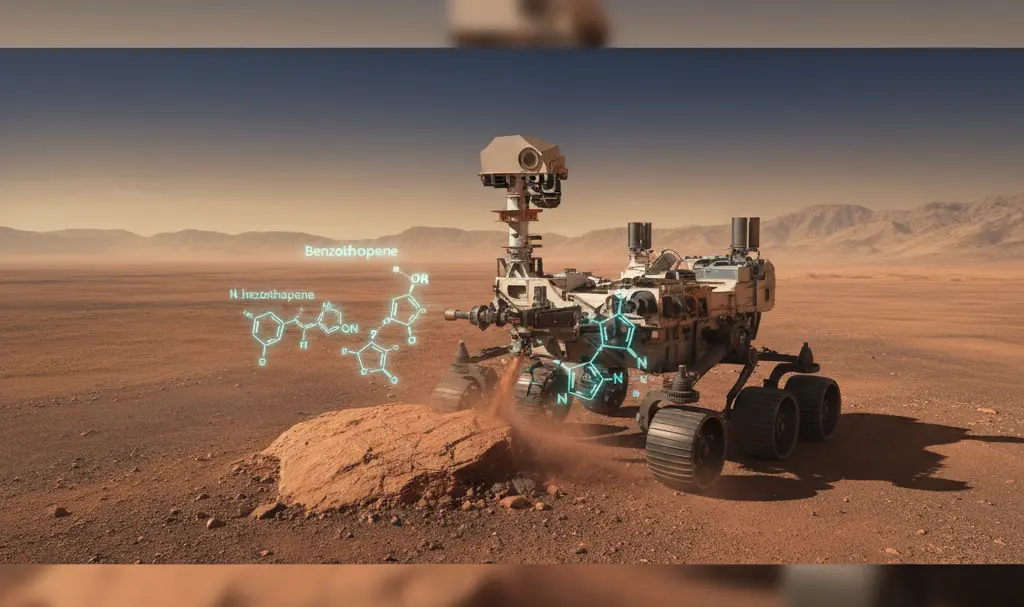
The chemical breakdown revealed a treasure trove of organic data. Among the identified compounds were naphthalene and benzothiophene—which currently stand as some of the largest and most complex organic molecules ever discovered on the Martian surface.
Benzothiophene, a two-ringed molecule containing sulfur, has generated particular excitement. Scientists believe it likely originated in the interstellar space of the early Solar System and was delivered to the planets via meteorite impacts. Just as astronomers witness planetary collision ASASSN-21qj and other cosmic phenomena reshaping star systems, ancient meteorite bombardments heavily influenced the chemical makeup of our local planets.
“The very same materials that rained down on Mars in the form of meteorites also fell on Earth, likely providing the foundational building blocks for life as we know it on our home planet,” noted researchers involved in planetary geology studies.
The DNA Connection: N-heterocycles on Mars
Perhaps the most thrilling outcome of the experiment was the first-ever detection of possible N-heterocycles. These are essential ring-like chemical structures that form the foundational backbone of DNA and RNA.
Official NASA communications have confirmed that these structures can act as chemical precursors to even more complex, nitrogen-bearing molecules. Crucially, compounds of this exact nature had never before been confirmed directly on the Martian surface or within recovered Martian meteorites.
Is This Definitive Proof of Martian Life?
Despite the excitement, scientists are maintaining strict caution when interpreting these results. While these molecules are associated with life on Earth, their mere presence is not definitive proof of biological activity.
The current experiment cannot definitively differentiate whether these organic compounds were created by ancient living organisms, formed through natural, non-biological geological processes, or delivered from space by meteorites. Therefore, this is not a confirmation of past or present life on Mars.
A Habitable Ancient Environment
What scientists do emphasize with high confidence is the incredible preservation potential of the planet. The fact that complex organic matter can be preserved in Martian rocks for 3.5 billion years is a massive revelation. It proves that ancient Mars possessed a potentially habitable environment, opening new pathways for discovering organic carbon traces.
Billions of years ago, the Red Planet likely possessed all the necessary conditions and raw materials to support microbial life.
The Future of Mars Exploration
Curiosity, operational since 2012, continues to deliver invaluable scientific data, although its hardware limitations are growing over time. To fully understand these organic molecules, scientists desperately need to analyze Martian soil in advanced Earth-based laboratories.
The Perseverance rover has already collected pristine rock samples for the ambitious Mars Sample Return (MSR) mission. However, the program is currently facing severe budget constraints and massive restructuring following recent US Congressional reviews, delaying the timeline for when these samples might reach Earth.
Meanwhile, international space collaboration continues to push boundaries, much like we see with Poland Artemis II mission contribution in the space industry. Europe’s upcoming Rosalind Franklin rover, managed by the European Space Agency (ESA), is slated to launch toward Mars in the late 2020s. Equipped with a significantly deeper drill than Curiosity, it may uncover even better-preserved organics shielded from harsh surface radiation.
Frequently Asked Questions (FAQ)
Why is the discovery of N-heterocycles on Mars so important?
N-heterocycles are complex chemical structures that act as the fundamental building blocks for DNA and RNA. Finding them on Mars suggests that the planet once had the necessary chemical precursors required to support biological life, even if we haven’t found definitive proof of life itself.
Does the presence of organic molecules mean there is, or was, life on Mars?
No. While organic molecules are essential for life as we know it, they can also be created through purely abiotic (non-living) geological processes, such as water-rock interactions, or they can be delivered by meteorite impacts. Scientists cannot yet determine the exact origin of these specific Martian organics.
Why was the TMAH experiment considered risky for the Curiosity rover?
The TMAH experiment was incredibly risky because it was the first extraterrestrial use of this specific chemical reagent, and the rover only carried two small vials of it. This meant the scientific team had a maximum of two attempts to successfully perform the complex chemical breakdown without any room for error.
Source: Gemini & Opening photo: Gemini
About Post Author
