

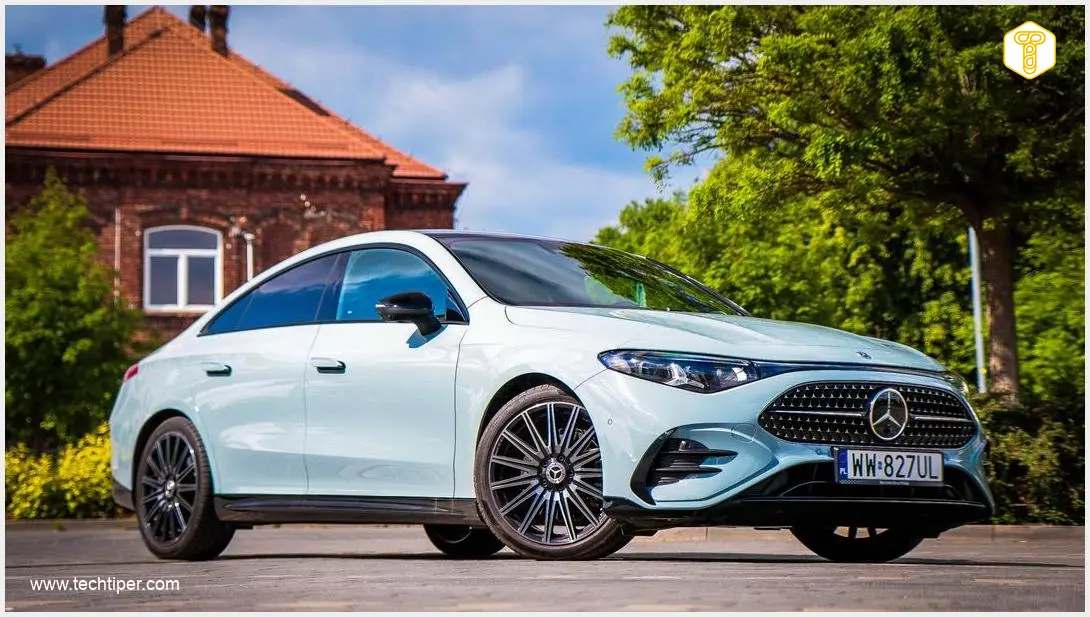
Mercedes CLA 220 4MATIC Review
-
Infotainment System
-
Driving Comfort
-
Engine/Hybrid Performance
-
Driver Assistance Systems
-
Interior Design & Quality
-
Practicality/Cargo Space
A Capable ICE Contender with Premium Features
The Mercedes CLA 220 4MATIC shines with its advanced MB.OS infotainment, cutting-edge driver assistance systems, and impressive fuel efficiency. While offering a comfortable ride, minor refinement issues with the hybrid system at low speeds and a lack of a front trunk mark it as slightly less polished than its electric counterpart.
Advantages
- Advanced MB.OS infotainment system with extensive features and regular updates.
- Cutting-edge driver assistance systems, particularly outstanding headlight quality and 360-degree camera.
- Highly fuel-efficient hybrid powertrain for long journeys, especially outside the city.
- Comfortable driving experience with balanced steering and good handling.
- Premium interior with high-quality materials, customizable ambient lighting, and return of physical steering wheel controls.
- Top-tier Burmester sound system.
Disadvantages
- Hybrid system exhibits occasional hesitation and jerking at very low speeds in urban driving.
- Lack of a front trunk and limited main trunk capacity compared to the EV model.
- Small side mirrors compromise visibility.
- Reliance on subscription services for full functionality (“Digital Extras”).
- Minor interior fit and finish issues (e.g., occasional creaking).
- Traffic sign recognition can be inconsistent.
Welcome to our comprehensive review of the Mercedes CLA 220 4MATIC. This combustion-engine variant follows the highly anticipated electric version, which, as explored in our Mercedes CLA 250 EQ review, introduced significant advancements to the Mercedes lineup. Naturally, the internal combustion engine (ICE) counterpart faces high expectations, especially since many of the recent innovations have focused on the EV powertrain. While the CLA 220 4MATIC shares many components with its electric sibling, it aims to offer a different kind of endurance. Let’s delve into its unique characteristics, advantages, and potential drawbacks.

Contents
Mercedes CLA 220 4MATIC Pricing and Trim Levels
Mercedes has revised its car configuration approach. For the CLA, the journey begins with choosing your body style: a sedan or a Shooting Brake. Opting for the Shooting Brake, which offers a larger trunk, comes at an additional cost (approximately 6,000 units). Following this, you select your design line—Progressive, Athletic, or Sporty.
The differences between these lines primarily concern exterior aesthetics and basic equipment. Regardless of your choice, the same powertrain options are available, with approximate pricing as follows:
- CLA 180 (front-wheel drive): 192.5 thousand units
- CLA 200 (front-wheel drive): 202.5 thousand units
- CLA 200 4MATIC (all-wheel drive): 212.5 thousand units
- CLA 220 (front-wheel drive): 213.5 thousand units
- CLA 220 4MATIC (all-wheel drive): 223.5 thousand units
All current models are mild hybrids, combining a 30 HP electric motor with a 1.5-liter gasoline engine offering various base power outputs (136 HP for CLA 180, 163 HP for CLA 200, or 190 HP for CLA 220). Stronger AMG variants are expected in the future. All versions come exclusively with automatic transmissions. All-wheel drive (4MATIC) is an optional upgrade, typically costing around 10,000 units.
Naturally, the electric EQ variants are generally priced higher but offer significantly more power (224, 272, or 354 HP) and often additional practicalities like a front trunk. Mercedes provides a consistent 2-year warranty for the entire CLA range, with unlimited mileage, and extended warranty packages are also available.
Estimated Insurance Costs for the Mercedes CLA 220 4MATIC
Based on market data, comprehensive insurance for the CLA, for a driver with several years of experience, could be approximately 9,810 units for a full package including collision coverage, while basic liability might start around 780 units.
Key Specifications of the Mercedes CLA 220 4MATIC
As mentioned, Mercedes has opted for hybrid-only combustion CLA variants, powered by a single gasoline engine with different power outputs. Manual transmissions are no longer offered, and the default drive is front-wheel. The performance figures are respectable, with more powerful AMG versions anticipated to join the lineup later.
From a practical standpoint, the combustion CLA is slightly less versatile than its electric sibling, as it lacks a front trunk (frunk). The main trunk at the rear, while adequately sized, isn’t exceptionally large. For those needing more cargo space, the Shooting Brake body style offers increased practicality with its fastback-like roofline. However, for the CLA, design often takes precedence over pure practicality.
A Brief History of the Mercedes CLA
Mercedes introduced the CLA as a response to the growing demand for more aerodynamically styled, sporty-looking vehicles. It aimed to offer this aesthetic without completely sacrificing practicality and comfort. The CLA is the smallest car in this design language, first appearing on the market in 2013 and quickly gaining considerable interest.
The second generation was released in 2019, building upon the original’s success. The third, and current generation—the 2025 model year being reviewed here—stirred things up considerably by placing a greater emphasis on electric powertrains. While electric models gained prominence, Mercedes naturally didn’t forget the combustion variant, which is the subject of this review. From the outset, two body types have consistently been available: the sedan and the Shooting Brake.
The Mercedes CLA 220 4MATIC represents the premium C-segment as a 4-door coupe sedan. Its primary competitor is often considered the BMW 4 Series Gran Coupe. Theoretically, the Audi A5 could also be a rival, though its focus has shifted in its latest generation. Surprisingly, finding other combustion-engine rivals in this niche is challenging, while the electric CLA faces tougher competition in attracting buyers.
Mercedes CLA Infotainment System: Continuously Evolving
The CLA is the first Mercedes vehicle to feature the new MB.OS software, designed from the ground up for regular updates. After less than a year since reviewing the electric model, I’ve already noticed significant improvements.
Overall, it’s a relatively simple system (for the premium segment) yet offers extensive capabilities. It’s easy to learn, operates efficiently, and provides a rich set of features. Despite the CLA being one of Mercedes’ entry-level models, it boasts numerous displays. Standard equipment includes a 10.25-inch screen for the digital instrument cluster and a 14-inch central touchscreen. Optional extras include another 14-inch display for the passenger and a Head-Up Display (HUD).
The Central Screen: A Multimedia Hub
MB.OS is a platform that encourages immediate registration with your Mercedes Me account to unlock full functionality. This is particularly crucial for the “digital add-ons” mentioned during configuration, where the CLA’s features are heavily dependent on purchased subscriptions. This applies not only to multimedia but also to comfort functions and driver assistance systems. Furthermore, the driver’s account naturally allows for synchronization of all personal settings.
The system interface in the tested CLA effectively utilizes the large screen area, with clear, large icons that are easy to operate. The main dashboard typically shows navigation and media playback. Contextually relevant app shortcuts and climate control are always visible at the bottom. The top bar contains icons for connectivity, among other things, and doubles as a pull-down notification panel. A back button, activated by a left-edge swipe, is also present. Naturally, a dedicated app drawer is included.
I appreciate Mercedes for providing a detailed, built-in owner’s manual, accompanied by a “Tips” program. This offers clever aids for daily car operation, including for electric vehicle aspects. Another key innovation in MB.OS is the advanced voice assistant, which utilizes AI. While a localized voice version is still awaited, the current English variant is quite capable.
For comfort, the Mercedes CLA offers basic climate control settings, but much more emphasis is placed on lighting and sound. The lighting system features an extensive, dual-zone ambient setup, which we’ll discuss further when exploring the interior. Interestingly, you can also customize the car’s sound profile, both externally and internally. This includes various notifications, warnings, and, of course, engine sound.
Regarding daily conveniences, Mercedes, as always, offers many seat-related solutions, though the driver benefits slightly more (e.g., easy-entry/exit function). Basic central locking settings round out the convenience features.
The Mercedes CLA’s system truly shines in its multimedia aspects. It features comprehensive connectivity, essential for utilizing the wide array of applications downloadable from its proprietary app store. However, this also brings “Digital Extras,” or subscription services, which might not appeal to everyone, as they involve paying a subscription fee for features already physically installed in the car.
The sound system in the tested CLA 220 4MATIC is the top-tier Burmester setup, and it’s well worth the investment. I previously lauded its sound quality in the quiet electric model, and in the combustion version, the audio remains a significant advantage. All aspects are above average, though it’s worth experimenting with the various predefined settings or adjusting the sliders manually, especially since there are many sound modulation options available.
Navigation, Android Auto, and Apple CarPlay: Meeting Expectations
The navigation system in the tested Mercedes stands out for its active support from Google, though not necessarily for the maps themselves. The road database is updated independently, and I found no missing local information. The program is straightforward to use, provides ample useful information, and most importantly, operates smoothly and guides you accurately to your destination.
By opting for another digital add-on, you can enable an augmented reality effect, where arrows are superimposed onto the live camera feed from the front, indicating which way to turn at upcoming intersections.
While I couldn’t test Android Auto and Apple CarPlay in the electric CLA, I was able to this time, as it’s an optional service purchased for a specific period. Once activated, both platforms work flawlessly, offering wireless integration. This seamless connectivity enhances the user experience, especially for navigation and media.
The Passenger Screen: Not to Be Outdone
The tested Mercedes CLA 220 4MATIC was equipped with an additional passenger screen, essentially a mirrored display of the central one. Interestingly, it doesn’t dim during use or while driving, unlike some other brands. This means the driver can glance over and see what the passenger is currently viewing.
In practice, the passenger display’s capabilities are mainly limited to media control and accessing downloaded apps. Surprisingly, I didn’t find an option to connect Bluetooth headphones for independent audio playback, which Mercedes might address in future updates.
Clear Digital Gauges and Head-Up Display (HUD)
Mercedes has long been known for implementing a wide variety of digital instrument cluster designs across nearly all its models. With the CLA and the new MB.OS platform, the manufacturer has significantly reduced the number of available visualizations, focusing instead on functionality. Readability is excellent, and the displays are visually engaging without distracting the driver.
The CLA offers three distinct themes. The first features classic twin dials, which can be personalized by turning off the scale to leave just the needle and central digit. The second theme provides an extended navigation view, allowing you to manage it by selecting from recent destinations. Finally, there’s a comprehensive overview of what the driver assistance systems detect around the car. The CLA proves to be an observant vehicle, accurately identifying not only vehicle types but also buildings, pedestrians, and even smaller obstacles. Everything appears to operate in real-time, underscoring the quality of the system.
When using the classic dial theme, Mercedes allows juggling central widgets. These primarily include various trip computer variations where you can monitor fuel consumption. You can also display a minimized navigation view and control it fully. The only missing feature was multimedia management.
The Head-Up Display (HUD) appears very simple, and in many ways, it is. You can choose between an elaborate or minimalist display; the latter simply shows your current speed. The more comprehensive option adds indications from driver assistance systems (including parking sensors) and navigation instructions.
Modern Interior of the Mercedes CLA
This generation of the CLA marks a clear shift in Mercedes’ interior design philosophy, especially for its entry-level models. As such, you’ll find certain cost-saving measures in the cabin, some more significant than others. Nevertheless, the quality of materials and the overall layout are well-considered. My only minor complaint is the fit and finish of some elements, which occasionally creak – an unexpected issue in this segment.
Keyless entry was present in the tested CLA 220 4MATIC and worked flawlessly. Mercedes extends the door handles as you approach and unlocks the central lock when you stand by the door. Locking, however, is activated solely by touching visible grooves on the handle; the car doesn’t automatically lock when you walk away. Settings allow you to decide if automatic unlocking should occur or if you prefer to touch the handles each time. Similarly, the electrically operated trunk lid supports a foot-swipe gesture and can be closed along with central locking via a separate button.
First Row: Coupe-Style Frameless Doors
As a coupe-styled vehicle, frameless windows were a natural inclusion. From the outside, you’ll notice the retractable door handles, although these are an optional extra; base models feature traditional handles. The doors open wide, making entry and exit relatively easy, though naturally, it’s not an SUV, so mind your head when getting out. Inside, the door panels feature pleasant-to-touch finishes, though the storage compartment uses hard plastic, albeit with a rubber insert. In a cost-saving move, Mercedes has limited the window switches to two, with an additional button to toggle control for the rear windows.
Comfortable, Yet Simple, Seating
Mercedes uses ecological leather throughout the CLA’s interior, including the seats. These are well-contoured, providing above-average lateral support. Overall, they are comfortable for long journeys, offering numerous adjustment options, including an extendable thigh support and adjustable headrests. The front part of the seat cushion can also be independently raised. Most seat adjustments are managed via controls on the door panel, with the exception of lumbar support, which is adjusted through the central screen. Other amenities include automatic seatbelt tensioning, memory functions, and 3-stage heating. Furthermore, a simple massage function and “seat kinetics” (subtle micro-adjustments) are available, proving invaluable on longer trips. The driver’s seat also benefits from an automatic sliding function for easier entry and exit.
The Steering Wheel: Physical Switches Return!
In previous years, Mercedes rigorously adhered to a modern, touch-sensitive approach for steering wheel design. However, with the CLA, specifically the combustion version, a minor breakthrough has occurred: physical switches have returned, which we’ll discuss shortly. The flat-bottomed, thick, and partially perforated rim is very comfortable in the tested configuration. Steering wheel adjustment is manual and covers two directions (tilt and telescope).
Regarding controls, the upper spokes now feature a left-hand switch for cruise control speed and a right-hand knob for audio volume. These are precise, physical controls, marking a positive step for ergonomics. My only minor gripe is that pressing the black panels too firmly can cause a creak. The lower sections of the spokes remain unchanged, featuring pressable panels that are partially touch-sensitive (d-pad style). Fortunately, the layout is well-defined with additional protrusions, making it a generally convenient solution. The left section manages further cruise control functions, while the right controls the digital instrument cluster.
Behind the steering wheel are the characteristic stalks, also carried over from the electric model. Thus, don’t look for a traditional engine start button – you start the CLA 220 4MATIC with the right-hand stalk. This stalk also handles manual gear changes, replacing paddle shifters, though it’s unlikely to be a frequently used feature.
The Dashboard: A Multimedia Station
Piano black dominates the vertical dashboard, designed to seamlessly integrate the displays. While this material naturally attracts dust, it wasn’t noticeable during the tests. From an ergonomic perspective, much of the interaction is via touch panels, but the system is well-configured to make this intuitive. The top of the dashboard houses part of the audio system, additional air vents, and the HUD projector. Descending to the piano black surface, the screens naturally become prominent, flanked by partially illuminated plastic air vents. If you’re curious about the CLA interior without the optional passenger display, refer to our CLA 250 EQ review.
Before moving further down, it’s worth noting the camera above the central screen, suitable for video calls or even taking photos. Alongside it are sensors that monitor driver attention. Below the central display are more subtle air vents, and below those, key physical buttons (including hazard lights). Further down, a convenient and efficient wireless charging pad awaits.
A convenient feature in the tested Mercedes CLA is the additional storage space beneath the center tunnel, perfect for larger items, which can be secured with a rubber strap. We can also find two USB-C ports in this area. Returning to the top, comfortable cup holders with additional stabilizers are present; the entire assembly can be removed for an even larger storage compartment. The non-adjustable armrest hides a simple organizer and a softly lined, albeit modestly sized, compartment.
The glove compartment in front of the passenger is also not overly capacious. However, near the headliner, a simple lighting panel is found, though surprisingly, it’s not possible to activate all light sources with a single click. On the other hand, the auto-dimming rearview mirror works flawlessly.
Second Row: Some Compromises, But Still Good
Entering the rear seats is certainly not as convenient as the front, but this is typical for this body style. While it doesn’t require extreme contortions, one must mind their head. Inside, the rear door panel is equally well-finished but features a minimalist storage compartment.
There’s ample rear legroom for individuals up to approximately 1.9 meters (6 feet 3 inches) tall, though the sloping roofline might limit headroom. Naturally, two occupants will be most comfortable, allowing access to the armrest with open cupholders and a smartphone holder.
Other conveniences include central air vents with two USB-C ports. There are also coat hooks, seat-back pockets, and ISOFIX child seat anchors hidden behind fully removable covers. Mercedes does not offer heated rear seats or additional climate zones in this class.
Unmissable Lighting and a Special Panoramic Roof
In a Mercedes, lighting is crucial, both exterior and interior. When the CLA recognizes you, welcome animations play, but more importantly, the powerful lights integrated into the mirrors illuminate the car’s sides exceptionally well. Furthermore, opening the front doors triggers additional ground lighting. Inside, the excellent impression continues with warm and appropriately bright basic lighting. The ambient lighting system is highly extensive, offering divided color zones and a wide selection of hues. This system is integrated with the assistance systems, providing visual cues for potential hazards. My only minor critique is that the illuminated air vents create noticeable reflections in the windows, so reducing their brightness might be advisable.
The large panoramic roof comes standard, visually enlarging and brightening the otherwise dark interior. Despite sunny conditions, I didn’t notice any adverse light reflections, making it a comfortable feature.
Only One Trunk Remains
The fact that the third-generation CLA was designed with an electric powertrain in mind is most evident in its trunk space, which is optimized for the EV version. The combustion model loses the substantial front trunk (frunk). However, the main trunk offers a decent loading aperture for a sedan. The lid is electrically operated and supports a foot-swipe gesture for opening.
Comparing the CLA’s trunk capacity generation by generation, despite the car’s overall growth, the actual cargo space has noticeably shrunk in this tested model. The basic capacity is 405 liters (approximately 14.3 cubic feet), which isn’t particularly large considering the car’s overall size. Fortunately, the rear seatbacks can be folded (40:20:40 split) to accommodate longer items. Convenience features include additional space under the floor and tie-down points for nets. One of the spaces near the wheel arches also has a simple organizer. Hooks are absent. A tow hitch is an optional extra.
Mercedes CLA Driving Impressions: A Focus on Comfort
The Mercedes CLA has always had a hint of sportiness in its DNA, stemming from its body line. However, beyond the top-tier AMG versions, it is fundamentally a compact car designed for maximum versatility. Therefore, the tested CLA 220 4MATIC primarily offers a comfortable driving experience. While designed for comfort, it doesn’t shy away from dynamic maneuvers.
The suspension provides good damping characteristics, though I recall the CLA EQ handling road imperfections slightly better. Surprisingly, the difference isn’t due to weight (the ICE model is about 300 kg lighter) but rather the 19-inch wheels on the CLA 220 4MATIC, which replaced the 18-inch variant on the electric model. The AMG design line might also contribute to this difference. Nevertheless, I still describe the CLA as a comfortable car that handles road imperfections well. Moreover, the car exhibits minimal body roll during cornering, and the chassis works seamlessly with the all-wheel-drive system.
The steering system strikes an ideal balance between precision and lightness. There’s no tiring, forced effort or uncertainty in its behavior under any conditions. The tested CLA goes where you direct it and quickly communicates essential feedback from the front wheels. The turning circle is acceptable at 11.2 meters (approximately 36.7 feet).
Driving Dynamics of the Combustion Mercedes CLA: A Different Character
The third-generation CLA, in its combustion form, is currently offered with a single gasoline engine under the hood, available in various power outputs. As of this review’s publication, an AMG version is likely to further diversify the lineup. The engine is a 1.5-liter, 4-cylinder, turbocharged unit, producing 190 HP in our CLA 220 test model. Additionally, an electric motor generates 30 HP, resulting in a total system output of approximately 210 HP and 300 Nm of torque. Power is sent to all four wheels (4MATIC) via an 8-speed dual-clutch transmission (e-DCT), specifically designed for hybrid applications, and it warrants further discussion.
According to manufacturer data, the Mercedes CLA 220 4MATIC accelerates from 0 to 100 km/h (62 mph) in 7.1 seconds, which is a very respectable figure. In practice, achieving this is not difficult, though selecting Sport mode beforehand makes a noticeable difference.
Speaking of modes, there are four options: Comfort, Sport, Eco, and Individual. The Individual mode, as expected, allows combining behaviors from the other modes. The most noticeable changes are in throttle response, how quickly the combustion engine shuts off, and its maintained RPMs. Driving the Mercedes CLA 220 4MATIC is undoubtedly pleasant. It’s a very well-insulated car, with engine noise only audible under heavy load—but you can mask it with the audio system! Surprisingly, it sounds quite good, with three selectable tones. It doesn’t feel artificial, though it’s certainly not the actual sound of the 4-cylinder engine under the hood.
Returning to the driving experience, I particularly appreciate the hybrid system’s operation in suburban driving. The CLA 220 4MATIC smoothly switches to electric-only propulsion even at 70 km/h (43 mph), and under certain conditions, even at 100 km/h (62 mph) on a gentle incline. I didn’t expect the relatively modest electric motor to perform so well, making it a pleasant surprise that enhances longer journeys. High speeds are also no problem for the reviewed car. Just like the electric CLA proved excellent for thousands of kilometers on highways, its combustion counterpart handles them with ease. Again, the excellent interior insulation, combined with the superb audio system, provides comfort and ample power for cruising.
However, not everything is perfect. While the hybrid system works very well outside the city, in urban environments, it exhibits a noticeable delay in conjunction with the transmission. When trying to accelerate smoothly from a standstill—not aggressively—the CLA first moves on electric power, then noticeably hesitates as the engine starts and the gear adjusts, before accelerating more forcefully. This behavior can be anticipated and managed by understanding the driving modes and throttle input.
These minor issues primarily occur at very low speeds and also during deceleration. On a few occasions—relatively rare compared to hundreds of potential situations—the Mercedes suddenly jerked the entire car when the combustion engine shut off during gentle braking before traffic lights. I emphasize that this happened only a few times, but in this class, greater smoothness is expected, and I hope a software update will address it. After all, it’s an entirely new powertrain for Mercedes.
Since this is a hybrid, a recuperation system is naturally included. However, there are no paddles or software switches for it. It operates by default in an adaptive mode, which cannot be manually changed—though there’s no real need to. The implementation in the CLA 220 4MATIC works exceptionally well because it’s predictive, using navigation data (corners, intersections) and radar (other cars) to intelligently decelerate and recover energy. It functions very precisely and is simply convenient.
Fuel Consumption and Range of the Mercedes CLA 220 4MATIC
The fuel tank in the CLA 220 4MATIC holds 51 liters (approximately 13.5 gallons) of gasoline, which isn’t particularly large for a 4.7-meter (15.4-foot) car. Of course, it’s a hybrid, so there’s also a 48V traction battery (1.3 kWh), but cheaper variants have even smaller tanks. The following measurements were taken at ambient temperatures above 20 degrees Celsius (68°F).
- City Driving (congested): The CLA 220 4MATIC consistently achieved around 8 liters per 100 km (29.4 mpg). With smoother traffic, this easily drops to 7 liters per 100 km (33.6 mpg), offering a range of approximately 720 km (447 miles). Extreme results ranged from 5 liters per 100 km (47 mpg) during calm night driving to 9 liters per 100 km (26.1 mpg) when driving more aggressively.
- Out-of-Town Driving (efficient): In this scenario, the CLA 220 4MATIC consumed as little as 4 liters per 100 km (58.8 mpg), offering an impressive range of approximately 1270 km (789 miles).
- Highway Driving:
- 100 km/h (62 mph): 4.5 liters per 100 km (52.3 mpg) – approx. 1130 km (702 miles) range
- 120 km/h (75 mph): 5.7 liters per 100 km (41.3 mpg) – approx. 890 km (553 miles) range
- 130 km/h (81 mph): 6.1 liters per 100 km (38.6 mpg) – approx. 830 km (516 miles) range
- 140 km/h (87 mph): 6.4 liters per 100 km (36.8 mpg) – approx. 790 km (491 miles) range
Overall, the Mercedes CLA 220 4MATIC offers very low fuel consumption, making it an enjoyable car for longer trips. It’s clear that the manufacturer prioritized consistent acceleration without compromising efficiency. The aerodynamic body and hybrid system allow for economical driving without hindering traffic flow.
Mercedes CLA Assistance Systems: Non-Intrusive and Effective
Mercedes distinguishes itself in the realm of driver assistance systems, firmly solidifying its premium segment status. This isn’t just about the sheer number of features or their associated switches, which are actually few. Instead, it’s the quality of the offering that truly matters. Basic descriptions of selected solutions are also available within the infotainment software.
The traffic sign recognition system is one area where Mercedes could still refine its performance. It occasionally displays outdated speed limits or overlooks urban area signs. However, the audible warning for alleged speeding isn’t irritating and can be quickly disabled via a constantly visible icon on the central screen (top bar).
The side mirrors also require some getting used to. They are incredibly small, suggesting Mercedes prioritized aerodynamic efficiency significantly. Visibility is restricted, but one can adapt over time, especially since blind-spot monitoring works flawlessly (including cross-traffic detection). Furthermore, the right mirror automatically dips when reversing.
Moving on to the cruise control, I have no complaints about its operation. It’s an adaptive, even predictive, implementation where the software can use navigation data to slow down for turns or upcoming speed limits. The radar system works without fault, with no discernible jerking. Additionally, the lane-keeping assist system operates very confidently and accurately recognizes the correct driving path. We also get automatic lane change capability, though I felt the CLA EQ’s software detected such opportunities more quickly.
Both the taillights and headlights of the CLA are prime examples of Mercedes’ new design language, where the star motif is even more prominent. However, the combustion variant doesn’t feature illuminated stars, as a functional grille is needed for engine cooling. Focusing on illumination quality itself, everything is literally sensational. The tested car could confidently rank among the best in this regard, not just within its class. Every aspect performs exemplarily, and the software illuminates the road shoulders exceptionally well, especially noticeable (positively) during maneuvering. The segmented high beams are outstanding, precisely cutting out other vehicles. When no other cars are present, the full power activates, practically turning night into day, illuminating an incredible distance ahead.
Another highly successful feature in the tested CLA 220 4MATIC is the 360-degree camera system. The image quality is excellent in all conditions, complemented by very good surrounding illumination, particularly from the powerful lights in the mirrors. Sensibly planned views and seamless switching between them greatly facilitate maneuvering. Mercedes also promotes various assistants that help you exit a parking spot or simply park in different ways. Operating these solutions is very intuitive, as you control the CLA’s movements via augmented reality on the central screen. The car’s autonomous movement is relatively smooth, although you still need to be mindful of obstacles like curbs.
Mercedes CLA 220 4MATIC Review: Final Thoughts
Our review of the Mercedes CLA 220 4MATIC has shown it to be a very capable car in a segment with surprisingly few direct competitors. I must admit that the EQ variant (as seen in our Mercedes CLA 250 EQ review) created more of a “wow” effect, largely due to the revolutionary advancements in electric powertrains. However, the combustion version certainly allows for longer journeys, with its aerodynamic body proving beneficial in both iterations. The software and, more importantly, the driver assistance systems are equally impressive, where Mercedes truly stands out as a leader (e.g., headlight quality).
On the other hand, I have to acknowledge that the electric model is superior in some aspects. It offers more cargo space (frunk) and drives significantly smoother. Mercedes should address the occasional jerking experienced at low speeds when the hybrid system engages or disengages the combustion engine. Regardless, it’s worth remembering that the CLA’s aerodynamic design, in part, led to features like the small side mirrors. Another notable feature worth considering is the seamless integration of communication apps like WhatsApp into Apple CarPlay, which enhances connectivity on the go.
Frequently Asked Questions (FAQ)
How does the Mercedes CLA 220 4MATIC’s hybrid system perform in urban vs. highway driving?
The CLA 220 4MATIC’s hybrid system excels in suburban and highway driving, smoothly switching to electric propulsion and offering impressive fuel economy. However, in congested city traffic, the system can exhibit slight hesitation and jerking at very low speeds when transitioning between electric and combustion power.
What are the key differences in interior experience between the combustion CLA 220 4MATIC and its electric EQ counterpart?
While both share the advanced MB.OS infotainment and high-quality assistance systems, the electric CLA EQ often benefits from a front trunk (frunk) for additional storage and a generally smoother driving experience due to its electric powertrain. The combustion model retains its aerodynamic design but lacks the frunk and can have minor refinement issues with hybrid transitions.
Are there any significant usability improvements in the CLA 220 4MATIC’s infotainment system compared to earlier Mercedes models?
Yes, the CLA 220 4MATIC features the new MB.OS, designed for continuous updates and enhanced functionality. It offers a user-friendly interface, comprehensive connectivity for apps, and an advanced AI voice assistant. A notable improvement is the return of physical switches on the steering wheel, enhancing ergonomics for critical controls.
Source: Original article. Opening photo: Lukasz Pajak.
About Post Author
