

Contents

The Curious Case of Your Head and Garage Door Remote Range
The urban legend that a garage door remote gains extra range when held against your head sounds like something out of a science fiction movie. It’s a claim so peculiar, yet so widely discussed online, that we simply had to investigate. This persistent myth has circulated for years, prompting our dedicated tester to grab a remote, head to a garage door, and begin a rigorous examination.

Putting the Myth to the Test: Does Your Head Really Extend Remote Range?
Our experimental method this time wasn’t overly complicated. First, our tester needed to accurately determine the maximum reliable distance at which the remote, held normally in hand, could still operate the garage door. This baseline was crucial to ensure our researcher wasn’t standing at a borderline distance where the door might open inconsistently. We needed a clear point where the remote would not work without the ‘head trick’.
With the baseline established, the next step was straightforward: hold the garage door remote against the head and press the button. To our surprise, the garage door indeed opened, despite the tester remaining at the previously determined non-functional distance. This wasn’t simply due to the remote’s elevated position; when held against the hand at the same distance, the door also opened.
Thus, we successfully confirmed this intriguing myth. But why exactly does our body improve the range of a garage door remote?
The Science Behind It: Your Body as an Antenna
This same ‘trick’ works with car remotes as well, and for a very simple, scientific reason. Devices like garage door openers and car key fobs emit electromagnetic waves, typically at frequencies no greater than approximately 430 MHz, which have wavelengths up to 70 cm.
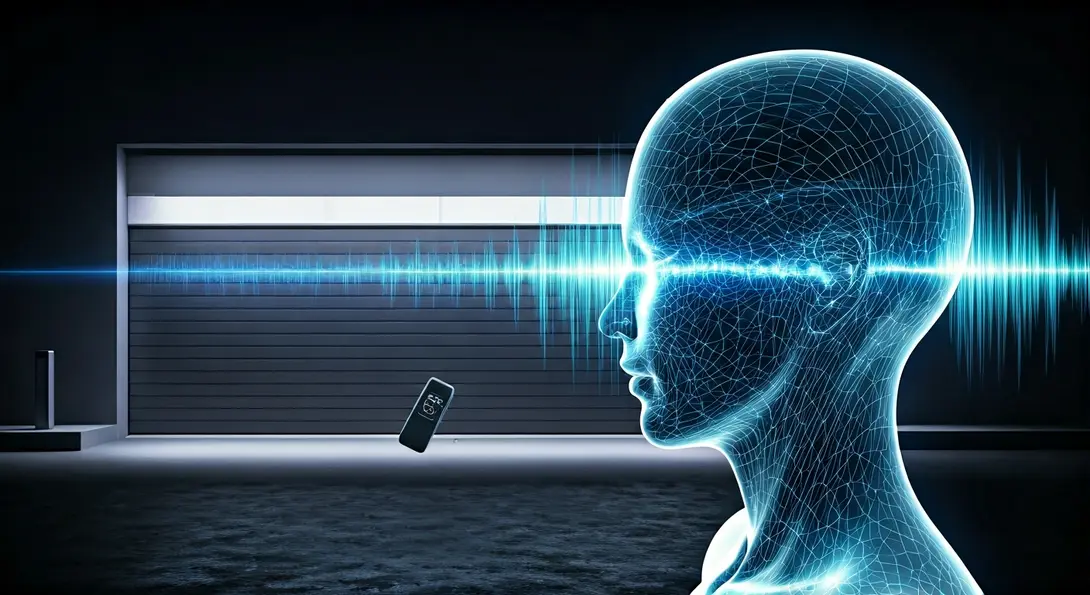
Your head significantly amplifies the range of these waves because it is largely composed of water. Water is an excellent conductor of electricity and, in this context, acts as a dielectric material that can couple with and effectively extend the antenna of the remote. In essence, your body, particularly your head, becomes an additional, larger antenna.
You might recall our previous findings from testing whether an active humidifier slows down internet speed. We observed that the mist generated by a humidifier can hinder wave propagation, potentially reducing download speeds. However, mist doesn’t possess the stable form of the human brain, which is approximately 80 percent water. The consistent, dense water content in your head provides a much more effective medium for signal enhancement.
The signal emitted by the remote reflects off your head and is also partially conducted through it, allowing it to more effectively reach the garage door sensor, even when you are beyond its standard operating range. To put it simply, your head transforms into a supplementary antenna. The same phenomenon would occur if you were to hold the remote against, for example, a large 5-liter container of water.
Understanding principles of signal propagation and how various materials interact with electromagnetic waves is fascinating. For instance, exploring the nuances of electric vehicle fire safety involves understanding how different energy forms behave under extreme conditions. Similarly, when discussing audio quality, knowing which Bluetooth codec is the best and why involves delving into how digital signals are compressed and transmitted.
In conclusion, the next time your garage door remote isn’t quite reaching, you can confidently use your head—literally—to give it that extra boost. It’s not magic; it’s physics!
Other Tech Myths We’ve Explored
As part of our myth-busting series, we’ve investigated numerous other common beliefs. You can find our detailed findings, often with accompanying video explanations, on topics such as:
- Does pressing the button make pedestrian crosswalk lights change faster?
- Can you unlock a smartphone with a photo of your face?
- Do washing machines misrepresent washing times?
- Do foil caps protect against 5G waves?
- Does unlocking a smartphone with a spoon really work?
Frequently Asked Questions (FAQ)
Your head, being composed of approximately 80% water, acts as a dielectric material that effectively extends the remote’s antenna. Water is a good conductor and allows the electromagnetic waves from the remote to couple with your body, thereby increasing their effective range and helping them reach the receiver more efficiently.
Yes, to some extent, as most of your body contains water. However, the head is particularly effective due to its high concentration of water and its position, which often allows for better signal propagation pathways. Any large, water-filled object, like a container of water, could similarly act as an extended antenna.
No, holding a low-power remote control against your head to extend its range is not considered harmful. The electromagnetic waves emitted by such devices are very low frequency and power, far below levels that could cause any adverse health effects.
This myth is common because it actually works, even if the underlying scientific reason isn’t always understood. People try it out of desperation when their remote’s range is insufficient, and they often discover its effectiveness through anecdotal experience, leading to its spread as a curious trick.
While using your head is a neat trick, better long-term solutions for poor remote range include replacing the remote’s battery, checking for obstructions near the garage door receiver, or potentially upgrading to a newer remote or receiver system with improved range capabilities.
Source: Our own research and testing.
Opening photo: Krzysztof Rojek.
About Post Author
