Contents
MLS Showcased an ‘iPhone-Streamed Match.’ The Truth Can Be Disappointing.
Hollywood studios, major sports leagues, and tech giants often lead us to believe that modern films and live broadcasts can be created with just an ordinary smartphone. However, behind that “ordinary phone” frequently lies equipment that costs more than a luxury apartment. Major League Soccer (MLS) recently showcased a vision of the future that, upon closer inspection, might have slightly misled viewers.
Is a Camera in Your Pocket a Reality or a Marketing Illusion?
The “Shot on iPhone” slogan has transcended mere marketing from the Cupertino company. For some reason, filmmakers (and others) have decided to shoot their productions with smartphones rather than professional cameras, as has been the practice for the last century. All of this is in the name of… well, what exactly? At first glance, it appears to be nothing more than a flashy display of a given phone’s technology. But can we truly say this involves the “work” of the same smartphone you hold in your pocket? Recent examples prove that in many cases, marketing has outpaced reality by hundreds of thousands of dollars.
An MLS Match Streamed by iPhone… and Million-Dollar Equipment
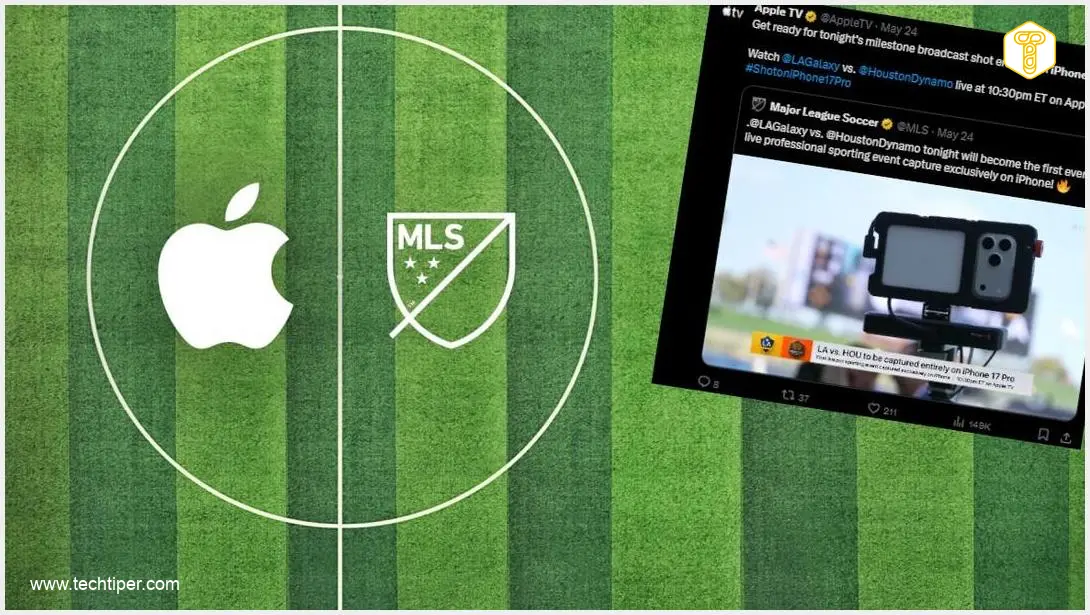
The inspiration for this article came directly from MLS, the top-tier professional soccer league in the United States and Canada. This league took the pioneering step of broadcasting a match using iPhones. Specifically, fifteen iPhone 17 Pro Max devices were strategically placed throughout Dignity Health Sports Park in Carson, California, to cover the LA Galaxy vs. Houston Dynamo match. On the surface, this seemed brilliant—a game attended by nearly 24,000 live spectators, broadcast exclusively using iPhones and the Apple ecosystem. It appeared to be a perfect demonstration of capabilities for the year 2026!
However, while it works brilliantly as a marketing stunt, the reality is far more complex. Many of these phones were equipped with professional cinematic lenses. For instance, some setups included the Fujinon HZK25-1000mm lens, which alone costs around $265,000. Considering this, it’s difficult to attribute the broadcast’s success solely to the iPhone when crucial infrastructure comes from third-party suppliers, with a single lens costing more than 200 iPhone 17 Pro Max units or a substantial home in a major city. When examining behind-the-scenes footage, it’s often hard to even identify the iPhone among the array of lenses, converters, batteries, and other attachments. Despite this, MLS, partnered with Apple, proudly declared: “Shot on iPhone!”
Nevertheless, only a handful of internet users likely noticed this discrepancy; the vast majority will simply remember that the LA Galaxy vs. Houston Dynamo match was streamed using an iPhone. The fact that the smartphone underwent modifications worth hundreds of thousands of dollars often fades into the background. After all, the final effect looked fantastic.
It’s also worth noting that the choice of the iPhone 17 Pro Max was no accident. While it is undoubtedly one of the most powerful smartphones on the market, its marketing value significantly surpasses equivalents from other brands. Crucially, MLS is sponsored by Apple, which holds exclusive rights to broadcast the league’s matches. Therefore, it’s unsurprising that the league enthusiastically promotes this latest achievement, simultaneously boosting Apple’s marketing with their variation of the “Shot on iPhone” slogan.
Hollywood Embraces Smartphones, But With a Catch
Streaming matches with smartphones isn’t the beginning of a revolution; rather, it’s the next evolution. The trend started with recording films using phones. A prime example is the upcoming cinematic hit, “28 Years Later.” Director Danny Boyle primarily shot it using the iPhone 15 Pro Max, a fact that resonated brilliantly from a marketing perspective. The illusion, however, began to crack when behind-the-scenes footage emerged. This revealed that, similar to the live match broadcasts, the smartphone was merely one component of a much larger ecosystem that couldn’t function without external lenses and equipment costing hundreds of thousands of dollars.
Danny Boyle, in an interview, shared his artistic rationale: “The iPhone is a brilliant camera. It’s light and agile. You can take it anywhere without attracting attention. We used special rigs—sometimes we had up to 20 iPhones on one rig. This gives a 180-degree view, a kinetic energy. In editing, you can manipulate it, make jump-cuts, move through space, and that’s what we wanted to capture – that raw, urgent feeling of survival.”
Interestingly, there’s no evidence that “28 Years Later” was directly funded by Apple or that it was a classic product placement. Danny Boyle repeatedly emphasized that the decision to use iPhones was driven by artistic necessity—he aimed to preserve the “raw,” almost guerrilla-style atmosphere of the first film in the series, and a modern smartphone served as a natural equivalent to the amateur cameras used in 2002. Nevertheless, the director did receive direct technical support from Apple. The company assisted the crew in integrating iPhones with professional filmmaking equipment (such as specialized rigs, cages, and lens adapters) to enable recording in 4K ProRes format and achieve image quality suitable for a feature-length blockbuster. Apple also provided engineering resources to ensure the equipment could withstand the rigorous conditions of the film set.

For a deeper dive into how camera technology has evolved and its impact on filmmaking, consider reading our analysis on old vs. new smartphone camera comparison: shocking results.
When Authenticity Shines: The Case of “Tangerine”
To put this in perspective, it’s worth looking back a decade. An earlier pioneer of “smartphone films” was the low-budget comedy titled “Tangerine.” Sean Baker shot the entire film using three iPhone 5s devices. In this instance, we see an effect much closer to true smartphone filmmaking than “28 Years Later.” The film had a budget of just $100,000, so the creators genuinely embraced the raw, unfiltered aesthetic directly from the camera of what is now considered an archaic smartphone.
Sean Baker, in an interview with IndieWire, explained: “The iPhone 5s gave us a freedom that traditional cameras couldn’t provide. It allowed us to become invisible. We could shoot in real locations, in real environments, and capture the raw, unfiltered energy of Los Angeles. People didn’t even know we were making a film. They thought we were just people playing with our phones.”
This starkly illustrates the difference between artistic use of a smartphone and pure marketing. Baker used iPhones because they offered him freedom, naturalness, and the ability to blend seamlessly into the real streets of Los Angeles, not to sell viewers a vision of “cinema from a phone.” Paradoxically, the low-budget “Tangerine” seems a much more authentic example of a film shot on a smartphone than contemporary blockbusters equipped with hundreds of thousands of dollars worth of gear.
Beyond Apple: Samsung and the Olympics
Smartphones are also used to cover events beyond soccer matches and feature films. Samsung, for example, showcased its capabilities at the Olympic Games. Earlier this year, the Galaxy S25 Ultra was used to live-stream parts of the opening ceremony of the Milano-Cortina d’Ampezzo 2026 Winter Olympics. Approximately 26 Galaxy S25 Ultra smartphones were deployed to capture and live-stream the event.
Crucially, the Korean company didn’t employ an expensive marketing trick involving “shot on Samsung but with a million-dollar lens.” The setup primarily involved smartphones mounted on tripods. This kind of effect is achievable by anyone, so it’s difficult to find any misrepresentation or exaggeration here, highlighting a more transparent use of smartphone technology for professional broadcasting.
Considering advancements in smartphone camera sensors, you might be interested in the latest iPhone 200MP camera sensor rumors and the future of photography.
The Truth Behind “Shot on Smartphone” Slogans
Whether we like it or not, a significant portion of productions and events “shot on smartphones” are little more than a marketing ploy. In reality, a video recorded on an iPhone 17 Pro Max by an average user has nothing in common with a film recorded on the same smartphone, but paired with a $260,000 lens, a professional gimbal, and a microphone handled by a dedicated sound engineer.
So why do creators insist on adding “Shot on iPhone” to their productions when, ultimately, it bears little resemblance to reality? Firstly, collaborations with companies like Apple often involve financial and economic incentives. Secondly, marketing elements are equally crucial. Many people wouldn’t have watched the recent LA Galaxy vs. Houston Dynamo match if it had been broadcast “the traditional way.” However, if it’s hailed as the first-ever match streamed solely with iPhones, curiosity alone draws in a larger audience, asking, “How did they do it?” or “Can you see the difference?”
The same mechanism applies to films. “28 Years Later” would naturally attract many viewers with a strong fondness for previous horror films in the series. But when you add that the film was shot on an iPhone, additional viewers who might not care much about the plot will instantly flock to theaters, eager to see the results of filmmakers working with an “ordinary phone.”
As we’ve seen, this “ordinary phone” is far from ordinary in these contexts, but the marketing machinery of giants like Apple is powerful enough to push their slogans and versions of reality. Smartphones have indeed transformed how films and broadcasts are created. However, the problem lies in the fact that the marketing of tech giants increasingly sells us not reality, but a carefully orchestrated version of it.
Frequently Asked Questions (FAQ)
What does “Shot on iPhone” truly mean in professional productions?
While the “Shot on iPhone” slogan suggests a production relies solely on the smartphone’s built-in camera, in professional contexts like major sports broadcasts or feature films, it often means the iPhone is just one component within a much larger, highly specialized, and expensive setup. This can include professional cinematic lenses, gimbals, external microphones, and extensive rigging, with the additional equipment sometimes costing hundreds of thousands of dollars.
Why do major productions like MLS games and Hollywood films use iPhones if they still require expensive gear?
There are several reasons. For sports leagues and events, there might be sponsorship deals and exclusive broadcasting rights with tech giants like Apple, making the iPhone choice a strategic marketing move. For filmmakers, iPhones offer unique artistic advantages like portability, discretion, and a specific aesthetic, especially for a raw, ‘guerrilla’ style. However, in both cases, the “Shot on iPhone” branding generates significant public curiosity and media attention, drawing in viewers who are intrigued by the concept, regardless of the behind-the-scenes complexities.
How does the use of smartphones in films like “Tangerine” differ from “28 Years Later” or MLS broadcasts?
“Tangerine” (2015) is often cited as a more authentic example of smartphone filmmaking because it was made on a genuinely low budget ($100,000) using only three iPhone 5s devices with minimal external accessories. The director, Sean Baker, used the iPhones to achieve a raw, immediate, and invisible style of filmmaking that allowed him to blend into real-world settings. In contrast, “28 Years Later” and the MLS broadcasts, while using iPhones, integrate them into extensive professional setups with costly lenses and support equipment, blurring the line between true smartphone production and traditional filmmaking enhanced by a smartphone component.
Source: “Self-developed content.” & Opening photo: “MLS / press materials, own modifications.”
About Post Author