

Contents
The NBA’s Game-Changing Move: AI to Assist Referees and Enhance Play
Artificial intelligence is increasingly making its mark in the world of professional sports. The National Basketball Association (NBA) has announced plans to implement an advanced AI-powered system designed to automatically resolve certain officiating decisions. This move aims to streamline gameplay without human intervention or lengthy video reviews.
Revolutionizing NBA Officiating: AI Takes Center Court
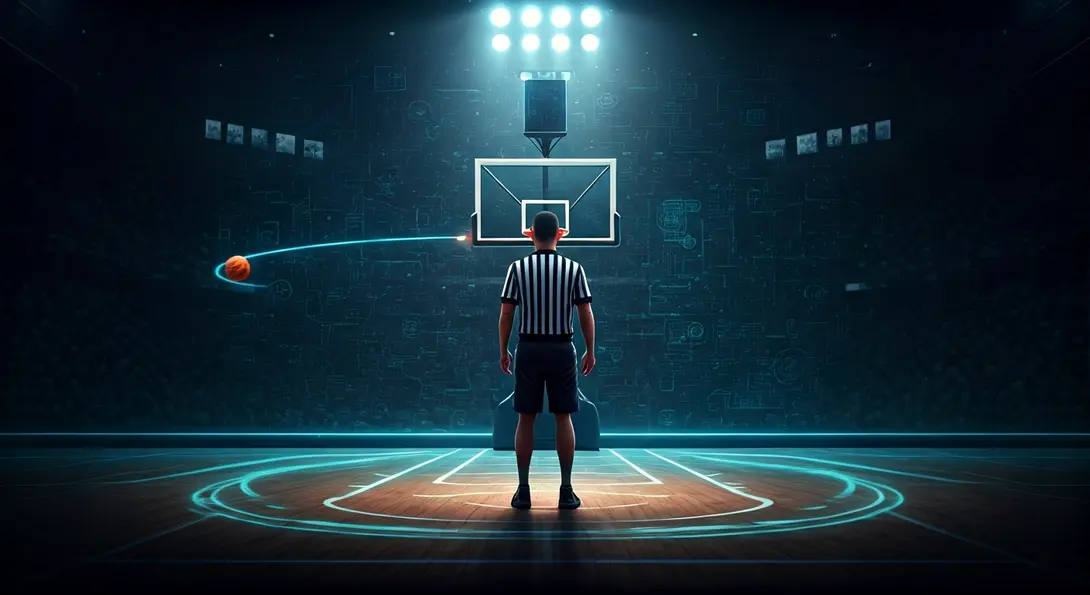
The NBA is gearing up for another technological leap. League Commissioner Adam Silver revealed the organization’s intention to deploy an AI-based system for adjudicating selected referee calls. The primary focus of this innovation is the automatic detection of when a ball goes out-of-bounds and simultaneously identifying which team should retain possession to restart play from the sideline.
This new solution is designed to operate much like the Hawk-Eye system, well-known in tennis. By utilizing an array of cameras strategically positioned around the court and algorithms that meticulously analyze ball movement, possession decisions are expected to be instantaneous. This eliminates the need for extensive video analysis or prolonged consultations among officials, promising to significantly speed up game flow.
Speaking on “The Pat McAfee Show” on ESPN, Silver emphasized that the league’s objective is to “eliminate a whole category of ‘objective decisions’ that frequently lead to stoppages and discussions in today’s games.” This proactive approach underscores the NBA’s commitment to a more fluid and less contentious game experience.
The Shift from Human Review to Instant AI Decisions
Commissioner Silver drew parallels between the NBA’s planned system and the technology already established in professional tennis, where electronic line-calling systems are standard and have largely replaced traditional human line judges. The integration of AI is also expected to alleviate the burden on human referees, allowing them to concentrate on interpreting player contact and assessing fouls—elements of the game that still demand nuanced human judgment and discretion.
While the league has not yet specified a precise launch date for the system, Commissioner Silver indicated that its deployment would happen “relatively soon,” signaling an imminent transformation in NBA officiating.
AI’s Growing Presence Across Professional Sports
While the NBA’s latest project might seem futuristic, professional sports have been actively incorporating AI, motion-tracking cameras, and real-time data analytics for several years. The most prominent example remains tennis, with the Hawk-Eye system being a staple at major tournaments like the Grand Slams.
However, AI’s influence is rapidly expanding into other major sports:
- Football (Soccer): FIFA and UEFA currently employ Semi-Automated Offside Technology (SAOT). This system leverages a network of cameras and sensors embedded within the ball to track player positions almost in real-time. This allows offside calls to be made significantly faster than with traditional Video Assistant Referee (VAR) reviews.
- Baseball: Major League Baseball (MLB) has been developing automated systems for strike zone evaluation. The Automated Ball-Strike System (ABS) tracks the ball’s trajectory to determine if it crosses the strike zone.
- Formula 1: Advanced AI analytics play a crucial role in motorsport. Algorithms assist teams in predicting pit stop strategies, analyzing tire wear, and simulating race outcomes based on real-time telemetry data.
The continuous integration of AI across various sports highlights a broader trend towards leveraging technology to improve accuracy, efficiency, and fairness in competition. For further insights into how AI is reshaping human roles in different fields, explore topics such as AI’s impact on creative professions.

The Evolving Role of Referees in an AI-Enhanced Era
The proliferation of these technologies demonstrates a growing reliance on automation in sports to minimize human error. Sports organizations generally emphasize that AI is intended to support officials, rather than entirely replace them, though tennis presents a notable exception where AI has largely taken over line-calling duties.
It is important to remember that even the most sophisticated AI systems still struggle with interpreting situations that demand contextual understanding and an assessment of players’ intentions. While AI excels at objective measurements, the nuanced, subjective aspects of human interaction and decision-making on the field often remain beyond its current capabilities. This dilemma of balancing objective digital accuracy with the subjective reality of human performance is a recurring theme in modern technology, reminiscent of discussions on AI and the authenticity of human imperfection.
Nevertheless, the NBA appears confident that at least a segment of officiating decisions can be delegated to algorithms. If this project proves successful, the basketball league could become another significant sport where AI plays a real-time role in governing the flow of the game.
Frequently Asked Questions (FAQ)
What specific decisions will NBA’s AI system handle?
The NBA’s AI system is primarily designed to automate objective calls such as determining when the ball goes out-of-bounds and identifying which team should retain possession. This focuses on situations that currently lead to game stoppages for video review.
How will AI impact the speed and fairness of NBA games?
By automating objective decisions, the AI system aims to significantly reduce the time spent on video reviews and discussions, thereby accelerating game flow. This can lead to more continuous play and potentially fewer controversies over factual calls, enhancing the overall fairness and enjoyment of the game.
Is AI expected to fully replace human referees in the NBA?
No, Commissioner Adam Silver has stated that AI is intended to support human referees, not replace them entirely. The goal is for AI to handle objective calls, allowing human officials to focus on subjective decisions like fouls and player contact, which still require human interpretation and judgment.
What are some current limitations of AI in sports officiating?
While AI excels at objective measurements, its main limitations in sports officiating involve interpreting subjective situations. These include understanding player intent, assessing the context of physical contact, and making judgment calls that require human empathy or an understanding of the game’s nuances and spirit. These complex aspects often remain beyond the current capabilities of even advanced AI systems.
Source: Reuters, Internal Research. Opening photo: Gemini
About Post Author
