

Contents
Habitat 67: The Lego-Inspired Visionary City That Could Have Been
Habitat 67 in Montreal has stood for decades as an icon of futuristic architecture. This modular housing complex, resembling enormous building blocks, was intended to revolutionize residential living and offer a groundbreaking alternative to cramped, conventional apartment buildings. While the project was only partially completed, a stunning new visualization created using Unreal Engine 5 now allows us to witness the breathtaking scope of its original vision.
The Genesis of a Revolutionary Concept
The visionary behind Habitat 67 was architect Moshe Safdie. He developed the concept during his time as a student at McGill University in Montreal. Safdie’s core idea was to create a residential community that harmoniously blended the advantages of urban living with the comfort and privacy typically associated with single-family homes. His design philosophy emphasized three key elements for each dwelling:
- Abundant natural light
- Private terraces
- Access to green spaces
Safdie’s design process was remarkably innovative. He used Lego bricks to conceptualize and build models of individual segments, meticulously exploring how these modules could be interconnected to form larger, cohesive structures. He later recounted how he and his team would frequently purchase entire sets of Lego from stores to fuel their creative architectural explorations.
From Grand Vision to Partial Reality: Expo 67 and Beyond
Moshe Safdie proudly unveiled his ambitious design during Expo 67 in Canada. The initial plans were incredibly ambitious, envisioning a massive complex comprising approximately 1,200 apartments. However, the sheer scale and complexity of the proposed construction, coupled with its projected costs, proved to be formidable challenges.
Ultimately, the full scope of the project could not be realized. Only 158 apartments were constructed. Despite this reduction in scale, Habitat 67 quickly became one of Canada’s most recognizable architectural landmarks and a powerful symbol of the experimental spirit prevalent in 1960s architecture.
Unreal Engine 5 Unlocks the Full Vision
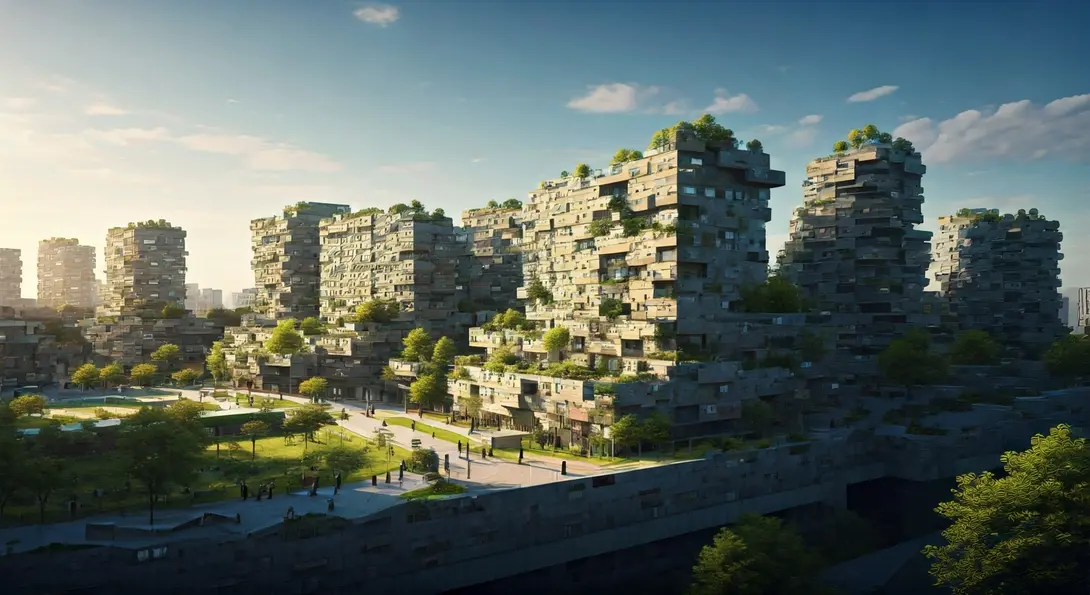
Today, thanks to cutting-edge visualization technology, we can finally experience Moshe Safdie’s complete, unbuilt vision for Habitat 67. A new visualization prepared in Unreal Engine 5 offers a spectacular glimpse into what the full version of the project would have looked like. The animated presentation reveals a colossal modular complex that evokes images of a futuristic city straight out of a science fiction film. It features multi-level terraces, hundreds of interconnected segments, and expansive, dynamic spaces between the buildings, creating a vibrant, integrated urban environment.
For enthusiasts of digital rendering and advanced graphics, this project highlights the capabilities of modern game engines in architectural visualization. Similar advancements are transforming other industries, from generative AI in gaming to the incredible realism seen in titles leveraging technologies like path tracing in games like Resident Evil Requiem.
A Paradox of Prestige
Paradoxically, the housing complex that was initially conceived to provide modern, relatively affordable housing has evolved into one of Montreal’s most prestigious addresses. Apartments within Habitat 67 command exceptionally high prices and have long been regarded as luxurious properties, a testament to the enduring appeal and unique architectural significance of Safdie’s groundbreaking design.
Frequently Asked Questions (FAQ)
What was the original vision behind Habitat 67?

Habitat 67 was conceived by architect Moshe Safdie as a modular housing complex that would blend the benefits of urban density with the comfort and privacy of suburban single-family homes. The design aimed to provide each resident with abundant natural light, a private terrace, and access to green spaces, all within a high-density, multi-level structure.
How did Moshe Safdie design Habitat 67?
Moshe Safdie famously used Lego bricks as a primary design tool. He constructed models of individual modular units and experimented with different ways to combine them into larger, interconnected structures, allowing him to visualize and refine the complex’s unique architectural form.
Why was Habitat 67 not fully completed as originally planned?
The original plan for Habitat 67 was an ambitious complex of around 1,200 apartments. However, the project’s construction proved to be highly complex and significantly more expensive than anticipated, leading to a scaled-back version with only 158 units being built.
What role does Unreal Engine 5 play in understanding Habitat 67’s full vision?
Unreal Engine 5, a powerful real-time 3D creation tool, has been used to create a detailed and immersive visualization of Moshe Safdie’s complete, unbuilt design for Habitat 67. This allows viewers to experience the architect’s grand, futuristic vision for the complex, showcasing its full modularity and extensive communal spaces as if it were fully realized.
Is Habitat 67 still considered affordable housing today?
No, despite its original intent to offer modern and relatively affordable housing, Habitat 67 has become one of Montreal’s most exclusive and prestigious addresses. Apartments within the complex are now considered luxury properties and command very high prices.
Source: gamestar.de
Opening photo: Unreal Engine / YouTube / screenshot
About Post Author
