

Contents
700 Million Years of History Etched in Human Blood: Scientists Unravel Its Ancestry
Our blood holds a profound memory spanning 700 million years. Recent groundbreaking research by Japanese scientists reveals that the blood and immune cells found in modern animals, including humans, originate from a genetic program inherited from our single-celled ancestors. Furthermore, the way these cells mature in bone marrow mirrors ancient evolutionary stages that unfolded hundreds of millions of years ago.The Deep Evolutionary Roots of Our Blood
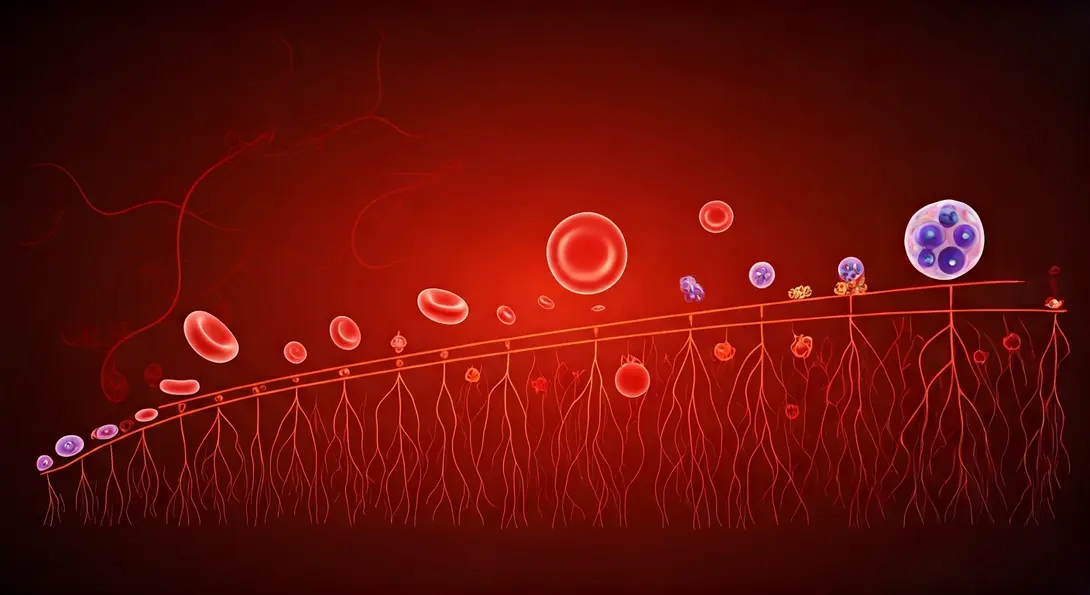
Scientists at Kyoto University have meticulously reconstructed the “family tree” of blood cells, tracing their lineage back approximately 700 million years. Their comprehensive study involved analyzing gene activity in blood and immune cells across a diverse range of species, from simple single-celled organisms to complex vertebrates. The findings reveal that our modern hematopoietic system—responsible for blood cell formation—is not an entirely new development. Instead, it appears to be an evolutionary overlay on a far older system, inherited from long-extinct single-celled ancestors. This suggests that the fundamental blueprint for blood production was established long before the advent of multicellular life. To reach these conclusions, researchers compiled massive transcriptomic datasets. This allowed them to identify recurring gene expression patterns across different evolutionary lineages and pinpoint elements common to blood cells in animals and their single-celled relatives. The extensive comparative analysis underscored a crucial insight: the contemporary hematopoietic system did not emerge de novo with the appearance of animals. Rather, it represents a remarkable continuation of a much older genetic program, already present in individual cells that thrived during the era when the first multicellular organisms were just beginning to form.Macrophages: The Ancient Pioneers of Blood Cells
One of the most striking revelations from this research concerns the role of macrophages—the large phagocytic cells of the immune system. The study identifies macrophages as the most “primitive” form of blood cell, highlighting their fundamental importance in early evolutionary development. By comparing gene expression signatures, scientists demonstrated that human macrophages bear the strongest resemblance to single-celled organisms. This similarity suggests that the earliest blood cells in primeval animals functioned much like macrophages, engulfing food particles and neutralizing pathogens. In essence, evolution began building the complex hematopoietic system by specializing a basic phagocytic cell, which then diversified into various other cell types, each with distinct functions. The core characteristics of macrophages—their ability to engulf, digest, and respond to chemical stimuli—are direct inheritances from distant single-celled ancestors. These ancient organisms had to independently manage all aspects of their environment, from nutrient acquisition to defense, much like a macrophage does today.The FOS Gene: A Molecular Echo from Ancient Ancestors
A critical player in reconstructing the evolutionary lineage of blood cells is the FOS gene. This gene encodes a transcription factor—a protein that helps turn genes on or off—and is widely active across various blood cell types in numerous species. The Kyoto team meticulously traced the history of the FOS gene, demonstrating that its origins can be dated back to a single-celled ancestor that lived approximately 700 million years ago, coinciding with the emergence of the first multicellular animals. This discovery indicates that these ancient single-celled organisms already possessed a genetic “module” that was later adapted and refined for the creation of blood and immune cells in more complex life forms. The authors of the study, published in the prestigious journal PNAS, emphasize that identifying such an ancient and highly conserved regulatory element was key to piecing together a historical narrative that would otherwise remain obscured within fragmented genomic records. This kind of genetic continuity highlights the incredible efficiency of evolution in repurposing successful biological mechanisms. You can read more about how ancient life forms impact modern biology in our piece on Oviraptor dinosaur nest incubation, illustrating how even past behaviors leave lasting imprints.Methodology: Unraveling Blood’s Ancient Narrative
To achieve these profound insights, the researchers developed an innovative methodology for comparing gene expression profiles across evolutionarily distant species and cell types. They meticulously analyzed “cell lineages,” essentially tracing how successive cell types emerge from more primitive forms during an organism’s development, and how these sequences align across diverse animal groups. This approach allowed for a robust comparative framework, unlike some methods that have led to errors in other scientific fields, such as those discussed in sea level rise studies and coastal threat maps. Leveraging extensive transcriptomic datasets, the team identified which gene sets were shared by various blood cells, such as macrophages, mast cells, lymphocytes, and erythrocytes (red blood cells). This also allowed them to pinpoint which genes appeared later, coinciding with the specialization of particular blood cell lines. The conclusions are compelling and clear: the modern pathways of blood cell differentiation in vertebrates directly reflect the successive stages of their evolutionary history. This means that the intricate processes occurring within our bone marrow over a few days or weeks are a condensed replay of evolutionary events that unfolded over hundreds of millions of years. The study’s authors highlight the almost philosophical dimension of their work. It serves as a powerful reminder that within every drop of our blood pulses the enduring legacy of ancient single-celled organisms. The blood and immune cells circulating in the veins of humans and other animals today are not merely contemporary biological structures; they are the successful, evolutionarily validated continuation of systems that first arose hundreds of millions of years ago in a simpler, single-celled world.Frequently Asked Questions (FAQ)
The research revealed that the blood and immune cells in modern animals, including humans, originated from a genetic program inherited from single-celled ancestors over 700 million years ago. It shows that our hematopoietic system is an evolutionary extension of much older cellular mechanisms.
Macrophages, key immune cells, are identified as the most “primitive” form of blood cell. Their gene expression patterns closely resemble those of single-celled organisms, suggesting that the earliest blood cells functioned much like macrophages, inheriting their fundamental abilities to engulf and respond to stimuli directly from ancient ancestors.
The FOS gene, a transcription factor active in various blood cells, was traced back 700 million years to a single-celled ancestor. Its conservation over such a vast evolutionary period indicates that it was a fundamental genetic “module” adapted for developing blood and immune cells in multicellular organisms.
The study concludes that the modern pathways of blood cell differentiation in vertebrates, which occur over days or weeks in bone marrow, are a condensed replay of evolutionary processes that spanned hundreds of millions of years. This means our developmental biology mirrors deep evolutionary history.
Source: PNAS, Kyoto University, Science Alert, Sci Tech Daily, Interesting Engineering.
Opening photo: Gemini
About Post Author
