

Contents
The SpudCell Project: A Synthetic Cell Blurring the Lines of Life
In a groundbreaking development at the University of Minnesota laboratories, a synthetic cellular system named SpudCell has been created. What makes SpudCell remarkable is that it is constructed solely from non-living chemical substances. Yet, it behaves strikingly like a biological cell: it grows, “feeds,” and divides. This innovation has ignited a significant debate about where the boundary lies today between true life and its technological imitation.
What is SpudCell? A New Form of Artificial Life
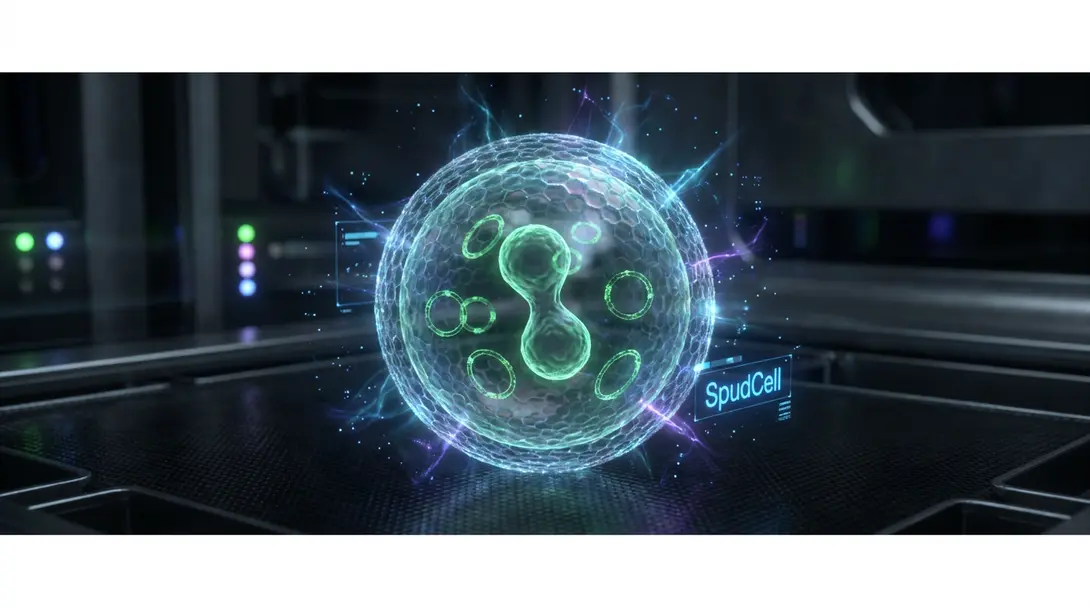
SpudCell is essentially a droplet of aqueous solution encased within a lipid membrane, precisely filled with a curated set of molecules and plasmid DNA. This sophisticated construct undergoes a complete, life-like cycle: it takes in resources from its environment, increases in volume, replicates its genome, and divides into subsequent “generational” cells.
Kate Adamala, a synthetic biologist and professor at the University of Minnesota, led the team responsible for constructing this novel cell. She emphasizes that every component of SpudCell is well-known and chemically defined, containing no hidden ingredients or reliance on natural cells as a starting point. This ensures complete control and understanding of the system.
Adamala deliberately chose not to name the cell after herself. Instead, she christened her creation “SpudCell,” a playful wordplay referencing Sputnik, the Russian satellite that inaugurated the space age in the 1950s. The researchers have published a detailed scientific article describing SpudCell’s function, though it is important to note that these findings are awaiting publication in a peer-reviewed scientific journal.
How Does the Synthetic Cell SpudCell Function?
At the core of SpudCell are several rings of DNA, known as plasmids. These plasmids form a compact genome that encodes a specific set of proteins. These proteins are crucial for replicating the DNA, communicating with the environment, and executing the division mechanism.
The cell employs surface “tags” encoded in its genome to attract smaller liposomes. These liposomes contain essential enzymes and molecules, which can be thought of as synthetic “meals” that fuel SpudCell’s growth and enable its genetic material to copy itself.
SpudCell’s division process is also chemically programmed. Another type of marker on its surface binds to streptavidin. The presence of streptavidin in the surrounding environment leads to changes in membrane tension, ultimately causing the droplet to split into two smaller daughter cells.
The entire cycle—from “birth” through feeding, growth, genome replication, to division—can be meticulously observed under a fluorescent microscope. In this controlled environment, successive generations of SpudCell even compete with each other for available resources, mimicking natural selection on a rudimentary level. The precision and programmability showcased by SpudCell highlight the incredible advancements in synthetic biology, drawing parallels to the sophisticated engineering seen in robotics, such as Kawasaki’s goat-like robot, where complex behaviors are synthesized from simpler components.
Is SpudCell “Alive”? The Scientific Debate
The creators of SpudCell are cautious about claiming they have created life. They point out that there isn’t a single, universally agreed-upon definition of what constitutes “life,” and their system merely mimics many of its characteristics.

As discussed in American media, researchers like John Glass from the J. Craig Venter Institute remind us that “aliveness” in science is often viewed as a spectrum rather than a sharp, definitive boundary. Most specialists still consider all artificial cells to be “life-like” but not yet fully alive.
Key reservations primarily revolve around SpudCell’s lack of autonomous metabolism and its limited capacity for evolution. SpudCell cannot independently generate its own translational machinery; it requires an external supply of enzymes to be “fed” and loses stability after a few to a dozen generations. From the perspective of classical biology, this means it is more akin to a complex, programmable bioreactor than a self-sustaining organism, even though its growth and division visually strongly resemble the behavior of true cells.
Potential Applications of Artificial Cells
From an applications standpoint, SpudCell primarily serves as a testing platform for future “mini biological factories.” These systems could be capable of safely producing pharmaceuticals, biological materials, or precisely engineered chemical compounds.
With complete control over their composition and a lack of capacity for long-term evolution, such synthetic cells could be safer in many scenarios than the genetically modified bacteria or viruses currently used in biotechnological production. This predictability and control make them ideal candidates for advanced industrial applications, much like the focus on reliable and efficient AI systems discussed in future tech events like CES 2026 with agentic AI from Samsung and Intel.
Frequently Asked Questions (FAQ)
While SpudCell exhibits many behaviors similar to natural cells, such as growth, metabolism (through external feeding), and division, it is entirely constructed from non-living chemical components and lacks autonomous metabolism and the complex, self-sustaining evolutionary capacity found in biological organisms. It requires external supplies of enzymes and loses stability after a limited number of generations.
The complexity arises because there is no universal scientific definition of “life.” SpudCell fulfills several criteria often associated with life (growth, reproduction, metabolism), but not all (e.g., full autonomy, sustained evolution). This places it in a grey area, prompting scientists to view “aliveness” as a spectrum rather than a binary state.
The creation of synthetic cells raises significant ethical considerations, particularly regarding the definition of life, potential misuse, and long-term environmental impacts. While SpudCell is currently a controlled laboratory system with limited autonomy, future advancements in synthetic biology will require careful ethical frameworks to ensure responsible development and application.
Source: CNN, ScienceAlert, The Economist, ACS Synthetic Biology, Biotic
Opening photo: Gemini
About Post Author
