Contents
Can Your Smartphone Really Detect Metal? We Put It to the Test
Smartphones are packed with features, many of which remain undiscovered by the average user. While innovations like thermometers in certain devices have garnered attention, the idea of a phone doubling as a metal detector is also gaining traction. We took it upon ourselves to investigate this intriguing capability in our studio and see how well it performs in real-world scenarios.
The Hidden Power of Your Smartphone: Unveiling Its Metal Detection Capability
Many modern smartphones come equipped with a magnetometer, a sensor primarily designed for navigation. This sensor can detect magnetic fields, and while its main purpose is to help your phone orient itself (like a compass), it can also register disturbances caused by metallic objects. This “side effect” is precisely what allows your smartphone to function as a basic metal detector when paired with the right software.
Our Hands-On Metal Detector Smartphone Test
To put this theory to the test, we gathered three essential items: a smartphone, a dedicated metal detector application, and a metallic object. For our experiment, we opted for a free “Metal Detector” app available on Google Play, but numerous alternatives can be found on both Google Play and the App Store.
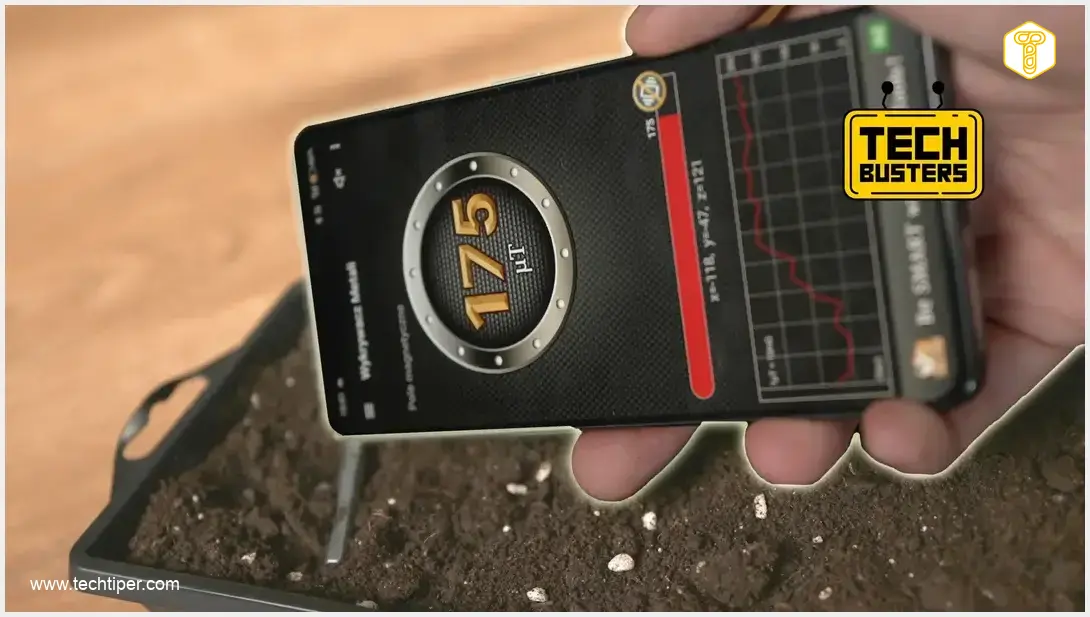
Our tester initiated the application and then carefully placed the top-left corner of the smartphone near a metal key. Instantly, the magnetic field intensity counter, measured in microteslas (μT), showed a significant spike, confirming the detection.
To increase the challenge, we decided to bury the metal key in a container filled with soil. Remarkably, even in this more difficult scenario, the smartphone with the activated application was able to accurately detect the key’s location beneath the surface.
The Science Behind It: How a Magnetometer Works in Your Phone
So, why does a smartphone act as a metal detector? The answer lies in its built-in magnetometer. The operating systems of Android and iOS primarily utilize this sensor for navigation. It’s the reason applications like Google Maps can accurately determine which way is North, guiding your travels.
The magnetometer was not originally conceived for finding metal; the presence of such objects simply registers as a disruption to the ambient magnetic field. However, in this unique context, what might seem like a “flaw” transforms into its greatest advantage, turning your everyday device into a surprising tool for discovery.
Exploring More Smartphone Myths and Capabilities
At TechBusters, we’ve delved into many more fascinating myths and capabilities surrounding technology. Much like we investigated the effectiveness of smartphone metal detectors, we’ve also explored topics such as the most popular smartphone of 2021 and warned about the dangers of buying old smartphones online. Some other intriguing questions we’ve tackled include:
- Are bananas fire-resistant?
- Is wireless charging truly more expensive?
- Can you register two fingerprints on one phone simultaneously?
- Do washing machines misrepresent washing times? We measured it!
- Do automatic doors open faster for taller individuals?
Frequently Asked Questions (FAQ)
Smartphone metal detectors are generally less accurate and have a much shorter detection range compared to professional, dedicated metal detectors. They are best suited for detecting larger metallic objects at very shallow depths or on surfaces, making them useful for small household tasks rather than serious treasure hunting or construction site surveys.

No, using a metal detector app will not damage your smartphone. These apps simply access the data from your phone’s existing magnetometer sensor. They do not involve any processes that could harm the device’s hardware or software.
A smartphone’s magnetometer primarily detects ferromagnetic metals such as iron, nickel, and cobalt, which produce a magnetic field. It can also detect larger non-ferromagnetic metals (like copper or aluminum) if they are close enough to induce a magnetic disturbance. However, precious metals like gold and silver, which are non-magnetic, are much harder for a smartphone to detect unless they are part of a larger, magnetically responsive alloy or in very close proximity.
Source: Own elaboration. Opening photo: Krzysztof Rojek, with own modifications.
About Post Author